
A death certificate is the official record of a person’s death, issued by the local registrar of births and deaths. Families need it for almost everything that follows: bank accounts, insurance, pension, property transfer, succession and legal heir certificates.
Quick answer
Every death in India must be reported to the local registrar within 21 days under the Registration of Births and Deaths Act, 1969. Within that time registration is free, and the registrar must give the informant a free death certificate.
If a death is reported late, a late fee applies, and longer delays need permission: from 1 October 2026, a delay of one to two years needs an order of an Executive Magistrate, and more than two years needs an order of a Judicial Magistrate First Class. You can apply and download certificates on the Civil Registration System (CRS) portal or your municipal portal.
Who must report a death?
- Death in a hospital or medical institution: the medical officer in charge reports it. The family should not file a separate report.
- Death at home: the head of the household, or the nearest relative present, or the oldest adult present.
- Death in a jail, hostel, dharamshala or similar place: the person in charge.
- Unclaimed body in a public place: the village headman or the officer in charge of the local police station.
Documents needed for a death certificate
- Death report form (Form 2), filled by the informant or the hospital
- Medical Certificate of Cause of Death (MCCD) from the hospital or doctor, where available (s.10)
- ID proof of the deceased (Aadhaar, voter ID, passport) and of the informant
- Proof of date and place of death, such as a hospital discharge or cremation or burial ground receipt
- For late registration: an affidavit and other proof, and the order of the authority where required
How to get a death certificate: step by step
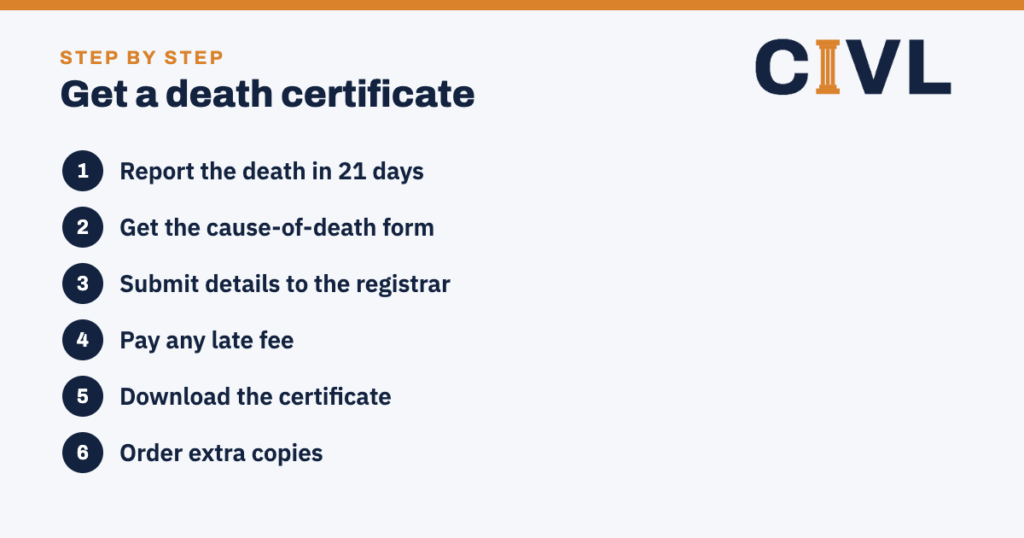
- Report the death within 21 days to the registrar of the area where the death happened (not where the person lived).
- Get the cause-of-death certificate from the hospital. Under the 2023 amendment, hospitals must send the MCCD to the registrar and give a copy to the nearest relative.
- Submit details online on the CRS portal or your municipal portal, or at the registrar’s office.
- Pay any late fee if 21 days have passed, and attach the permission or order if needed.
- Download the death certificate. Certificates can now be issued electronically, and the first copy to the informant is free (s.12).
- Order extra copies for banks, insurers and courts (s.17, small fee per copy).
Late registration of a death
| Delay after the death | What you need (from 1 October 2026) |
|---|---|
| Up to 21 days | Nothing extra; free |
| 21 to 30 days | Late fee |
| 30 days to 1 year | Written permission of the prescribed authority and a late fee; many states also ask for an affidavit |
| 1 to 2 years | Order of a District Magistrate, Sub-Divisional Magistrate or Executive Magistrate authorised by the DM, after verification |
| More than 2 years | Order of a Judicial Magistrate First Class, after verification and fee |
These tiers come from s.13 of the Act, as amended by the Registration of Births and Deaths (Amendment) Acts of 2023 and 2026. Late fees are set by state rules, so check with your registrar.
What the death certificate shows (and does not)
- Name, sex, age, address and Aadhaar or ID details of the deceased (as recorded)
- Date and place of death
- Name of the parent or spouse
- Registration number and date
- It does not show the cause of death; that stays in the confidential MCCD record (s.17 proviso).
Correcting a death certificate
If the name, age or another detail is wrong, apply to the registrar under s.15 with proof (Aadhaar, school certificate, passport). The registrar corrects the entry in the margin without altering the original. If the registrar refuses, you can appeal to the District Registrar within 30 days, and the appeal should be decided within 90 days.
What you need a death certificate for
- Closing or transferring bank accounts and claiming deposits
- Life insurance and accident claims
- Family pension and EPF claims (see our EPF withdrawal guide)
- Succession certificate and legal heir certificate applications
- Property mutation into the heirs’ names
- Probate of a will and closing utility connections
Death certificate for a death in hospital
When a person dies in a hospital, the hospital is responsible for reporting the death to the registrar. Ask the hospital for the registration number before you leave, and check within a week on the municipal or CRS portal that the death certificate has been generated. If the hospital has not registered it, ask the medical records department in writing and follow up with the registrar.
Death certificate for a death at home or while travelling
- At home: a family member reports the death to the local registrar (municipal office in towns, panchayat secretary or designated official in villages). A doctor’s certificate or a cremation or burial receipt helps.
- While travelling in India: the death is registered where it occurred, not in the home town. Ask the local hospital or police for help.
- Missing person: a death certificate cannot be issued without proof of death. After seven years of no news, a court can presume death under the Bharatiya Sakshya Adhiniyam, 2023.
How many copies of the death certificate do you need?
Most families need five to ten copies: one each for each bank, insurer, employer or pension office, the land records office, the court (for a succession certificate) and the telecom and utility companies. Digitally signed copies downloaded from the portal are accepted by most offices; some may still want certified paper copies.
Death certificate and Aadhaar
Under the 2023 amendment, births and deaths feed a national database, which can be used to update other records such as the electoral roll. The family can also inform UIDAI so that the person’s Aadhaar is not misused.
After you get the death certificate: a checklist
The death certificate is the first document almost every office will ask for. Get several attested copies or keep the digital certificate handy, then work through this list:
| Task | Where | What you usually need |
|---|---|---|
| Bank accounts and fixed deposits | Each bank branch | Death certificate, claim form, nominee’s KYC; legal heir proof if there is no nominee |
| Provident fund and pension | EPFO, or the pension disbursing office | Death certificate, Form 20 / 5(IF) / 10D for EPF; family pension forms for government pensions |
| Life and health insurance | The insurer | Death certificate, claim form, medical records, policy documents |
| Shares and mutual funds | Depository participant / AMC or RTA | Death certificate, transmission form, nominee’s KYC |
| Property records | Tehsil / municipality | Death certificate and legal heir or succession proof for mutation |
| Vehicle | RTO (Parivahan) | Death certificate, transfer application for the vehicle in the heir’s name |
| Income tax | Income Tax e-filing portal | Register as legal representative and file the deceased’s final return if needed |
| Utilities, gas and phone | Each provider | Death certificate and the new account holder’s ID |
Where there is a valid nomination, most institutions pay the nominee without a succession certificate. Where there is none, or the amount is large, they may ask for a legal heir certificate, succession certificate or probate.
Death of an Indian citizen abroad
A death outside India is registered under the law of that country, and the local authority issues the death certificate. The family should also inform the Indian embassy or consulate, which can register the death and help with bringing the body home or with local cremation or burial.
To use a foreign death certificate in India, it usually has to be apostilled (in countries that are part of the Hague Apostille Convention) or attested by the Indian mission. Get an English translation if the certificate is in another language. Banks, insurers and courts in India generally accept such a certificate in place of an Indian death certificate.
When a person is missing
If a person has gone missing and the body has not been found, there is no death to register, so no death certificate can be issued at first. The law presumes a person to be dead if they have not been heard of for seven years by those who would naturally have heard from them. This rule was in Section 108 of the Indian Evidence Act, 1872 and is now in Section 111 of the Bharatiya Sakshya Adhiniyam, 2023.
In practice, the family files a police missing-person report and keeps a copy. After seven years, they can ask a civil court for a declaration that the person is presumed dead. Banks, insurers and other offices then act on the court’s order. Some institutions and schemes have their own shorter procedures, so ask them early.
Applying from another city or from abroad
The death certificate is issued by the registrar of the place where the death happened, not where the family lives. If you live elsewhere, you can usually apply online on the Civil Registration System portal or the state’s portal and download the digital certificate. If an office visit is needed, a relative can go with an authority letter, your ID copy and the details of the death.
Death certificate after an accident or unnatural death
When a death is sudden, violent or suspicious (a road accident, drowning, burns, poisoning or a death in custody), the police hold an inquest and a post-mortem is usually done. This does not stop the death from being registered. The hospital or the police inform the registrar, and the family can apply for the death certificate in the usual way.
- Keep copies of the FIR or general diary entry, the inquest report and the post-mortem report. Insurers and the Motor Accident Claims Tribunal will ask for them along with the death certificate.
- The post-mortem report may take a few weeks; the death certificate can often be issued before it arrives.
- If the body was not identified at first, the registration may be in the “unknown” name and will need correction once identity is confirmed, through the police and the registrar.
Verifying a digital death certificate
Death certificates issued through the Civil Registration System carry a registration number and a QR code. Banks, courts and other offices can check them online, so a digitally signed death certificate printed on plain paper is valid. If an office refuses to accept it, point out that the Registration of Births and Deaths Act, 1969 allows certificates to be issued electronically, and ask for the refusal in writing.
Always check the printed details against the original records. A wrong spelling of the name, a wrong date of death or a missing parent’s or spouse’s name can cause trouble later in bank, insurance and property claims, so get it corrected early.
Death certificate vs legal heir and succession certificates
| Document | Issued by | What it proves |
|---|---|---|
| Death certificate | Registrar of births and deaths (municipality or panchayat) | That a person died, with the date and place of death |
| Legal heir certificate | Tahsildar or other revenue officer (varies by state) | Who the surviving family members (heirs) are |
| Succession certificate | Civil court | Who may collect the deceased person’s debts and securities, such as bank deposits and shares |
| Probate / letters of administration | Civil court or High Court | That a will is valid, or who may administer the estate if there is no will |
In almost every case you need the death certificate first; the other documents are applied for afterwards and use it as proof. So apply for the death certificate as soon as possible after the death, even if you do not yet know which other papers you will need. If the family is unsure what a particular bank or office will accept, ask it for its list in writing before applying to the court, because court certificates take months.
Common mistakes to avoid
- Assuming the hospital “will handle it” without checking that registration was done.
- Registering in the area where the person lived instead of where the death occurred.
- Not checking spellings against Aadhaar before the certificate is issued.
- Getting only one copy; banks and insurers often keep a certified copy.
- Delaying beyond a year and then needing a magistrate’s order.
Frequently asked questions
How many days do I have to register a death?
21 days from the date of death. Registration within that period is free.
How do I download a death certificate online?
Use the CRS portal (crsorgi.gov.in) or your state or municipal portal, search with the registration number or details, and download the digitally signed certificate.
Is a death certificate needed for a legal heir certificate?
Yes. The death certificate is the first document asked for in legal heir and succession applications.
Can a death certificate be issued for a death abroad?
An Indian registrar registers deaths that occur in India. For deaths abroad, the local death record and the Indian mission’s report are used.
What if the death happened many years ago and was never registered?
Apply for late registration. If more than two years have passed, you need an order from a Judicial Magistrate First Class after verification.
Why doesn’t the death certificate show the cause of death?
The law keeps the cause of death confidential. It is recorded separately in the MCCD.
Can I correct the age or name later?
Yes, under s.15, with documentary proof. The correction is noted in the margin of the register.
Who can get a copy of the death certificate?
Any person can ask for an extract of a death entry, but some registrars give copies only to family members or those with a legitimate need.
Is a digital death certificate valid?
Yes. Certificates issued electronically through the CRS or state portals carry a digital signature and a verification number and are legally valid.
Where can I get a ready-to-use document for claims after a death?
Banks and insurers often ask for an indemnity bond; use the CIVL indemnity bond format. To plan your own estate, see the will format.
Is there a fee for a death certificate?
Registering a death within 21 days is free, and the first copy is usually free or nominal. Late registration and extra copies carry small fees set by the state.
Can a death certificate be issued without a medical certificate?
Yes. A medical certificate of cause of death is needed only where a doctor attended the person. For a death at home without a doctor, the registrar records the death on the informant’s report.
Who can apply for a copy of a death certificate?
A family member or any person with a genuine need can apply. Some states ask the applicant to show their relationship or reason.
How long does it take to get a death certificate?
For a death registered on time, often within a week or two, and sometimes on the same day in hospitals and municipal offices with online systems.
CIVL format
Documents after a death in the family
For bank and insurance claims, use the indemnity bond format. To give up a share in inherited property, use the relinquishment deed format. Read our legal heir certificate guide next, or Ask CIVL.