
Need a will format? This page explains when you need it, what it must contain and how to make it valid, step by step. You can also get CIVL’s ready-to-use will format as an editable Word file and PDF.
Quick answer
A will says who gets your property after your death. Under the Indian Succession Act, 1925 it must be signed by you and attested by two witnesses. It needs no stamp paper, and registration is optional, though it makes the will harder to challenge.
Read the full guide: How to register a will in India
What is a will?
A will is a legal declaration of how your property should be distributed after you die. Any adult of sound mind can make one (Section 59), and it can be changed or revoked at any time during your life.
Section 63 requires the will to be signed by the testator and attested by at least two witnesses who saw you sign. Registration under Section 18 of the Registration Act is optional. Muslims are governed by personal law: they can generally bequeath up to one-third of their property by will without the heirs’ consent.
When you need it
- You own a house, land, bank deposits, shares or other assets.
- You want to leave property to someone other than (or in shares different from) your legal heirs.
- You want to avoid disputes among family members after your death.
- You want to appoint a guardian for minor children or an executor.
Stamp duty, notarisation and registration
| Requirement | What applies | Notes |
|---|---|---|
| Stamp paper / e-stamp | Not needed | Plain paper is enough. |
| Notarisation | Not needed | Optional; it does not replace attestation. |
| Registration | Optional | Register at the Sub-Registrar, or deposit it in a sealed cover. |
| Witnesses | Two (mandatory) | Both must see you sign. Do not use a beneficiary or their spouse. |
In some cities (such as Mumbai, Kolkata and Chennai) probate may be needed for certain wills before assets are transferred.
What the will must contain
- Your name, age, address and a statement that you are of sound mind and making the will voluntarily.
- Revocation of all earlier wills.
- List of your assets with identifying details (property address, bank and demat accounts).
- Who gets what, with alternates if a beneficiary dies before you.
- Name of the executor, and a guardian for minor children if needed.
- Date and place, your signature on every page, and the two witnesses’ signatures, names and addresses.
How to make it valid: step by step
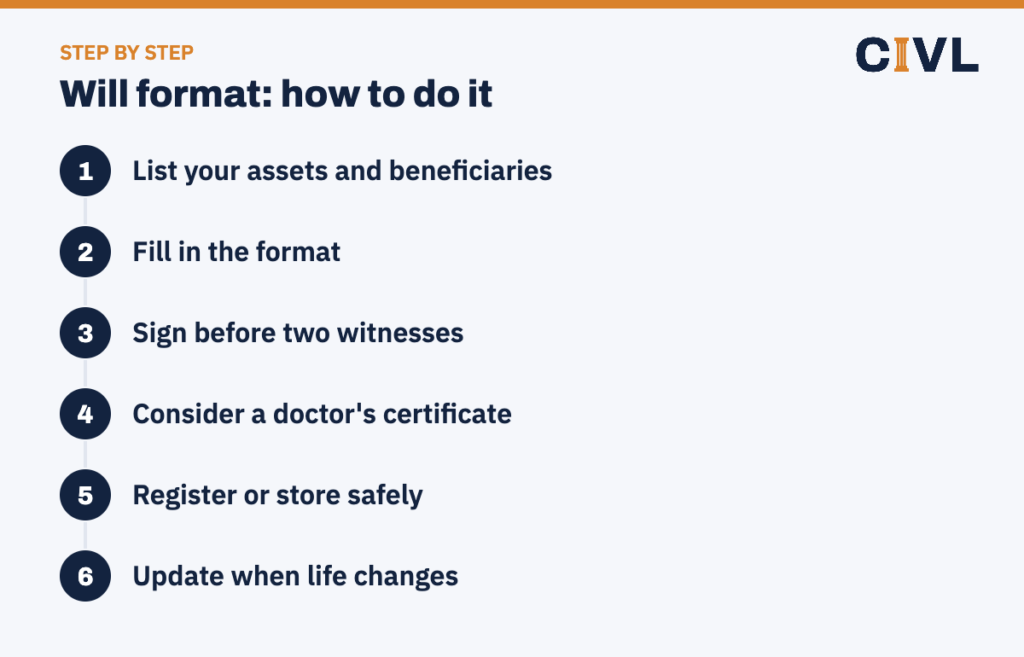
- List your assets and beneficiaries. Include account numbers and property details.
- Fill in the format. Write clearly; avoid vague phrases like “my things”.
- Sign before two witnesses. Sign every page while both witnesses watch; they then sign.
- Consider a doctor’s certificate. If you are elderly or ill, a certificate of sound mind on the same day helps.
- Register or store safely. Register it at the Sub-Registrar if you want, and tell the executor where it is kept.
- Update when life changes. Make a new will after marriage, birth of a child, or a major asset change.
Common mistakes to avoid
- Beneficiary as witness. A bequest to an attesting witness or their spouse can be void (Section 67), even though the will itself stays valid.
- Only one witness. Two witnesses are mandatory.
- Vague descriptions. Identify property by address and survey or flat number.
- Ignoring personal law. Muslims are generally limited to one-third by will.
- Forgetting joint and nominated assets. A nominee is generally a trustee for the legal heirs; your will decides the actual owner.
CIVL format
Get the ready-to-use will format
- Editable Word file and a print-ready PDF
- Notes on how to fill every blank
- Simple and detailed versions
- Asset schedule and executor letter
- Delivered to your email after payment
Price: ₹199 · Coming soon
Frequently asked questions
Is registration of a will compulsory?
No. Registration is optional under the Registration Act, 1908. An unregistered will is valid if properly signed and attested.
Do I need stamp paper for a will?
No. A will can be written on plain paper.
Can a will be changed?
Yes. You can make a new will or a codicil at any time. The latest valid will prevails.
What is probate?
A court certificate confirming the will. It is required in some cases and places; elsewhere, a will can often be acted upon without it.
Where can I get a ready-to-use will format?
CIVL’s will format comes as an editable Word file and a print-ready PDF, with notes on filling every blank and checking your state’s rules. Use the button above to be told when it is available.