
Property mutation, called dakhil kharij in Bihar and Uttar Pradesh, ferfar in Maharashtra and khata transfer in Karnataka, is how your name gets into the government’s land or property tax records after you buy, inherit or are gifted a property. This guide explains what property mutation does and does not do, the documents you need, how to apply online or at the tehsil, and what to do if someone objects.
Quick answer
Property mutation updates the revenue or municipal record to show the new owner’s name. Apply to the local revenue office (Tehsildar, Circle Officer or Talathi) for land, or to the municipal body for a house or flat, soon after registration or after the owner’s death. You need your title document (such as the registered sale deed, gift deed, will or succession papers), ID proof and the current record extract. Mutation does not give you ownership. It records ownership for tax purposes, and title disputes go to the civil court.
Related guides: sale deed registration and encumbrance certificate
What is property mutation?
Property mutation is a change in the name of the owner in the official records kept by the state. For agricultural and rural land, these are the revenue records, known by different names such as khatauni, jamabandi, 7/12 extract or RTC. For urban houses and flats, it usually means the property tax record of the municipal corporation or council.
Registration of a sale deed and property mutation are two different steps. Registration at the Sub-Registrar proves the transfer. Property mutation tells the revenue or municipal office who should now pay land revenue or property tax. In some states the Sub-Registrar passes the details to the revenue office automatically, but you should always check that the record has actually changed.
Mutation does not give ownership
The Supreme Court has repeatedly held that a mutation entry does not create or end title. It is made only for fiscal purposes, such as collecting land revenue. Where title is disputed, for example over a will, the person claiming must establish their right in a civil court, and mutation follows that decision (Jitendra Singh v. State of M.P., 2021; Suraj Bhan v. Financial Commissioner, 2007; Balwant Singh v. Daulat Singh, 1997).
When you need property mutation
- After buying property: on the basis of the registered sale deed.
- After a gift: on the basis of the registered gift deed.
- After the owner’s death: on the basis of a will, a succession or legal heir certificate, or the family details on record.
- After a partition or family settlement: on the basis of the registered partition deed or a relinquishment deed.
- After a court decree: on the basis of the certified copy of the decree.
Without property mutation, you may struggle to pay property tax in your own name, sell or mortgage the property, get a bank loan, receive compensation if land is acquired, or claim farm schemes that rely on land records.
Documents you need
- application form for property mutation (online or at the office)
- copy of the title document: registered sale deed, gift deed, partition deed, relinquishment deed, or will
- for inheritance: the owner’s death certificate and a legal heir or succession certificate, or a family tree affidavit where the state allows it
- latest record extract (khatauni, jamabandi, 7/12 or property tax bill) showing the previous owner
- identity and address proof of the applicant
- no-objection affidavits from other legal heirs, where required
- proof of payment of the fee and of up-to-date property tax or land revenue
Property mutation step by step
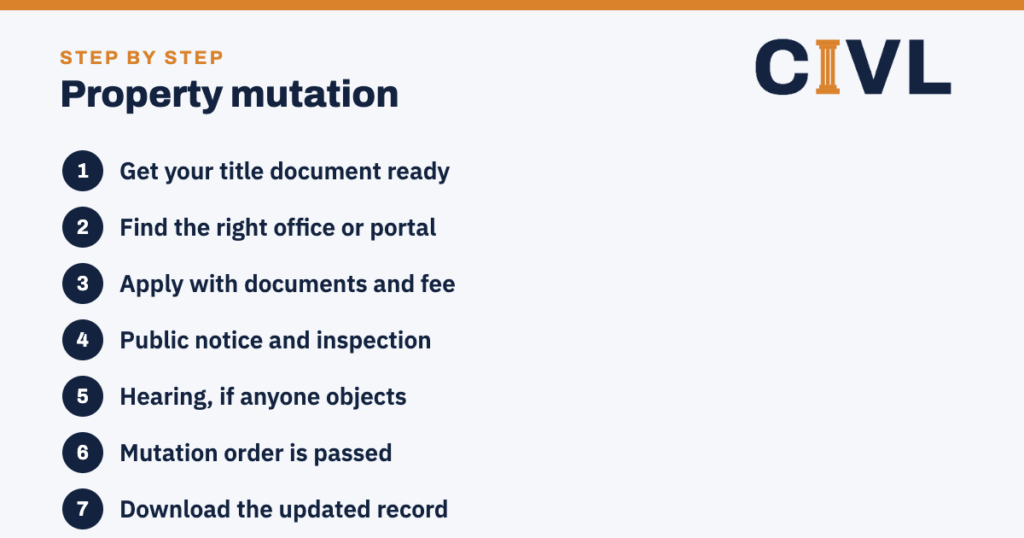
- Get your title document ready. Make sure your sale deed, gift deed or other document is registered and that you have certified copies.
- Find the right office or portal. For land, this is the Tehsildar, Circle Officer or Talathi of the area. For urban property, it is the municipal body’s property tax department. Many states now accept property mutation applications online.
- Apply with documents and fee. Fill the form, upload or attach the documents and pay the fee, which varies by state and is usually small. Note the application number.
- Public notice and inspection. The office usually issues a notice inviting objections and may send a revenue official to verify the facts.
- Hearing, if anyone objects. If someone files an objection, both sides are heard. If it turns on a real title dispute, you may be sent to the civil court.
- Mutation order is passed. The officer approves or rejects the property mutation by a written order.
- Download the updated record. Check the new record extract online or collect a copy, and make sure the name, area and survey number are correct.
Applying for property mutation online
Most states have a land records or revenue portal where you can apply for property mutation, track the application and download the updated record. Examples include Bihar Bhumi in Bihar and Mahabhumi in Maharashtra. Urban property mutation is often done through the municipal corporation’s property tax portal. Search for your state’s official land records site, and avoid paying agents who claim to “speed up” mutation.
What property mutation is called in your state
The process is the same idea everywhere, but the name on the form differs. Search your state portal with the local term:
| State | Common local term |
|---|---|
| Uttar Pradesh, Bihar | Dakhil kharij / namantaran |
| Maharashtra | Ferfar (mutation entry on the 7/12 extract) |
| Karnataka | Khata transfer (urban) / mutation in RTC (rural) |
| Tamil Nadu | Patta transfer |
| Punjab, Haryana, Rajasthan | Intkal / mutation in the jamabandi |
| West Bengal | Mutation (namjari) of land and municipal records |
Land record mutation and municipal mutation
Many owners need two separate property mutations:
- Revenue record: for agricultural or rural land, and in many towns for plots, the tehsil or revenue office updates the record of rights (khatauni, 7/12, jamabandi, RTC).
- Municipal record: for houses and flats in cities, the municipal corporation updates the property tax register in your name. This is what lets you pay property tax and get utility connections in your name.
- Housing society: for a flat in a cooperative society, also apply for transfer of the share certificate and membership.
Check your property mutation was done correctly
After the order, download the updated record from your state’s land records (Bhulekh) portal or the municipal website. Check the spelling of every name, the khasra or survey number, the area and each owner’s share. Mistakes are easier to correct within weeks than years later.
Fees and timelines
| Item | What to expect |
|---|---|
| Fee | Set by each state or municipal body; usually a small fixed fee. Some municipal bodies charge more for urban property |
| When to apply | As soon as possible after registration or the owner’s death; some states and municipal bodies set a time limit and charge a late fee |
| Time to decide | Varies by state. Many states set a time limit under their Right to Services laws, often a few weeks for undisputed cases |
| Objections | Disputed cases take longer and may need a hearing |
| Appeal | To a higher revenue officer, such as the Sub-Divisional Officer or Deputy Collector, within the time set by state law |
If your property mutation is rejected or delayed
- Ask for a copy of the order and the reasons for rejection.
- If documents were missing, reapply with the missing papers.
- If the order is wrong, file an appeal to the higher revenue officer within the time allowed by your state’s land revenue law.
- If the delay is beyond the notified time limit, complain under your state’s Right to Services law, or use RTI to ask for the status of your file.
- If someone disputes your ownership, get the title decided by the civil court; the revenue office will then mutate according to the decree.
Common mistakes to avoid
- Thinking registration is enough. Property mutation is a separate step in most states.
- Treating mutation as proof of ownership. When buying, always check the chain of registered title documents, not just the mutation record.
- Leaving out other legal heirs in inheritance cases. This invites objections later.
- Not checking the updated record for mistakes in name, area or survey number.
- Paying middlemen. Use the official portal or office and keep every receipt.
Frequently asked questions
Is property mutation compulsory?
In most states, the new owner is expected to apply, and you will need the updated record to pay tax, sell or take a loan. Some municipal laws make it compulsory within a set time.
Does property mutation prove ownership?
No. The Supreme Court has held that mutation entries are only for fiscal purposes. Ownership is proved by registered title documents or a court decree.
Can I apply for property mutation online?
In many states, yes, through the state’s land records portal or the municipal property tax portal. Some states still need a visit to the tehsil or circle office.
How is property mutation done after the owner’s death?
The legal heirs apply with the death certificate and a will, legal heir certificate or succession certificate. If the heirs agree, a relinquishment deed can put the property in one heir’s name.
What if someone objects to my property mutation?
The officer will hear both sides. If the objection raises a genuine title dispute, you may need a declaration from the civil court first.
How soon after registration should I apply for property mutation?
As soon as possible after the sale deed or other document is registered. Some states start mutation automatically from the registration office, but others need a separate application and may fix a time limit or charge a late fee.
Is property mutation needed for a flat?
Yes, in the municipal property tax records, so that tax bills and utility connections are in your name. In a cooperative housing society you should also get the share certificate transferred.
Is stamp duty payable for property mutation?
No. Stamp duty is paid on the sale deed or other transfer document. Property mutation only carries a small application fee in most states.
Where can I get ready-to-use documents for a property mutation?
CIVL’s will format, gift deed format and relinquishment deed format cover the most common transfers that lead to property mutation.
CIVL format
Get the transfer document right first
A clean property mutation starts with a proper transfer document. Use CIVL’s gift deed format, relinquishment deed format or will format. Still stuck? Ask CIVL.