
Need a relinquishment deed format? This page explains when you need it, what it must contain and how to make it valid, step by step. You can also get CIVL’s ready-to-use relinquishment deed format as an editable Word file and PDF.
Quick answer
A relinquishment deed (release deed) is used when a co-owner or legal heir gives up their share in a jointly held property in favour of the other co-owners. For immovable property it must be registered, on stamp paper as per your state, with two witnesses.
Read the full guide: Property mutation (dakhil kharij): how to update land records
What is a relinquishment deed?
When property is inherited, every legal heir gets a share. If one heir wants the others to hold the property, they can release their share by a relinquishment deed. It can only be made in favour of an existing co-owner; giving a share to an outsider is a sale or a gift, not a relinquishment.
Because it affects rights in immovable property, the deed must be registered under Section 17 of the Registration Act, 1908. Once registered, it generally cannot be cancelled except by a court on grounds such as fraud or coercion.
When you need it
- After a parent’s death, siblings agree that one of them will own the family house.
- A co-owner wants to exit jointly bought property in favour of the other.
- Legal heirs want to simplify the title before selling or mutating property.
- A bank or buyer asks for a clear single-owner title.
Stamp duty, notarisation and registration
| Requirement | What applies | Notes |
|---|---|---|
| Stamp paper / e-stamp | Required | Many states charge a reduced rate between family members. |
| Notarisation | Not enough | Registration is required for immovable property. |
| Registration | Required | At the Sub-Registrar where the property is located. |
| Witnesses | Two | They attend registration with ID. |
Stamp duty on release deeds varies between states and often depends on the relationship between the parties. Check your state’s rate before booking registration.
What the relinquishment deed must contain
- Names, ages and addresses of the releasor (giving up the share) and the releasee(s).
- How the co-ownership arose: inheritance from whom, or joint purchase.
- Full description of the property and the share being released.
- Statement that the release is voluntary, with or without consideration (state the amount if any).
- Statement that the releasor will have no further claim.
- Signatures of the parties and two witnesses, with date and place.
How to make it valid: step by step
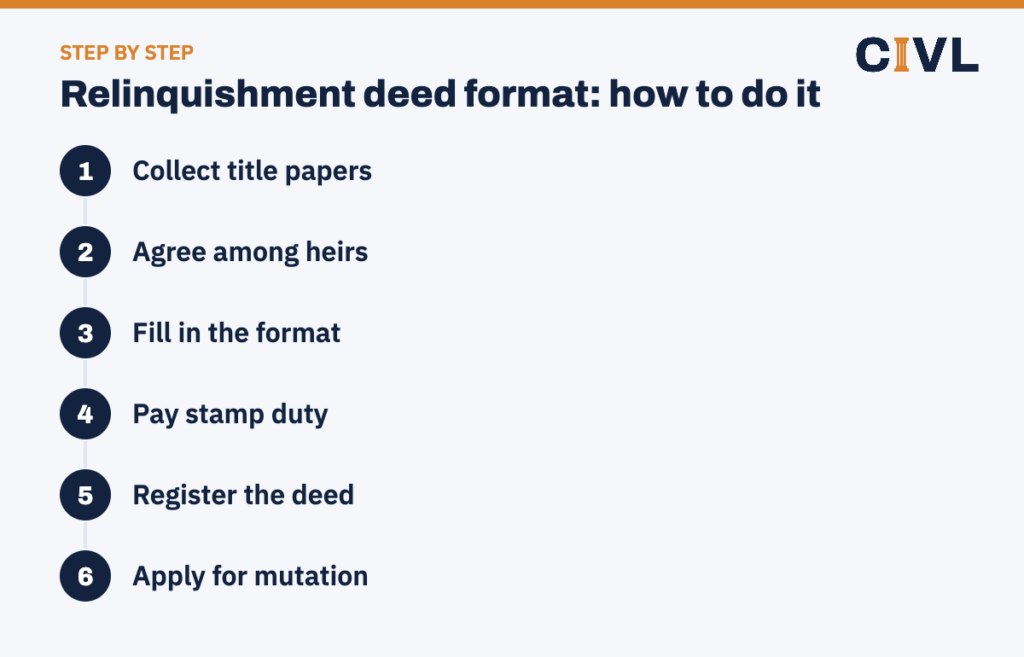
- Collect title papers. Death certificate, legal heir or succession certificate, and the original title deed.
- Agree among heirs. Make sure all co-owners agree, to avoid later disputes.
- Fill in the format. Describe the property and share exactly.
- Pay stamp duty. At your state’s rate for release deeds.
- Register the deed. Parties and two witnesses attend the Sub-Registrar.
- Apply for mutation. Update municipal and revenue records in the releasee’s name.
Common mistakes to avoid
- Releasing to an outsider. That is a sale or gift and attracts different stamp duty.
- Pressure on a family member. A release obtained by coercion can be set aside by a court.
- Not registering. An unregistered release of immovable property is not effective.
- Unclear share. State the fraction or the specific portion released.
CIVL format
Get the ready-to-use relinquishment deed format
- Editable Word file and a print-ready PDF
- Notes on how to fill every blank
- Versions with and without consideration
- Legal heirs’ consent declaration
- Delivered to your email after payment
Price: ₹199 · Coming soon
Frequently asked questions
Can a relinquishment deed be cancelled?
Not unilaterally. Only a court can set it aside, for example for fraud, coercion or misrepresentation.
Is a relinquishment deed the same as a gift deed?
No. A relinquishment is made in favour of an existing co-owner; a gift can be made to anyone.
Do all heirs need to sign?
The heir giving up the share must sign. The others sign as releasees, and it helps if all heirs consent.
What is the stamp duty?
It depends on the state; many charge a lower fixed or percentage rate for family releases.
Where can I get a ready-to-use relinquishment deed format?
CIVL’s relinquishment deed format comes as an editable Word file and a print-ready PDF, with notes on filling every blank and checking your state’s rules. Use the button above to be told when it is available.