
Need an indemnity bond format? This page explains when you need it, what it must contain and how to make it valid, step by step. You can also get CIVL’s ready-to-use indemnity bond format as an editable Word file and PDF.
Quick answer
An indemnity bond is a written promise to make good any loss another party suffers because they relied on you, for example when a bank issues a duplicate FD receipt or a company issues duplicate share certificates. It is made on stamp paper as per your state, signed before witnesses and usually notarised.
Read the full guide: Succession certificate: how to apply in India
What is an indemnity bond?
Under Section 124 of the Indian Contract Act, 1872, a contract of indemnity is one where a person promises to save another from loss caused by the promisor’s conduct or by someone else. Section 125 sets out what the indemnified person can recover.
Banks, companies, registrars, universities and government offices ask for indemnity bonds before releasing money or documents without the usual original papers, so that they are protected if a rival claim comes up later.
When you need it
- Claiming a deceased relative’s bank balance or shares without a succession certificate.
- Getting duplicate share certificates, FD receipts, insurance policies or degree certificates.
- Refund of a lost demand draft or cheque.
- Release of a security deposit or payment without the original receipt.
Stamp duty, notarisation and registration
| Requirement | What applies | Notes |
|---|---|---|
| Stamp paper / e-stamp | Required | The value depends on your state and sometimes on the amount covered. |
| Notarisation | Usually | Most banks and companies ask for a notarised bond. |
| Registration | Not needed | Not a property transfer. |
| Witnesses | Two | Some institutions also ask for a surety. |
Institutions often provide their own wording. Use theirs if they insist, and check the stamp value with them.
What the indemnity bond must contain
- Name and address of the person giving the indemnity (indemnifier) and the institution protected.
- What is being released or issued without the original document, with numbers and amounts.
- Promise to compensate the institution for any loss, claim, cost or expense.
- Undertaking to return the original if found.
- Surety details, if required.
- Date, place, signatures and two witnesses.
How to make it valid: step by step
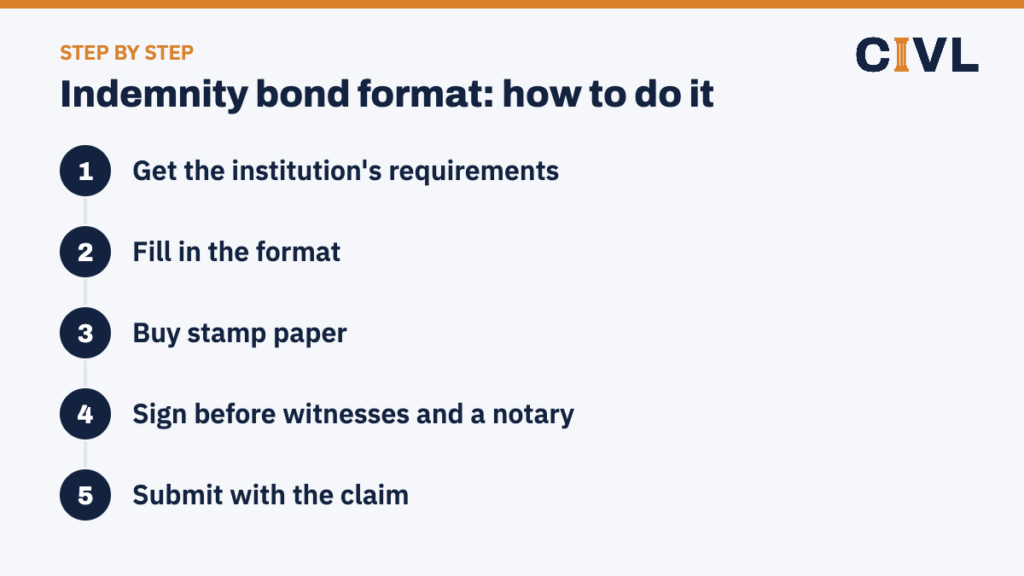
- Get the institution’s requirements. Ask for their format, stamp value and whether a surety is needed.
- Fill in the format. Quote account, folio or certificate numbers exactly.
- Buy stamp paper. As per your state’s rate for indemnity bonds.
- Sign before witnesses and a notary. Carry ID for yourself and the surety.
- Submit with the claim. Attach death certificate, legal heir proof or FIR/lost report as required.
Common mistakes to avoid
- Wrong stamp value. An under-stamped bond can be rejected.
- Missing co-heirs. For a deceased person’s assets, institutions usually want all legal heirs to sign or give NOCs.
- Signing an open-ended promise. Read the scope and amount carefully before signing.
CIVL format
Get the ready-to-use indemnity bond format
- Editable Word file and a print-ready PDF
- Notes on how to fill every blank
- Versions for bank claims, shares and lost documents
- Surety declaration
- Delivered to your email after payment
Price: ₹99 · Coming soon
Frequently asked questions
What is the stamp duty on an indemnity bond?
It is set by each state’s stamp law. Ask the institution or check your state’s schedule.
Who can be a surety?
Usually a financially sound person known to the institution, often with property or an account there.
Is an indemnity bond the same as a guarantee?
No. In an indemnity, you promise to cover loss; in a guarantee, you promise to pay if someone else defaults (Section 126).
Where can I get a ready-to-use indemnity bond format?
CIVL’s indemnity bond format comes as an editable Word file and a print-ready PDF, with notes on filling every blank and checking your state’s rules. Use the button above to be told when it is available.