

A legal heir certificate is an official document that names the surviving family members of a person who has died. You need a legal heir certificate to claim pension and service dues, transfer electricity and gas connections, update property tax and land records, and settle many smaller claims. This guide explains who can apply for a legal heir certificate, the documents you need, the enquiry process and what to do if it is delayed or disputed.

Quick answer
A legal heir certificate is issued by the state revenue department, usually the Tahsildar or Taluk office, and in some places the municipal body. Apply online on your state’s e-District or service portal, or at the office, with the death certificate, an affidavit listing all heirs, and ID and relationship proofs. Local revenue officials verify the family before the certificate is issued, often within about a month. It is different from a succession certificate, which a court issues for bank deposits and shares.
Related guide: Death certificate: how to register a death and get the certificate
What is a legal heir certificate?
A legal heir certificate lists the people who are the deceased person’s heirs, with their relationship to the deceased. It is issued after a local enquiry, not after a court case. Depending on the state, it may also be called a survivor certificate, family member certificate or varisu certificate.
A legal heir certificate only identifies the heirs. It does not divide the property, and it does not decide disputes about who owns what. Those questions are decided by the law of succession and, if needed, by a civil court.
When you need a legal heir certificate
- family pension, gratuity, provident fund and other dues of a government or private employee
- transfer of electricity, water, gas and telephone connections
- mutation of property tax and land records into the heirs’ names (see property mutation)
- insurance and smaller bank claims, where the bank does not insist on a succession certificate
- compensation claims, such as under government schemes
Who can apply for a legal heir certificate
Any legal heir can apply, typically the spouse, a son or daughter, or a parent of the deceased. The heirs are decided by the personal law that applies, such as the Hindu Succession Act, 1956, Muslim personal law or the Indian Succession Act, 1925. Under the Hindu Succession Act, for example, the spouse, children and mother are all Class I heirs and share equally. Daughters have the same rights as sons.
Documents you need
- death certificate of the deceased
- application form (online or at the Tahsildar or municipal office)
- affidavit or self-declaration naming all legal heirs, with their relationship and age
- identity and address proof of the applicant and of each heir
- proof of the deceased’s address, such as a voter ID card, ration card or bank passbook
- proof of relationship, such as a marriage certificate, birth certificates or school records
- for a minor heir, the guardian’s details, and in some cases a court guardianship order
Legal heir certificate step by step
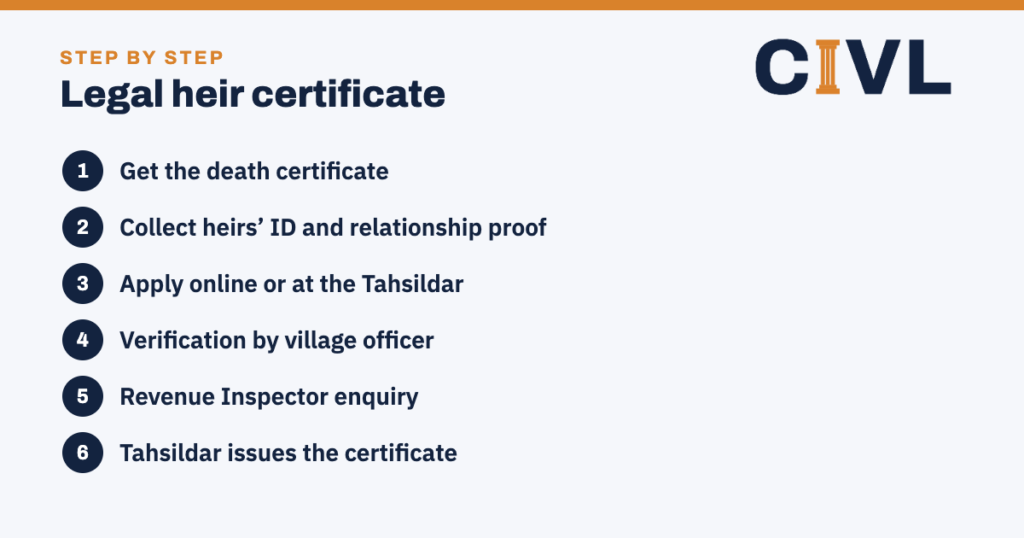
- Get the death certificate. Register the death with the local body within 21 days and collect the certificate. You cannot apply for a legal heir certificate without it.
- Collect heirs’ ID and relationship proof. List every heir, including married daughters and heirs living elsewhere. Leaving anyone out is the most common reason for rejection.
- Apply online or at the Tahsildar. Most states let you apply on the state e-District or citizen service portal. Upload the documents, pay the small fee and note the application number.
- Verification by the village officer. The Village Administrative Officer, Patwari or Talathi checks the family details, and may ask the heirs to sign before them.
- Revenue Inspector enquiry. A Revenue Inspector may visit the home and speak to neighbours to confirm the heirs.
- Tahsildar issues the certificate. Once the reports are positive, the Tahsildar signs the legal heir certificate. Download it from the portal or collect it from the office.
Example: Tamil Nadu
In Tamil Nadu, the legal heir certificate is issued by the Tahsildar. You can apply through the e-Sevai citizen portal or an e-Sevai centre. After you apply, the Village Administrative Officer and the Revenue Inspector verify the family, and the certificate is usually issued in about 30 days. If there is an unreasonable delay, you can approach the Revenue Divisional Officer.
Fees and timelines
| Item | What to expect |
|---|---|
| Fee | Small; set by each state. Pay only the official fee shown on the portal |
| Time to issue | Often about 30 days; many states set a limit under their Right to Services law |
| Validity | Does not usually expire, but some offices ask for a recent copy |
| If delayed | Complain to the senior revenue officer or under your state’s Right to Services law |
| If refused | Ask for written reasons, then appeal to the senior revenue officer or approach the civil court |
Legal heir certificate vs succession certificate
| Point | Legal heir certificate | Succession certificate |
|---|---|---|
| Issued by | Tahsildar or revenue office (sometimes municipal body) | District Judge (civil court) |
| Purpose | Identifies the heirs | Authorises collection of debts and securities |
| Used for | Pension, service dues, utilities, mutation | Bank deposits, shares, bonds |
| Cost | Small fee | Court fee based on the value of assets |
| Time | Weeks | Months |
Read more in our guide to the succession certificate.
Who is named in a legal heir certificate
The legal heir certificate lists the people who inherit under the personal law that applied to the deceased. The office does not decide shares; it only records who the heirs are. In practice:
- Hindus, Sikhs, Jains and Buddhists: the Hindu Succession Act, 1956 applies. Class I heirs include the widow, sons, daughters and mother, and children of a predeceased son or daughter. Daughters, including married daughters, have the same rights as sons.
- Muslims: heirs and shares follow Muslim personal law.
- Christians, Parsis and others: the Indian Succession Act, 1925 applies.
List every heir in the application, including married daughters and heirs living abroad. Leaving someone out is the most common reason a legal heir certificate is later cancelled.
Legal heir certificate and family member certificate
Some states issue a separate “family member” or “surviving member” certificate, mainly for pension, compassionate appointment or government dues, while the legal heir certificate is used for inheritance. Ask the revenue office which certificate your purpose needs, because the two list people differently. For a government employee’s pension, the department may also accept its own nomination records.
Using your legal heir certificate
- Bank accounts: where there is no nominee, banks usually ask for the legal heir certificate, death certificate, an indemnity bond and sometimes a no-objection letter from the other heirs.
- Property records: submit it with the death certificate to the revenue office for mutation of land or house records.
- Utility connections and tax: use it to transfer electricity, water and property tax records into an heir’s name.
If there is a dispute between heirs
A revenue officer cannot decide a real dispute, such as a claim that one person is not a legal heir, or a disputed will. In such cases the office may refuse the legal heir certificate and ask the parties to get a decision from the civil court. Free legal aid is available through your District Legal Services Authority if you cannot afford a lawyer.
Common mistakes to avoid
- Leaving out an heir, such as a married daughter or a child from an earlier marriage. The certificate can be cancelled later.
- Applying before the death is registered. Get the death certificate first.
- Using a legal heir certificate where a succession certificate is needed, for example for large bank deposits or shares without nominees.
- Paying agents extra. Use the official portal and keep the receipt.
- Not matching names across documents. Correct spelling differences with an affidavit before you apply.
Frequently asked questions
Who issues a legal heir certificate?
Usually the Tahsildar or Taluk office of the area where the deceased lived. In some cities, the municipal corporation issues it.
How long does a legal heir certificate take?
Often about a month after you apply, depending on the state and the verification.
Can I apply for a legal heir certificate online?
Yes, in most states, through the state’s e-District or citizen service portal. Some states still need an office visit for verification.
Is a legal heir certificate enough to transfer property?
It helps with mutation of property tax and land records, but it is not a title document. Heirs may also need a relinquishment deed or partition deed to put the property in one person’s name.
Can a legal heir certificate be cancelled?
Yes. If it was obtained by hiding an heir or by giving false information, the revenue authorities or a court can cancel it.
Can a married daughter be named in a legal heir certificate?
Yes. A married daughter is a legal heir just like a son or an unmarried daughter, and her name must be included in the legal heir certificate.
Do I need a legal heir certificate if there is a nominee?
The nominee can usually receive the money without a legal heir certificate, but holds it for the legal heirs. Heirs who want their share from the nominee may still need the certificate.
Do I need a death certificate before applying for a legal heir certificate?
Yes. A registered death certificate is the first document the revenue office asks for. Register the death within 21 days to avoid delay.
Where can I get ready-to-use documents for a legal heir certificate?
Offices often ask for affidavits and, later, a family arrangement. Use CIVL’s relinquishment deed format and indemnity bond format.
CIVL format
Settle the family paperwork
Use CIVL’s relinquishment deed format when heirs agree to give up their share, and the indemnity bond format for bank and insurance claims. Read about the succession certificate and property mutation. Still stuck? Ask CIVL.