
Use this free interest calculator to work out the interest and total amount due on an unpaid loan, bill, cheque or court decree in India: simple or compound, with part payments and the rates the law sets.

Quick answer
The interest calculator adds interest to the amount owed from the date it was due up to today or the date of payment. Choose the type of claim, enter the amount, rate and dates, and add any part payments.
The law fixes some rates: 18% on a cheque or promissory note with no rate written on it, three times the RBI bank rate (compounded monthly) on a late payment to an MSME supplier, and usually up to 6% after a court decree.
Read the full guide: MSME delayed payment: how to file a complaint on the ODR portal
1What is the money for?
2Amount and rate
3Dates
4Part payments (optional)
Each part payment is applied first to the interest due and then to the principal. Nothing you type is sent to CIVL or stored.
Total amount due
Enter the amount and dates
The result updates as you type.
How to use the interest calculator
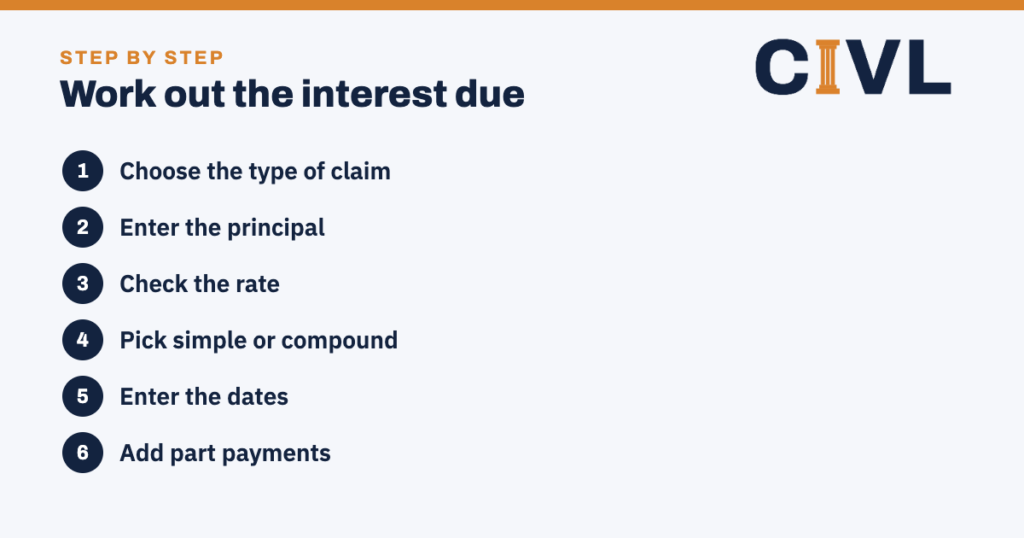
- Choose the type of claim. A loan with an agreed rate, a cheque or note with no rate, an MSME supplier’s bill, a court decree, or your own rate.
- Enter the principal. This is the amount that was due, without any interest.
- Check the rate. The interest calculator fills in the usual rate for your claim. Change it to match your agreement or decree.
- Pick simple or compound. Most claims use simple interest. MSME claims use monthly compounding.
- Enter the dates. Interest runs from the date the money was due up to today, or up to the date it was paid.
- Add part payments. Enter the date and amount of each one. Then copy or print the result and the working.
Which interest rate applies?
The interest calculator uses the rate you enter. This table shows where the common rates come from:
| Situation | Rate | Law |
|---|---|---|
| Loan or contract with an agreed rate | The agreed rate (a court can cut it down if it is excessive) | Indian Contract Act, 1872; Usurious Loans Act, 1918 |
| Cheque, promissory note or bill with no rate written on it | 18% a year from the due date | Negotiable Instruments Act, s.80 |
| Late payment to a registered micro or small supplier | 3 × RBI bank rate, compounded monthly | MSMED Act, 2006, ss.15–16 |
| Debt with no agreed rate | Up to the current bank lending rate, from the due date or a written demand | Interest Act, 1978, s.3 |
| From filing the suit to the decree | A reasonable rate decided by the court | CPC, s.34 |
| After the decree until payment | Up to 6% a year (higher in commercial cases) | CPC, s.34 |
Simple interest or compound interest?
Simple interest is charged only on the principal. ₹1,00,000 at 12% a year for two years gives ₹24,000 interest.
Compound interest is also charged on interest already added. The same ₹1,00,000 at 12% compounded yearly for two years gives ₹25,440. Compounded monthly, it gives about ₹26,973. The interest calculator works out all three.
Courts usually allow compound interest only when the contract says so, or when a law provides it (as the MSMED Act does) or in banking and commercial practice. If you are unsure, use simple interest in the interest calculator.
How part payments are counted
Unless you and the other side agreed otherwise, a part payment is usually set off first against the interest due and then against the principal. The Supreme Court applied this rule to decrees in Gurpreet Singh v. Union of India (2006). The interest calculator follows it, so the interest stops growing only on the part of the principal actually repaid.
Interest on late payments to MSMEs
A buyer must pay a micro or small enterprise registered on Udyam by the agreed date. The agreed date can never be more than 45 days after the goods or services were accepted. If the buyer pays late, it owes compound interest with monthly rests at three times the bank rate notified by the RBI (MSMED Act, ss.15 and 16).
The RBI bank rate is 5.75% from 7 October 2026, so the MSME rate is 17.25% a year, which the interest calculator fills in for you. The rate changes whenever the RBI changes the bank rate. A supplier can file a claim on the MSME ODR portal (odr.msme.gov.in), which replaced the Samadhaan portal for new cases on 15 October 2025. The claim starts with online negotiation and then goes to the Micro and Small Enterprises Facilitation Council (s.18). The buyer cannot deduct this interest for income tax (s.23). Read our Udyam registration guide.
How to claim the interest
- Work out the amount with the interest calculator and keep the printout.
- Send a written demand or legal notice. See how to send a legal notice and the money recovery notice format.
- Mention the rate and its source (agreement, invoice, s.80 NI Act or MSMED Act) in the notice.
- Check you are within time. Most money claims must be filed within 3 years: use our limitation period calculator.
- For a bounced cheque, read the cheque bounce case guide.
Common mistakes to avoid
- Starting interest from the date of the loan instead of the date it fell due.
- Claiming compound interest when the agreement says nothing about it.
- Forgetting to deduct part payments.
- Claiming a very high penal rate. Courts often reduce it.
- Using an old RBI bank rate for an MSME claim.
How does the interest calculator count days?
It counts the actual number of days between the two dates and uses a 365-day year. Banks and courts may round differently, so the result can differ by a few rupees.
What interest can I claim if no rate was agreed?
For a cheque, promissory note or bill of exchange with no rate written on it, the law sets 18% a year (NI Act s.80). For other debts, a court can allow a reasonable rate, often 6% to 12% a year, under the Interest Act and section 34 of the CPC.
What is the MSME interest rate today?
Three times the RBI bank rate, compounded monthly. With the bank rate at 5.75% (from 7 October 2026), it is 17.25% a year.
Can a court reduce agreed interest?
Yes. If the rate is excessive or works as a penalty, a court can reduce it under the Usurious Loans Act, state moneylending laws or section 74 of the Contract Act.
Is interest after a decree limited to 6%?
Usually, yes. Section 34 of the CPC allows up to 6% a year after the decree. In a commercial case it can be higher, but not more than the agreed rate or the rate nationalised banks charge on commercial loans.
Does sending a legal notice stop interest?
No. Interest keeps running until the money is paid, and the interest calculator counts it up to the date you choose. A notice records your demand and, under the Interest Act, can be the starting date for interest when nothing was agreed.
Where can I get a ready-to-use money recovery notice?
Use the CIVL money recovery notice format. Add the figure from the interest calculator to your demand.
CIVL format
Ready to demand payment?
Use the money recovery notice, the legal notice format or the cheque bounce notice. Questions? Ask CIVL.