
Use this free limitation period calculator to find the last date to file a civil case, appeal, consumer complaint, cheque bounce complaint or RTI first appeal in India. Choose the type of case, enter the date time started, and it works out the deadline under the Limitation Act, 1963.
Quick answer
The limitation period calculator adds the period for your type of case to the date time started, leaving out the starting day (s.12(1)). It restarts the count from a written acknowledgement or part payment (ss.18 and 19), adds any days the law lets you exclude, and applies the Supreme Court’s COVID-19 exclusion of 15 March 2020 to 28 February 2022.
Most money and contract claims have 3 years, property possession claims 12 years, and appeals 30 or 90 days. A late suit cannot be saved, so file well before the date shown.
1What kind of case or step is it?
2When did time start?
3Anything that changes the count? (optional)
This checker gives an estimate under the Limitation Act, 1963 and the special laws listed. It is general information, not legal advice. Courts decide the exact starting point, so file well before the last date. Nothing you enter leaves your browser.
How to use the limitation period calculator
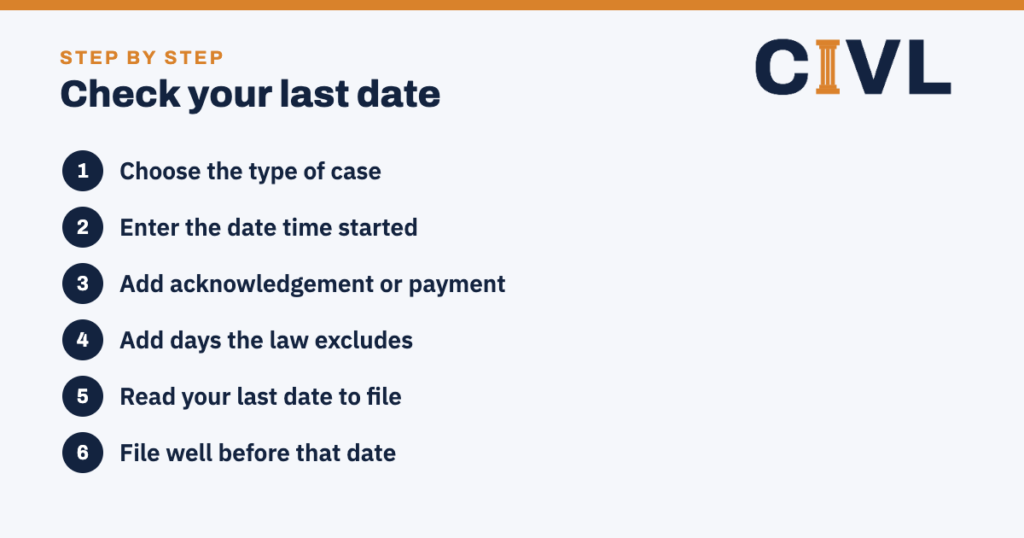
- Choose the type of case. Pick the closest match: a loan, unpaid price, breach of contract, rent, property, an appeal, or a special-law step such as a consumer complaint.
- Enter the start date. The label changes to tell you which date counts, such as the date of the breach or the date of the decree.
- Add an acknowledgement or part payment. For money claims, a signed acknowledgement or part payment made in time starts a fresh period.
- Add excluded days. For example, the days taken to get a certified copy of the decree for an appeal (s.12), or time spent in good faith in the wrong court (s.14).
- Read the result. The limitation period calculator shows the last date, the days left, how it was worked out, and what you can do if time has run out.
- File early. Courts decide the exact start date, so leave a safe margin.
Limitation periods the calculator covers
| Type of case | Period | Law |
|---|---|---|
| Money lent (loan) | 3 years | Articles 19, 21 |
| Price of goods sold | 3 years | Articles 14, 15 |
| Breach of contract | 3 years | Article 55 |
| Specific performance | 3 years | Article 54 |
| Arrears of rent | 3 years | Article 52 |
| Declaration of a right | 3 years | Article 58 |
| Cancelling a document | 3 years | Article 59 |
| Defamation | 1 year | Articles 75, 76 |
| Possession after dispossession | 12 years | Article 64 |
| Possession based on title | 12 years | Article 65 |
| Redemption of a mortgage | 30 years | Article 61 |
| Any other suit | 3 years | Article 113 |
| Appeal to a District Court | 30 days | Article 116(b) |
| Appeal to a High Court | 90 days | Article 116(a) |
| Review of a judgment | 30 days | Article 124 |
| Setting aside an ex parte decree | 30 days | Article 123 |
| Execution of a decree | 12 years | Article 136 |
| Consumer complaint | 2 years | CPA 2019, s.69 |
| Cheque bounce notice | 30 days from the return memo | NI Act, s.138(b) |
| Cheque bounce complaint | 1 month after the 15-day payment period | NI Act, s.142(1)(b) |
| RTI first appeal | 30 days | RTI Act, s.19(1) |
The limitation period calculator uses these periods. For the full list and examples, read our guide to the limitation period for civil cases in India.
How the limitation period calculator counts
- The first day is left out. Section 12(1) excludes the day from which the period runs, so three years from 10 March 2024 ends on 10 March 2027.
- Years and months follow the calendar. If the matching day does not exist (for example 29 February), the last day of that month is used.
- Acknowledgement or part payment. If made before time runs out, the limitation period calculator starts a fresh period from that date. If made later, it does not revive the claim, though a written promise to pay a time-barred debt can be a new contract under Section 25(3) of the Contract Act.
- COVID-19 exclusion. The Supreme Court excluded 15 March 2020 to 28 February 2022 for all judicial and quasi-judicial proceedings. Where time would have run out in that window, at least 90 days from 1 March 2022 was allowed. You can switch this off.
- Court holidays. If the court is closed on the last day, you may file on the day it reopens (s.4). The calculator warns you when the date falls on a weekend.
If the time has run out
If the limitation period calculator shows a date in the past, check the start date first. For suits, the court must dismiss a late case and cannot condone delay, because Section 5 does not apply to suits. For appeals and most applications, the court can admit a late filing under Section 5 if you show sufficient cause for the whole delay. Consumer commissions, cheque bounce courts and RTI appellate authorities also have power to admit late filings for sufficient cause. The limitation period calculator tells you which rule applies to your case.
What the limitation period calculator cannot do
- Decide the exact start date for you. For a continuing wrong, a fraud or a mistake, time can start later (ss.17 and 22).
- Cover every special law. Tax, service, arbitration, motor accident and family laws have their own limits.
- Apply state-specific rules, such as state rent laws or local land laws.
- Replace advice on a close case. If the result shows only a few days left, file now.
Frequently asked questions
Is the limitation period calculator free?
Yes. The limitation period calculator is free and works in your browser. Nothing you enter is sent to CIVL.
What is the limitation period for recovering money in India?
Generally 3 years, for example from the date a loan was made or the price fell due. A signed acknowledgement or part payment before it ends starts a fresh 3 years.
Does a legal notice extend the limitation period?
No. Sending a notice does not stop time. The only exception is the two-month notice before suing the Government under Section 80 CPC, which is excluded (s.15(2)).
Can a court allow a case filed late?
For appeals and most applications, yes, if you show sufficient cause under Section 5. For suits, no.
Should I apply the COVID-19 exclusion?
Yes, if any part of your limitation period fell between 15 March 2020 and 28 February 2022. If your period started after that, it makes no difference.
Why does my result differ from someone else’s count?
Most differences come from the start date. Courts decide when the cause of action arose, so treat the result as an estimate and file early.
Where can I get a ready-to-use legal notice or recovery notice format?
Use CIVL’s money recovery notice or legal notice format to make a demand before you file.
CIVL format
Ready to act?
Send a money recovery notice or a legal notice, and read how to send a legal notice in India. See all free legal tools. Still stuck? Ask CIVL.