
The limitation period is the time within which you must file a case in court. Miss it and the court must dismiss your case, however strong it is. This guide gives the limitation period for the most common civil claims in India, explains when time starts running, and shows how acknowledgements, part payments and other rules can extend or pause the limitation period.
Quick answer
Most civil claims for money or breach of contract have a limitation period of three years. Suits for possession of land based on title or dispossession have 12 years, and executing a decree also has 12 years. Appeals have short limits: 30 days to a District Court and 90 days to a High Court. A written acknowledgement or part payment before the period ends starts a fresh limitation period (Limitation Act, 1963, ss.18 and 19). Special laws, such as consumer and cheque bounce law, set their own limits.
Free tool: find your last date to file with the limitation period calculator.
Free tool: work out the interest and total amount due with the interest calculator.
What is a limitation period?
The Limitation Act, 1963 fixes the time for filing suits, appeals and applications. Its Schedule lists more than 130 types of claims, each with a limitation period and a starting point. Under section 3, any suit, appeal or application filed after the limitation period must be dismissed, even if the other side does not raise the point.
The purpose is fairness: evidence fades, and people should not face old claims forever. Limitation bars the remedy in court, though in some cases the underlying right remains. For possession of property, section 27 goes further and ends the owner’s right once the limitation period for recovery has passed.
Limitation period for common civil cases
| Type of claim | Limitation period | Time starts from | Article |
|---|---|---|---|
| Money lent (loan) | 3 years | When the loan is made, or as agreed | 19, 21 |
| Price of goods sold | 3 years | When the price is due | 14 |
| Breach of contract (compensation) | 3 years | When the breach occurs | 55 |
| Specific performance of a contract | 3 years | Date fixed for performance, or when performance is refused | 54 |
| Arrears of rent | 3 years | When each rent payment is due | 52 |
| Declaration of a right | 3 years | When the right to sue first arises | 58 |
| Cancelling a document (deed) | 3 years | When the facts entitling cancellation become known | 59 |
| Libel or slander (defamation) | 1 year | When the libel is published or slander spoken | 75, 76 |
| Possession of immovable property after dispossession | 12 years | Date of dispossession | 64 |
| Possession of immovable property based on title | 12 years | When the defendant’s possession becomes adverse | 65 |
| Redemption of a mortgage | 30 years | When the right to redeem arises | 61 |
| Any suit with no specific article | 3 years | When the right to sue accrues | 113 |
Appeals, reviews and execution
| Proceeding | Limitation period | Article |
|---|---|---|
| Appeal from a decree to a District Court | 30 days | 116(b) |
| Appeal from a decree to a High Court | 90 days | 116(a) |
| Review of a judgment | 30 days | 124 |
| Setting aside an ex parte decree | 30 days from the decree or from knowledge of it | 123 |
| Execution of a decree (other than an injunction) | 12 years | 136 |
Special laws with their own limitation period
- Consumer complaint: 2 years from the cause of action (Consumer Protection Act, 2019, s.69). See consumer complaint online.
- Cheque bounce: notice within 30 days of the bank memo, and complaint within one month after the 15-day payment period (Negotiable Instruments Act, ss.138 and 142). See cheque bounce case.
- RTI first appeal: 30 days from the reply or the deadline (RTI Act, s.19). See RTI first appeal.
- Suits against the Government: a two-month notice is needed before suing (Code of Civil Procedure, s.80), and that period is excluded from the limitation period (Limitation Act, s.15(2)). Suits filed by the Central or State Government generally get 30 years (Article 112).
How to check your limitation period: step by step
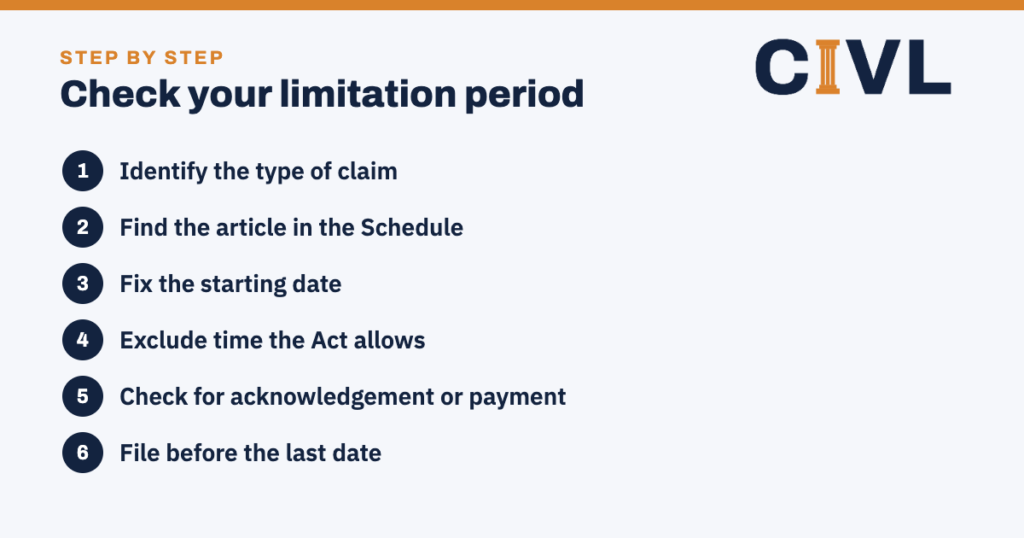
- Identify the type of claim. Is it a loan, a contract, property, rent or something else? The right article depends on this.
- Find the article in the Schedule. Use the table above or the Limitation Act on India Code.
- Fix the starting date. Each article says when time begins, for example the date of breach or of dispossession.
- Exclude time the Act allows. Leave out the day time starts (s.12(1)), time taken to get certified copies for an appeal (s.12), time spent in good faith in the wrong court (s.14), and periods of minority or unsoundness of mind (s.6).
- Check for acknowledgement or part payment. A signed, written acknowledgement of the debt, or a part payment, made before the limitation period ends starts a fresh period (ss.18 and 19).
- File before the last date. If the court is closed on the last day, you may file on the day it reopens (s.4).
Can a court allow a late case?
For appeals and most applications, yes. Under section 5, the court can condone delay if you show “sufficient cause”, such as illness or a genuine mistake, explained day by day. For suits, section 5 does not apply, so a late suit cannot be saved by condonation. That is why the limitation period for suits must be watched closely.
During the COVID-19 period, the Supreme Court excluded the time from 15 March 2020 to 28 February 2022 from limitation for all cases. This matters only for claims whose limitation period overlapped that window.
Does a legal notice extend the limitation period?
Generally, no. Sending a legal notice does not stop or extend the limitation period, except the two-month notice to the Government under section 80 of the Code of Civil Procedure. But if the other side replies admitting the debt in writing, that reply can count as an acknowledgement under section 18 and start a fresh limitation period. Read how to send a legal notice.
A worked example: counting the limitation period
Suppose you lent ₹2 lakh to a friend on 10 March 2023, payable on demand, with no written acknowledgement since then. The time limit for a loan is three years (Article 21), counted from the date of the loan, so the last day to file a recovery suit is 10 March 2026, excluding the first day under section 12.
- If your friend had signed a message admitting the debt on 1 January 2025, a fresh three-year period would run from that date, to 1 January 2028 (section 18).
- If your friend paid ₹20,000 towards the loan on 1 June 2025, and the payment is shown in their handwriting or a signed writing, a fresh period would run from that payment (section 19).
- If the last day falls on a court holiday, you can file on the next working day (section 4).
- Sending a legal notice on its own does not extend any of these dates.
Work out your date this way, write it down, and file well before it. Most limitation disputes come from cutting it close.
When the clock starts later
- Minors and persons of unsound mind (section 6): they can file within the same period counted from when the disability ends.
- Fraud or mistake (section 17): time starts running only when the fraud or mistake is discovered, or could have been discovered with reasonable care.
- Continuing wrongs (section 22): for a continuing breach or wrong, a fresh period begins every moment it continues.
- Court closed on the last day (section 4): you can file on the day the court reopens.
Common mistakes to avoid
- Waiting for a reply to a legal notice while the limitation period runs out.
- Counting from the wrong date, for example from the last reminder instead of the date of breach.
- Relying on an oral promise. Only a signed written acknowledgement restarts the limitation period.
- Assuming condonation is available for suits. It is not.
- Forgetting special laws that set shorter periods.
Frequently asked questions
What is the limitation period for recovery of money in India?
Generally three years, from when the money became due. A written acknowledgement or part payment within that time starts a fresh three-year period.
What is the limitation period for a property dispute?
For recovering possession of land or a house, usually 12 years from dispossession or from when the other person’s possession became adverse. Suits to cancel a deed or for a declaration usually have three years.
Can the limitation period be extended?
It cannot simply be extended, but some time can be excluded (ss.4 to 15), and acknowledgement or part payment starts a fresh period. Delay in appeals can be condoned for sufficient cause.
Does the limitation period apply to criminal cases?
The Limitation Act applies to civil proceedings. Criminal cases have separate rules under the criminal procedure law, and many serious offences have no limitation period.
What happens if I file after the limitation period?
The court must dismiss the suit under section 3, even if the other side does not object, unless an exclusion or fresh period applies.
Is the limitation period the same in every state?
Yes. The Limitation Act, 1963 applies across India. Some special Acts, including a few state laws, set their own time limits, and that special period applies to cases under them.
Does the limitation period apply to arbitration?
Yes. Section 43 of the Arbitration and Conciliation Act, 1996 applies the Limitation Act to arbitrations. The claim must be raised within the same period as a court case.
Can a contract shorten the limitation period?
Generally no. Under section 28 of the Indian Contract Act, a clause that limits the time to go to court is void, with a narrow exception for bank guarantees and similar guarantee contracts.
Where can I get a ready-to-use notice before the limitation period ends?
Use CIVL’s money recovery notice or legal notice format early, and ask the other side to acknowledge the debt in writing.
CIVL format
Act before time runs out
Send a clear demand using CIVL’s money recovery notice or legal notice format, and file well within the limitation period. Still stuck? Ask CIVL.