
Wondering how to send a legal notice in India? This guide explains when a notice is needed, what to write, how many days to give, and how to send it so you can prove it was delivered. You do not need stamp paper, and you do not always need a lawyer.
Quick answer
A legal notice is a formal letter telling someone what they owe you or what they did wrong, what you want, and the deadline before you go to court or a forum. You can draft and sign it yourself or through an advocate. Send it by Speed Post with proof of delivery (or courier and email as well), keep every receipt, and give a clear deadline, usually 15 to 30 days. Some laws fix the period: 15 days to pay after a cheque bounce notice, and two months before suing the Government.
Free tool: work out the interest and total amount due with the interest calculator.
What is a legal notice?
A legal notice is a written demand sent before starting a legal case. It puts the other side on record: here are the facts, here is what you must do, and here is what will happen if you do not. Many disputes over unpaid money, deposits, defective goods or property end at this stage, because a clear notice shows you are serious and organised.
For most civil disputes, the law does not force you to send a notice first. But a notice is still useful: it creates evidence that you tried to settle, it starts a paper trail, and courts and consumer commissions often look at whether the other side was told about the problem.
When is a legal notice compulsory?
In a few situations, the law itself requires notice, and missing it can sink your case. Before you decide how to send a legal notice, check whether one of these applies:
- Cheque bounce (Section 138, Negotiable Instruments Act): send the notice within 30 days of getting the bank’s return memo. The drawer then has 15 days to pay. See our cheque bounce notice format.
- Suing the Government or a public officer (Section 80, Code of Civil Procedure): two months’ written notice before filing the suit. A court can allow an urgent suit without notice only in limited cases.
- Ending a monthly tenancy (Section 106, Transfer of Property Act): 15 days’ notice, unless your rent agreement or a state rent law says otherwise.
- Contract terms: many agreements say a party must give written notice before ending the contract or claiming damages. Read the notice clause of your agreement.
How to send a legal notice: what you need first
- Full name and current address of the person or company you are writing to (for a company, its registered office address from the MCA website or its invoices)
- Your agreement, invoice, receipt, bank statement, chat or email records, and any earlier complaint
- A short timeline of what happened, with dates and amounts
- A clear demand: the exact amount, the action you want, or the thing you want them to stop
- The deadline you will give and what you will do after it (civil suit, consumer complaint, criminal complaint)
What a legal notice must contain
- Date and mode of sending (for example, “By Speed Post with proof of delivery and by email”).
- Sender and recipient details: names, addresses and, for a company, its registered office.
- Facts in date order: short numbered paragraphs, each with one fact and its date.
- The legal basis: the agreement clause, or the law you rely on, in plain words.
- Your demand: the exact amount (with interest, if the agreement allows it) or the action you want.
- The deadline: a fixed number of days from receipt of the notice.
- The consequence: what you will do if they do not comply, without threats you cannot carry out.
- Signature of the sender (or the advocate, with your authority), and a list of documents you are relying on.
CIVL’s legal notice format sets out all of these headings in order, ready to fill in.
How to send a legal notice: step by step
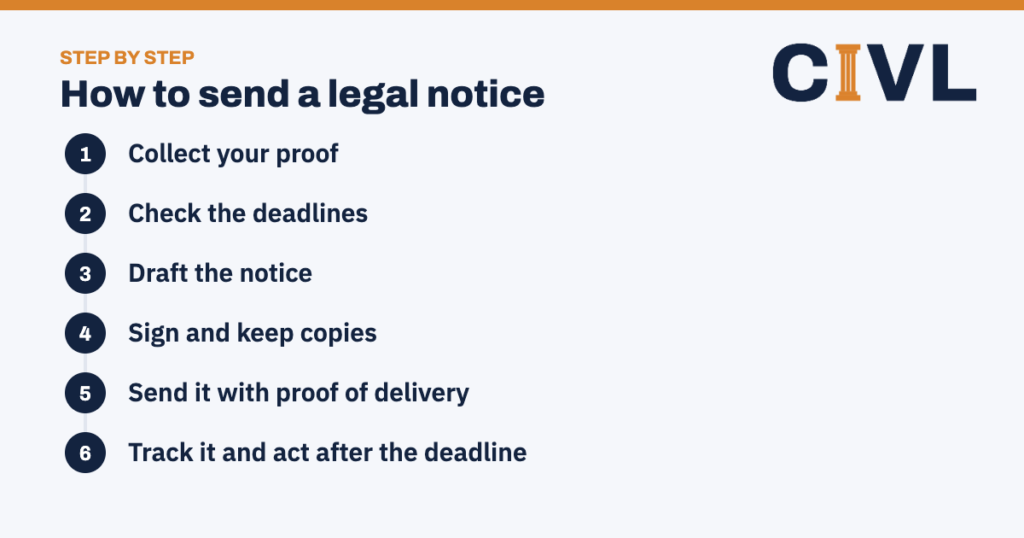
- Collect your proof. Put your agreement, payment proof, messages and earlier complaints in one folder. Number them; you will refer to them in the notice.
- Check the deadlines. Note any fixed period (30 days for a cheque bounce notice, the limitation period of three years for most money claims) and send the notice well before it runs out. A notice does not stop the limitation clock.
- Draft the notice. Use short paragraphs, stick to facts and dates, state one clear demand and one clear deadline. Write in English or in a language the recipient understands.
- Sign and keep copies. Sign every copy, keep one signed copy for yourself, and scan it. If an advocate sends it on your behalf, read it before it goes out.
- Send it with proof of delivery. Book it by Speed Post at a post office and ask for the proof of delivery add-on. You can also send the same notice by courier and email to every address you have. Keep the booking receipt.
- Track it and act after the deadline. Save the tracking page and the delivery proof. If the deadline passes without payment or a satisfactory reply, file your case, complaint or suit with the notice and proofs attached.
How to send a legal notice with proof after the Registered Post change
India Post folded domestic Registered Post into Speed Post from 1 September 2025. Speed Post comes with online tracking, and proof of delivery is now an optional add-on you ask for and pay a small extra charge for at booking. For a legal notice, always take that add-on, and keep the booking receipt, a printout of the tracking page and the delivery proof together.
If the recipient refuses the article, or it comes back “unclaimed” or “door locked” even though the address is correct, courts generally treat the notice as served. Keep the returned envelope sealed; it is evidence.
Fees and timelines
Here is roughly what it costs, and how long it takes, whether you work out how to send a legal notice on your own or use an advocate.
| Item | Cost | Time |
|---|---|---|
| Drafting it yourself | Free | A few hours |
| Speed Post with proof of delivery | Postage by weight and distance, plus a small proof-of-delivery charge | Usually delivered in a few days |
| Advocate drafting and sending | Fees vary widely by city and case | A few days |
| Deadline you give the other side | — | Usually 15 to 30 days; 15 days for a cheque bounce notice; two months for a suit against the Government |
| Next step if ignored (suit, consumer complaint, cheque case) | Court fee or forum fee, which differs by state and claim value | Depends on the court or forum |
Do you need a lawyer? How to send a legal notice yourself
No. Any person can write and sign a legal notice in their own name. A notice from an advocate often looks more serious and is sensible when a lot of money is at stake, the facts are complex, or a strict legal deadline applies. If you cannot afford a lawyer, the District Legal Services Authority in your district may provide free legal help to eligible people.
Common mistakes to avoid
- Missing a fixed deadline. A cheque bounce notice sent on day 31 is too late. Count days from the bank memo, not from when you noticed.
- Wrong name or address. Use the legal name and the registered office for a company. Send to every known address.
- Vague demands. “Settle the matter” is not a demand. Ask for a specific amount or action by a specific date.
- Overstating the facts or adding threats. Everything in the notice can be used in court. Do not threaten police action or publicity you cannot justify.
- No proof of sending. Ordinary post or a WhatsApp message alone is weak proof. Use Speed Post with proof of delivery and keep receipts.
- Waiting too long after the deadline. The limitation period keeps running while you wait.
After the notice: what happens next
Knowing how to send a legal notice is only half the job. The other side may pay, reply denying your claim, ask to negotiate, or ignore you. A reply is not the end; read it, keep it, and decide your next step. If you received a notice yourself, see our reply to legal notice format. For unpaid dues, the money recovery notice page explains the follow-up. For tenants chasing a deposit, see security deposit refund.
Frequently asked questions
Is it legal to send a legal notice without a lawyer?
Yes. You can draft, sign and send a legal notice in your own name. It carries the same legal effect as a notice sent by an advocate.
Does a legal notice need stamp paper or notarisation?
No. A legal notice is a letter. It does not need stamp paper, notarisation or registration.
Can I send a legal notice by email or WhatsApp?
You can send it by email or WhatsApp as well, and it helps to show the other side received it. But do not rely on them alone; also send it by Speed Post with proof of delivery, especially where a law fixes a deadline.
How many days should I give in a legal notice?
Usually 15 to 30 days. Where a law fixes the period, follow it: 15 days to pay after a cheque bounce notice and two months before a suit against the Government.
What if the other person refuses to accept the notice?
If it was sent to the correct address, a refused or deliberately unclaimed notice is generally treated as served. Keep the returned envelope unopened and the tracking record.
Does sending a legal notice extend the limitation period?
No. For most claims the limitation period keeps running. File your case in time even if you are waiting for a reply. (The notice period under Section 80 CPC for suits against the Government is excluded when counting limitation.)
Where can I get a ready-to-use legal notice format?
CIVL’s legal notice format gives you a fill-in-the-blanks notice with every heading in order, plus tips on how to send a legal notice with proof.
CIVL format
Need the legal notice itself?
Use CIVL’s legal notice format, or the cheque bounce notice format if a cheque has bounced. Still stuck? Ask CIVL.
Official sources
- Code of Civil Procedure, 1908, Section 80 (India Code)
- Negotiable Instruments Act, 1881, Sections 138 and 142 (India Code)
- Transfer of Property Act, 1882, Section 106 (India Code)
- Limitation Act, 1963 (India Code)
- India Post: Speed Post services
- National Legal Services Authority (NALSA): free legal aid