
Need a cheque bounce notice format? This page explains when you need it, what it must contain and how to make it valid, step by step. You can also get CIVL’s ready-to-use cheque bounce notice format as an editable Word file and PDF.
Quick answer
If a cheque given to you bounces, you must send a written demand notice to the person who issued it within 30 days of getting the bank’s return memo. They then have 15 days to pay. If they don’t, you can file a complaint under Section 138 of the Negotiable Instruments Act within one month. The notice needs no stamp paper or notary.
Read the full guide: Cheque bounce case: the complete process
What is a cheque bounce notice?
Under Section 138 of the Negotiable Instruments Act, 1881, issuing a cheque that bounces for lack of funds (or because it exceeds the arrangement with the bank) is a criminal offence, but only if the person who received the cheque follows the steps in the law. The most important step is a written demand notice asking the drawer to pay the cheque amount within 15 days.
If the notice is late, sent to the wrong person or demands the wrong amount, the whole case can fail. That is why the format and timing matter more here than in an ordinary legal notice.
When you need it
- A cheque given to you for a loan, a sale, rent, salary or any other debt has come back unpaid.
- The bank’s return memo says “Funds insufficient”, “Exceeds arrangement”, “Account closed” or “Payment stopped by drawer” (courts have treated these as covered).
- You presented the cheque within its validity of three months from the date written on it.
- The cheque was given to pay a legally enforceable debt, not as a gift.
Stamp duty, notarisation and registration
| Requirement | What applies | Notes |
|---|---|---|
| Stamp paper / e-stamp | Not needed | Plain paper or letterhead. |
| Notarisation | Not needed | Signed by the payee (you) or your authorised person. |
| Registration | Not needed | Proof of sending and delivery is what counts. |
| Witnesses | Not needed | Keep copies of the cheque and the bank’s return memo. |
The time limits come from the central Act and are the same in every state. Court fees for filing the complaint later differ by state.
What the cheque bounce notice must contain
- Your name and address (the payee) and the drawer’s name and address. If the cheque was issued by a company or firm, address it to the company and to the person who signed it.
- Cheque number, date, amount, bank and branch, and the debt or purpose it was given for.
- The date you presented it, the date it was returned, and the exact reason on the bank’s return memo.
- A clear demand to pay the cheque amount within 15 days of receiving the notice. If you also claim interest or costs, show them separately.
- A statement that if payment is not made, you will file a complaint under Section 138 read with Section 142.
- Your signature and date, with copies of the cheque and return memo attached.
How to make it valid: step by step
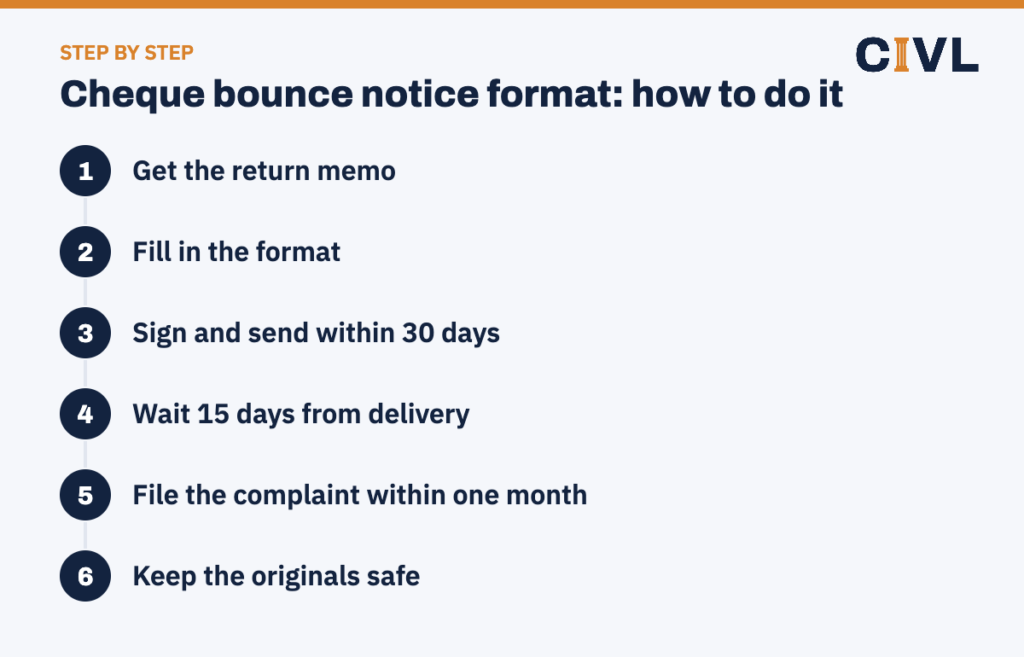
- Get the return memo. Collect the original cheque and the bank’s return memo. Note the date you received the memo; your 30 days start from then.
- Fill in the format. Enter the cheque details exactly as on the cheque and the reason exactly as on the memo.
- Sign and send within 30 days. Send by Speed Post with tracking and proof of delivery to every address you have for the drawer. An email copy helps but keep the postal proof.
- Wait 15 days from delivery. Note the date the notice was delivered (from tracking). The drawer has 15 days from that date to pay.
- File the complaint within one month. If unpaid, file the complaint before the Magistrate within one month after the 15 days end. The complaint is filed where your bank branch (where you deposited the cheque) is located.
- Keep the originals safe. You will need the original cheque, return memo, notice, postal receipts and tracking report in court.
Common mistakes to avoid
- Missing the 30-day deadline. Count from the day you got the bank’s return memo, not the cheque date.
- Demanding a lumped-up amount. Courts have held that the notice must clearly demand the cheque amount. Add interest or costs only as separate items.
- Filing too early. A complaint filed before the 15-day payment period ends is premature.
- Leaving out the company or signatory. For a company cheque, send the notice to the company and the signatory, and to directors in charge of the business if you plan to name them.
- Presenting the cheque after three months. A cheque presented after its validity cannot support a Section 138 case.
- Losing the originals. Never hand over the original cheque or memo; send copies with the notice.
CIVL format
Get the ready-to-use cheque bounce notice format
- Editable Word file and a print-ready PDF
- Notes on how to fill every blank
- Versions for an individual, a firm and a company drawer
- Date calculator sheet for the 30-day, 15-day and one-month deadlines
- Delivered to your email after payment
Price: ₹49 · Coming soon
Frequently asked questions
What is the time limit to send a cheque bounce notice?
Within 30 days of receiving the bank’s information that the cheque was returned unpaid (Section 138, proviso (b)).
How long does the drawer get to pay?
15 days from the day they receive your notice. If the notice is returned “refused” or “unclaimed” at the correct address, courts generally treat it as served.
When must I file the cheque bounce case?
Within one month after the 15-day payment period ends (Section 142(1)(b)). A court can accept a late complaint only if you show sufficient cause for the delay.
What is the punishment for cheque bounce?
Imprisonment up to two years, or a fine up to twice the cheque amount, or both. The court can also order interim compensation of up to 20% of the cheque amount during the case (Section 143A).
Can I send the notice myself?
Yes. The payee can sign and send the notice. What matters is that it reaches the drawer within time and demands the cheque amount.
Where can I get a ready-to-use cheque bounce notice format?
CIVL’s cheque bounce notice format comes as an editable Word file and a print-ready PDF, with notes on filling every blank and checking your state’s rules. Use the button above to be told when it is available.