
MSME delayed payment rules give micro and small suppliers a strong, fast route to recover dues from buyers who pay late. The buyer must pay within 45 days at most, owes compound interest after that, and since 15 October 2025 every new complaint is filed on the MSME ODR portal instead of MSME Samadhaan.
Quick answer
Under the MSMED Act, 2006, a buyer must pay a micro or small supplier on the agreed date, and never later than 45 days from accepting the goods or services (s.15). After that, the buyer owes compound interest with monthly rests at three times the RBI bank rate (s.16), which is 17.25% a year at the current bank rate of 5.75%.
The supplier must have a Udyam registration. New complaints go to the MSME ODR portal (odr.msme.gov.in), which offers online negotiation first and then sends the case to the state’s Micro and Small Enterprises Facilitation Council (MSEFC) for conciliation and arbitration, which should be decided within 90 days (s.18).
What counts as an MSME delayed payment?
An MSME delayed payment arises under the MSMED Act when a buyer of goods or services from a micro or small enterprise does not pay by the “appointed day”:
- the date agreed in writing, which cannot be more than 45 days after acceptance; or
- if there is no written agreement, within 15 days of acceptance or deemed acceptance.
The buyer can be a company, a government department, a public sector undertaking or a private business. Any contract term allowing more than 45 days does not override the Act for MSME delayed payment purposes.
Who can file an MSME delayed payment complaint?
- A micro or small enterprise with a valid Udyam registration. Medium enterprises cannot use the MSEFC route.
- The supplier must have been registered before the supply or contract. The Supreme Court held in Vaishno Associates v. Gujarat Urja Vikas Nigam (2023) that a supplier cannot claim the Act’s benefits for supplies made before registration.
- Manufacturers and service providers can claim. Udyam registration of pure traders gives them priority-sector lending benefits, but they should not rely on the delayed-payment remedy.
- The dispute must be about payment for goods or services supplied. Other commercial disputes go to the regular courts.
Not registered yet? See our free guide to Udyam registration. Registration is free and takes minutes, but it helps only for future supplies.
Interest on MSME delayed payment
Interest on an MSME delayed payment is compound, with monthly rests, at three times the bank rate notified by the RBI (s.16). It runs from the appointed day, regardless of any lower rate in the contract.
| RBI bank rate | MSMED interest rate | Interest on ₹1,00,000 overdue for one year (monthly compounding) |
|---|---|---|
| 5.75% (from 7 October 2026) | 17.25% a year | about ₹18,681 |
Use our free interest calculator, choose “MSME supplier”, and it fills in the current rate and compounds it monthly. The buyer also cannot deduct this interest as a business expense for income tax (s.23), which is another reason buyers prefer to pay on time.
The MSME ODR portal (replacing Samadhaan)
- The Ministry of MSME launched the MSME ODR portal in June 2025. From 15 October 2025, all new delayed payment references must be filed there (Ministry letter of 3 October 2025).
- MSME Samadhaan (samadhaan.msme.gov.in) still shows older cases, but it no longer takes new filings and redirects users to the ODR portal.
- The portal handles the whole case online: filing, notice to the buyer, negotiation, MSEFC conciliation, arbitration hearings and the award.
- The first stage is optional online negotiation between the parties. If that fails, the case goes to the MSEFC of the state where the supplier is located.
Documents needed
- Udyam registration certificate (showing the registration date), the first thing checked in any MSME delayed payment case.
- Purchase orders, work orders or the contract.
- Invoices with dates and amounts, and GST details.
- Delivery challans, e-way bills, acceptance or completion certificates.
- Emails, letters or WhatsApp messages chasing payment, and any reply admitting the dues.
- A statement of account showing what is outstanding and any part payments.
MSME delayed payment complaint: step by step
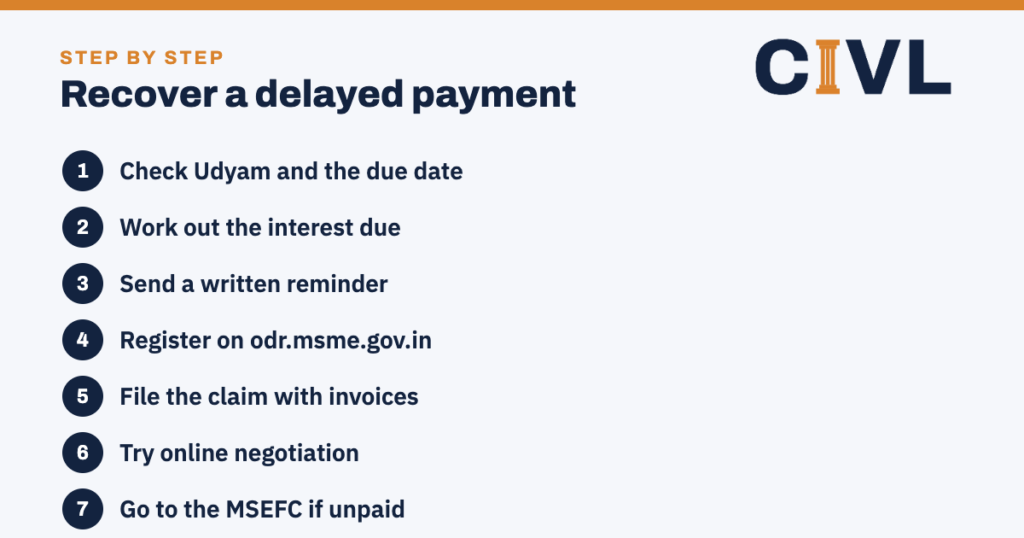
- Check your Udyam date and the due date. Make sure the registration came before the supply, and work out when 45 days from acceptance ended.
- Work out the interest. Use the interest calculator to get principal plus interest to date.
- Send a written reminder. A clear demand, or a formal money recovery notice, often gets payment without a case and is useful evidence.
- Register on the ODR portal. Log in at odr.msme.gov.in with your Udyam number and verify your details.
- File the claim. Start a new MSME delayed payment dispute, enter the buyer’s details, invoices and amount due, upload documents and e-sign. Note the case number.
- Try online negotiation. The buyer is invited to settle. A settlement reached here is recorded.
- Go to the MSEFC. If the buyer does not settle, the Council holds conciliation and then arbitration, and passes an award that is enforceable like a court decree.
What happens after the MSEFC award?
- An MSEFC award on an MSME delayed payment can be enforced like a civil court decree if the buyer does not pay.
- To challenge the award in court, the buyer must first deposit 75% of the awarded amount (s.19). This makes delaying tactics expensive.
- The MSEFC route overrides any private arbitration clause in the contract (Supreme Court, Gujarat State Civil Supplies Corporation v. Mahakali Foods, 2022).
- The Limitation Act applies to MSEFC arbitration (Silpi Industries v. KSRTC, 2021), so file within three years from the due date, counting any written acknowledgement or part payment that restarts the clock. Check the deadline with our limitation period calculator.
How the law makes buyers pay on time
- Income tax: since 2024, a business buyer can deduct a payment owed to a micro or small supplier in a year only if it is actually paid within the 45-day limit (old s.43B(h), carried into the Income-tax Act, 2025). Late payments are allowed only in the year they are paid.
- Interest is not deductible: MSMED interest paid by the buyer is never allowed as an expense (s.23).
- Disclosure: companies must report dues to micro and small suppliers outstanding for more than 45 days to the Registrar of Companies in the half-yearly MSME Form I, and disclose unpaid dues and interest in their annual accounts (MSMED s.22).
- TReDS: larger companies and PSUs are expected to be on TReDS platforms, where suppliers can sell their invoices to banks for early payment.
Tips before you file
- Write “This supplier is a micro/small enterprise, Udyam No. ___. Payment is due within 45 days under the MSMED Act” on quotations and invoices.
- Send a dated statement of account every month and keep the buyer’s replies.
- Claim the principal and interest separately in your claim so the Council can see each part.
- If the buyer is a government department, also escalate within the department; many have MSME payment cells.
Which state’s MSEFC hears an MSME delayed payment case?
An MSME delayed payment case goes to the Micro and Small Enterprises Facilitation Council of the state where the supplier is located, not where the buyer is (MSMED Act, s.18(4)). A small manufacturer in Kanpur supplying a company in Pune files before the Uttar Pradesh council, and the Pune buyer has to answer there.
- If the supplier has units in more than one state, use the location shown in the Udyam certificate for the unit that made the supply.
- The ODR portal routes the case to the right council automatically once the supplier’s Udyam details are verified.
- A clause in the contract choosing another city’s courts or a private arbitrator does not take the case away from the supplier’s MSEFC.
How long an MSME delayed payment case takes
The Act expects the council to decide a reference within 90 days (s.18(5)). In practice many councils take longer, but the stages are fixed:
| Stage | What happens | Usual time |
|---|---|---|
| Filing on the ODR portal | Claim, invoices and documents uploaded; buyer notified | Same day |
| Online negotiation (optional) | Buyer and supplier try to settle on the portal | About 2–4 weeks |
| Conciliation by the MSEFC | The council or a conciliator it appoints helps the parties agree (Arbitration and Conciliation Act, ss.65–81) | A few weeks to a few months |
| Arbitration | If conciliation fails, the council (or an institution it refers the case to) hears both sides and passes an award | Expected within 90 days of the reference; often longer |
| Challenge by the buyer | Buyer must deposit 75% of the award first (s.19) | Court timelines |
| Execution | Supplier files for execution in the civil court if the buyer does not pay | Court timelines |
A settlement reached in conciliation is recorded as a settlement agreement and has the same force as an arbitral award, so it can be enforced directly if the buyer later backs out.
Buyer defences in an MSME delayed payment case
| What the buyer says | How to answer |
|---|---|
| “The goods were defective.” | Show that no written objection was raised within 15 days of delivery. Under s.2(b), goods are treated as accepted if the buyer does not object in that time. |
| “You registered on Udyam after the contract.” | Check the date. If registration came after the supply, the Act will not apply to that supply (Vaishno Associates, 2023); claim in a civil court instead. |
| “Our contract gives 90 days to pay.” | Any agreed period longer than 45 days from acceptance is not valid for MSME delayed payment interest (s.15). |
| “We have a counter-claim.” | The buyer can raise a counter-claim or set-off before the MSEFC (Silpi Industries, 2021). Keep records ready to answer it. |
| “The claim is time-barred.” | Count three years from the due date, plus any fresh period started by a written acknowledgement or part payment (Limitation Act, ss.18 and 19). |
Answer every objection in writing, with dates, as soon as it is raised. A dated paper trail is usually what wins an MSME delayed payment case.
Worked example: an MSME delayed payment claim
Sharma Packaging, a micro enterprise in Kanpur registered on Udyam in 2023, supplies cartons to a food company. Invoice of ₹4,00,000 dated 1 March; goods accepted on 3 March; the purchase order says payment in 60 days.
- Due date: the 60-day term is longer than the law allows, so the appointed day is 45 days from acceptance, which is 17 April.
- Interest: from 17 April, interest runs at 17.25% a year, compounded monthly. If the buyer still has not paid a year later, the interest is about ₹74,700, so the claim is roughly ₹4,74,700.
- Notice: Sharma Packaging sends a money recovery notice with the interest worked out and a 15-day deadline. The buyer replies that it is “processing” the bill, which also counts as a written acknowledgement.
- Filing: with no payment, the supplier files the MSME delayed payment claim on the ODR portal, attaching the PO, invoice, delivery challan, e-way bill, Udyam certificate and the buyer’s reply.
- Result: faced with the 75% deposit rule and the loss of its tax deduction, the buyer settles at conciliation by paying the principal and most of the interest.
For your own MSME delayed payment, use the interest calculator with your own dates and amounts; the figures above are only an illustration.
MSEFC or a court case: which route is better?
| Route | When it suits | Points to note |
|---|---|---|
| MSEFC via the ODR portal | Micro or small supplier registered before the supply | Interest at 3 × bank rate, compounded monthly; 75% pre-deposit to challenge; small or no fee |
| Commercial court summary suit (CPC Order XXXVII) | Medium enterprises, unregistered suppliers, or claims based on a written contract or invoice | Pre-institution mediation is needed first for commercial suits of ₹3 lakh or more (Commercial Courts Act, s.12A); court fee payable |
| Cheque bounce complaint (NI Act s.138) | The buyer gave a cheque that bounced | Criminal case; strict 30-day notice and 30-day filing deadlines; can run alongside the MSEFC claim |
| Insolvency (IBC s.9) | Large undisputed debts of ₹1 crore or more owed by a company | Not a recovery tool for small sums; a genuine pre-existing dispute defeats it |
For most micro and small suppliers, the MSME delayed payment route is faster and cheaper than a civil suit and carries a much higher interest rate.
Tax on MSME delayed payment interest
- Interest received under the MSMED Act is taxable income of the supplier in the year it is received or accrues, depending on the accounting method.
- The buyer cannot deduct that interest as a business expense (s.23), and cannot deduct the principal either in a year it was paid late (old s.43B(h)).
- If GST was charged on the original invoice, discuss with your accountant whether the interest also attracts GST, since interest for delayed payment can be treated as part of the value of supply.
Common mistakes to avoid
- Registering on Udyam only after the dispute arises and expecting the Act to cover old supplies.
- Waiting years before filing. Limitation still applies to MSME delayed payment claims.
- Claiming interest at the contract rate instead of three times the bank rate, or as simple interest.
- Filing on Samadhaan, which no longer accepts new cases.
- Not keeping proof that the buyer accepted the goods or services.
- Ignoring the buyer’s objections about quality. Raise and answer them in writing early.
Frequently asked questions
What is the time limit for paying an MSME supplier?
The agreed date, but never more than 45 days from acceptance of the goods or services. Without a written agreement, 15 days.
What interest can I claim for MSME delayed payment?
Compound interest with monthly rests at three times the RBI bank rate. At the bank rate of 5.75%, that is 17.25% a year.
Is MSME Samadhaan still working?
Not for new cases. Since 15 October 2025, new MSME delayed payment complaints are filed on the MSME ODR portal, odr.msme.gov.in.
Can a medium enterprise file a complaint?
No. The MSEFC delayed-payment remedy is for micro and small enterprises only.
Is there a fee to file on the ODR portal?
There is generally no filing fee for the supplier. The Ministry’s ODR scheme also offers limited financial help towards online dispute resolution costs; check the portal for current terms.
How long does the MSEFC take?
The Act says the reference should be decided within 90 days. In practice it can take longer in busy states.
Can I file for MSME delayed payment against a government department?
Yes. Central and state government departments and public sector undertakings are buyers under the Act and can be taken to the MSEFC.
Do I need a lawyer for the MSEFC?
No. Suppliers often file and argue their own case on the ODR portal. Take professional help for large or complicated claims.
Which state’s council hears an MSME delayed payment case?
The Micro and Small Enterprises Facilitation Council of the state where the supplier is located (s.18(4)). The buyer has to appear there even if it is based in another state, and a clause in the contract choosing other courts does not change this.
Can the buyer raise a counter-claim before the MSEFC?
Yes. The Supreme Court held in Silpi Industries v. KSRTC (2021) that a buyer can raise a counter-claim or set-off in MSEFC arbitration. Keep proof of delivery, acceptance and quality ready to answer it.
Is MSME delayed payment interest taxable for the supplier?
Yes. Interest recovered under the MSMED Act is the supplier’s income and is taxed like other business income. GST may also apply to interest charged for late payment, so check with your accountant before issuing an interest invoice.
Can I go to court instead of the MSEFC?
Yes. A micro or small supplier can choose a civil or commercial court, and suppliers who are not covered by the Act must use the courts. The MSEFC route is usually faster and cheaper, and the 75% deposit rule makes it harder for the buyer to delay.
Where can I get a ready-to-use money recovery notice?
Use the CIVL money recovery notice to demand payment, with interest, before or alongside an MSME delayed payment complaint.
CIVL format
Recover what you are owed
Send a money recovery notice or a general legal notice, read how to send a legal notice, and work out dues with the free interest calculator. Or ask CIVL a question.