

Tenant eviction in India has to go through the law, not the locksmith. A landlord can recover possession only by ending the tenancy properly and, if the tenant does not leave, getting an order from a court, rent controller or rent authority. Cutting off water, changing locks or throwing out belongings can backfire badly.

Quick answer
First check which law governs the tenancy: the Transfer of Property Act, 1882, or your state’s rent control or tenancy Act. For a month-to-month tenancy under the TPA, end it with a written notice of 15 days (s.106). Under rent control laws, you must also prove a ground such as arrears, sub-letting, misuse or the landlord’s bona fide need.
If the tenant stays on, file an eviction case before the civil court, rent controller or rent authority, and then execute the order. A landlord has 12 years from the end of the tenancy to sue for possession (Limitation Act, Art. 67).
Which law governs tenant eviction?
| Situation | Law | Key point |
|---|---|---|
| Premises not covered by rent control (most new or high-rent tenancies) | Transfer of Property Act, 1882 | End the lease by notice (s.106) or on expiry (s.111); then sue for possession |
| Old or low-rent tenancies in cities with rent control | State rent control Act (e.g. Delhi Rent Control Act, 1958; Maharashtra Rent Control Act, 1999) | Eviction only on grounds listed in the Act |
| States that adopted Model Tenancy Act-style laws | State tenancy Act (e.g. Andhra Pradesh, Tamil Nadu) | Written agreement, rent authority and rent court, set grounds |
The Delhi Rent Control Act applies only to premises let at ₹3,500 a month or less, so most present-day Delhi tenancies fall under the TPA. Check your state’s Act before you act.
Common grounds for tenant eviction
- Non-payment of rent, often two months’ arrears not paid within a month of notice
- Sub-letting or parting with possession without consent
- Misuse of the premises or use for a different purpose
- Substantial damage or unauthorised structural changes
- The landlord’s bona fide need for own use or for family members
- Premises needed for repairs or rebuilding that cannot be done while occupied
- Tenancy period over and the tenant holding over without consent
Recent court rulings on tenant eviction
- Landlord decides the need: the Supreme Court held in February 2025 that a landlord is the best judge of their requirement, and a tenant cannot insist that some other property be used instead (Kanahaiya Lal Arya v. Md. Ehshan).
- Tenant cannot deny title: in September 2025 the Court held that a tenant who has paid rent cannot dispute the landlord’s title, and in an eviction suit the landlord only has to show a better claim than the tenant (Jyoti Sharma v. Vishnu Goyal, 2025 INSC 1099).
- Uttar Pradesh: in August 2026 the Allahabad High Court struck down key provisions of the UP Regulation of Urban Premises Tenancy Act, 2021, including eviction by order of the Rent Authority, and held that older law revives to the extent needed. Until the position settles, check the correct forum for UP evictions before filing.
Tenant eviction: step by step
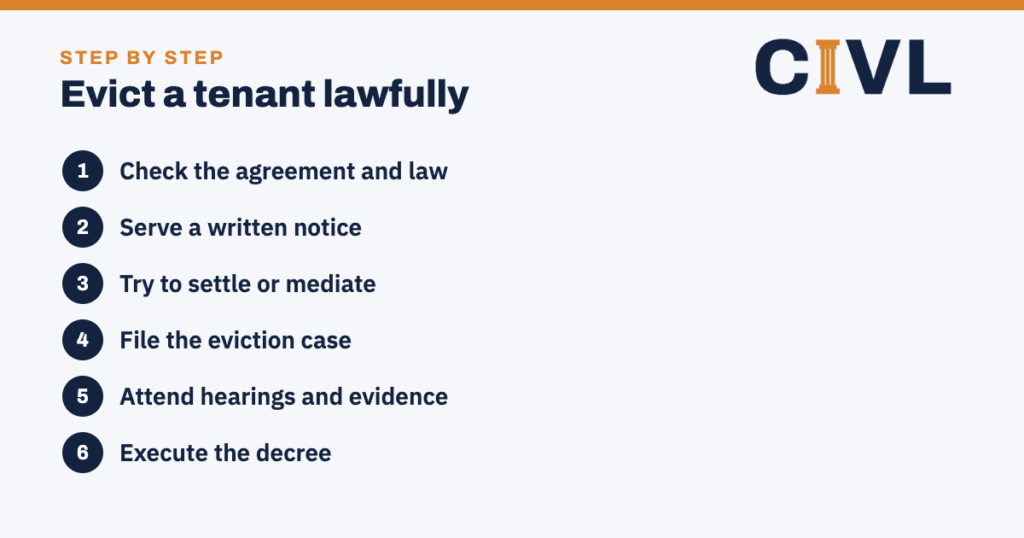
- Check the rent agreement and the law. Note the term, lock-in, notice clause and whether rent control applies.
- Serve a written notice ending the tenancy and stating the ground, by Speed Post with proof of delivery and, if possible, by hand and email. Under TPA s.106, 15 days for a monthly tenancy, unless the contract says otherwise.
- Try to settle. Many cases end with a dated vacating agreement. Pre-litigation mediation or a Lok Adalat can help.
- File the eviction case in the right forum: civil court (TPA), rent controller (rent Acts) or rent authority/court (MTA-type Acts). Claim arrears and mesne profits (compensation for use after the tenancy ended).
- Attend hearings. In Delhi, bona fide need cases follow a summary procedure: the tenant must seek leave to defend within 15 days.
- Execute the decree. If the tenant still does not leave, apply for execution; the court bailiff delivers possession, with police help if needed.
Tenant eviction under the Model Tenancy Act, 2021
The Model Tenancy Act is a template for states, not a law that applies everywhere. Where a state has adopted it, tenancies must be in writing and reported to the Rent Authority within two months. A tenant who stays after the tenancy ends must pay twice the monthly rent for two months and four times after that (s.23). Rent courts aim to decide cases within 60 days, with an appeal to the Rent Tribunal.
What a landlord must not do during tenant eviction
- Cut off water, electricity, lights or sanitation to force the tenant out. Delhi’s Act (s.45), the MTA (s.20) and many other laws forbid this, and the controller can order immediate restoration.
- Change the locks, remove belongings or use force. This can lead to police complaints and civil claims.
- Accept rent after the notice period without reserving your rights; it can be treated as consent to continue the tenancy (TPA s.116).
Tenant eviction: rights the tenant has
- A tenant can be removed only through due process of law.
- The tenant can deposit rent in court or with the rent authority if the landlord refuses to accept it, where the law allows.
- The security deposit must be returned on handing back possession, less lawful dues. See our security deposit guide.
Tenant eviction notice: what to include
- Names and addresses of landlord and tenant, and the property
- Date and terms of the rent agreement
- Clear statement that the tenancy is terminated, and the date by which the tenant must vacate
- The ground (arrears, sub-letting, bona fide need, expiry) where the law requires one
- Arrears due, and a demand for payment
- Notice that you will claim damages for use and occupation after the date
- Signature and date; keep proof of delivery
Tenant eviction for non-payment of rent
Arrears of rent are the most common ground for tenant eviction. Send a demand for the arrears first. Under many rent laws and the MTA, eviction on this ground is allowed if the tenant does not pay two months’ arrears within a month of notice. In court, the tenant may be ordered to deposit the arrears and keep paying rent while the case goes on, failing which the defence can be struck off.
Tenant eviction for the landlord’s own use
Rent laws allow eviction where the landlord needs the premises for their own residence or business, or for family members. The need must be genuine, not a mere wish. As the Supreme Court said in 2025, the landlord decides which property suits them; the tenant cannot dictate alternatives.
Evicting a tenant without a written agreement
If there is no written agreement, a monthly tenancy is presumed for residential premises, and 15 days’ notice under s.106 usually applies. Rent receipts, bank transfers and utility bills help prove the tenancy and the rent amount. You can generate receipts with our rent receipt generator.
How long a tenant eviction case takes
Tenant eviction timelines vary widely by state and court, but the stages are the same. The table shows what to plan for.
| Stage | Usual time | What speeds it up |
|---|---|---|
| Notice ending the tenancy | 15 days for a monthly TPA tenancy, or as the agreement or state law says | Clear notice, sent by Speed Post and email |
| Settlement talks or mediation | A few weeks | A dated vacating agreement signed by both sides |
| Summary or special procedures | A few months (e.g. Delhi s.25B bona fide need cases; MTA-type rent courts aim for 60 days) | Using the special forum where the law provides one |
| Regular civil suit for possession | Often one to several years | Complete documents, no adjournments, an interim order for deposit of rent |
| Execution of the decree | A few weeks to months | Applying for execution promptly with police assistance if needed |
A well-documented tenant eviction case with a registered agreement, a clear notice and a regular rent record moves much faster than one built on oral promises.
Mesne profits in a tenant eviction case
Once the tenancy ends, the tenant who stays on is in unauthorised occupation. The landlord can claim mesne profits, meaning compensation for use and occupation, usually at the current market rent rather than the old agreed rent.
- Claim mesne profits in the same eviction suit, from the date the tenancy ended until possession is handed over. The court can order an enquiry into the amount (CPC, Order XX Rule 12).
- Ask the court to direct the tenant to deposit the admitted rent or occupation charges while the case is pending.
- Under Model Tenancy Act-type laws, a tenant who holds over must pay twice the monthly rent for two months and four times after that.
- In Maharashtra, a licensee under a leave and licence agreement who does not leave on expiry is liable to pay damages at double the licence fee (Maharashtra Rent Control Act, s.24).
- Keep evidence of market rent, such as recent agreements for similar flats in the building or a broker’s letter.
Tenant eviction from commercial premises
Tenant eviction from shops, offices and warehouses follows the same basic rules, with a few differences:
- Disputes about immovable property used only for trade or commerce are “commercial disputes” (Commercial Courts Act, 2015, s.2(1)(c)(vii)). Claims of ₹3 lakh or more go to the commercial court.
- Unless urgent interim relief is sought, the landlord must first try pre-institution mediation (s.12A) before filing a commercial suit.
- A lease of more than one year must be registered. An unregistered long lease may be treated as a month-to-month tenancy, so check the notice period carefully.
- For a lease for manufacturing purposes, TPA s.106 treats the lease as year to year, ended by six months’ notice, unless the contract says otherwise.
Tenant eviction when the tenant has abandoned the premises
Sometimes a tenant stops paying, stops answering calls and seems to have left, but furniture is still inside. Breaking in is risky even then, because the tenant may return and file a complaint. A safer route:
- Send a written notice to the tenant’s last known address, email and phone, asking them to confirm whether they have vacated and to remove their belongings by a set date.
- Check with neighbours, the society office and utility bills for signs of occupation, and keep notes.
- If there is no reply, file a suit for possession (or the special forum’s application) and ask the court to appoint a local commissioner to open the premises and make an inventory.
- Store the belongings listed in the inventory and give the tenant a final notice to collect them.
A court-supervised tenant eviction takes a little longer but protects the landlord from charges of trespass or theft.
Worked example: tenant eviction from a leave and licence flat in Mumbai
Mr Desai let his Andheri flat on an 11-month registered leave and licence agreement at ₹45,000 a month. The agreement expired on 31 March, but the licensee did not leave and stopped paying.
- On 2 April, Mr Desai sends a notice by Speed Post and email recording that the licence has expired, demanding possession within 15 days and claiming double the licence fee from 1 April.
- He does not accept any payment described as “rent” after expiry, to avoid an argument that a new tenancy began.
- On 20 April, he applies to the Competent Authority under the Maharashtra Rent Control Act, which has a summary procedure for leave and licence cases, attaching the registered agreement and proof of notice.
- The Competent Authority orders the licensee to vacate. The licensee hands over the keys and the security deposit is adjusted against the arrears and damages.
A registered agreement made this tenant eviction quick. Without one, the landlord would have had to prove the tenancy terms in a regular court first.
How to avoid tenant eviction problems in the first place
- Use a written rent agreement, registered where the law requires it, with clear notice and lock-in clauses.
- Complete tenant police verification where your city requires it.
- Take rent only by bank transfer or UPI, and issue receipts.
- Record the condition of the property with dated photos and an inventory signed by the tenant.
- Keep the tenant’s permanent address, ID and an emergency contact on file.
- Act on the first missed payment with a polite written reminder, not after six months of arrears.
Common mistakes to avoid
- No written rent agreement, or an unregistered agreement for more than 11 months. Read our rent agreement registration guide.
- A notice that does not clearly end the tenancy or that is sent to the wrong address.
- Filing in the wrong forum, especially in Uttar Pradesh after the 2026 ruling.
- Accepting rent after the notice expires.
- Self-help tenant eviction that turns a strong case into a criminal complaint.
Frequently asked questions
How much notice is needed for tenant eviction?
For a month-to-month tenancy under the TPA, 15 days (s.106), unless the agreement provides otherwise. Rent control Acts may have their own notice rules.
Can I evict a tenant without going to court?
Only if the tenant leaves voluntarily. Otherwise you need an order from the court, rent controller or rent authority.
How long does a tenant eviction case take?
It varies widely: a few months in summary or rent-authority procedures, and years in contested civil suits.
Can I claim rent for the period the tenant stays after notice?
Yes, as mesne profits or damages for use and occupation, and under MTA-type laws at twice or four times the rent.
Can a tenant refuse to leave if the agreement has expired?
A tenant holding over without consent is not protected. The landlord can sue for possession and compensation.
Is a police complaint enough to remove a tenant?
No. Police do not decide tenancy disputes; they help only to enforce a court order or prevent violence.
What if the tenant sub-let the flat?
Unauthorised sub-letting is a ground for eviction under most rent laws and the MTA.
Can a tenant eviction be done during a lock-in period?
Usually not, unless the tenant breaches the agreement (for example, by not paying rent). Read the lock-in and termination clauses carefully.
Can I evict a tenant to sell the property?
Under a TPA tenancy, you can end it by notice. Under rent control Acts, sale alone is often not a ground; the buyer may take the property subject to the tenancy.
Is tenant eviction from a shop handled differently?
Partly. If the premises are used only for trade or commerce and the claim is ₹3 lakh or more, the suit goes to the commercial court, and pre-institution mediation is required first unless urgent relief is sought. The grounds and notice rules otherwise follow the TPA or the state rent law.
Can I claim double rent from a tenant who refuses to leave?
Only where the law provides it. Model Tenancy Act-type laws allow twice and then four times the monthly rent, and Maharashtra allows double the licence fee for a licensee who overstays. Elsewhere, claim mesne profits at the market rate in the eviction suit.
What if the tenant has left but their belongings are still inside?
Do not break in. Send written notices, gather proof that the flat is unoccupied, and then file for possession and ask the court to appoint a local commissioner to open the premises and prepare an inventory. This protects you from complaints of trespass or theft.
Where can I get a ready-to-use notice format?
Use the CIVL legal notice format for a notice to vacate, and the rent agreement format for your next tenancy.
CIVL format
Notices and agreements for landlords
Start with the legal notice format. For unpaid rent, use the money recovery notice. For your next tenant, use the rent agreement format. Check deadlines with our limitation period calculator, or Ask CIVL.