
If your security deposit is not returned after you move out, you do not have to accept it. A security deposit not returned on time is one of the most common tenant complaints in India, and the law is on your side. This guide explains what a landlord can and cannot deduct, how to protect your deposit before you leave, how to send a legal notice, and where to file a case if your security deposit is not returned even after that.
Quick answer
A landlord can keep only what the rent agreement allows, usually unpaid rent, unpaid bills and the cost of damage beyond normal wear and tear, and must return the rest when you hand back the property. Found your security deposit not returned? Ask for it in writing, then send a legal notice giving 15 days. If that fails, file a civil suit for recovery within three years (a faster summary suit is often possible on a written agreement), or apply to the Rent Authority where your state has one. This is a civil dispute, so the police usually will not step in.
Free tool: make HRA rent receipts in a minute with the rent receipt generator.
Related guide: Tenant eviction in India: the legal process for landlords
What the law says about your security deposit
There is no single central law on rent deposits. Your rights come mainly from your rent agreement and the Indian Contract Act, 1872. The landlord holds the deposit only as security. Once the tenancy ends and you hand back possession, the balance after lawful deductions must be refunded. If it is not, that is a breach of contract, and you can claim the amount with compensation (Contract Act, s.73).
In states that have adopted a tenancy law based on the Model Tenancy Act, 2021, the deposit is capped at two months’ rent for homes and six months’ rent for other premises. It must be refunded when the landlord takes back vacant possession, after deducting any amount the tenant owes (section 11 of the model law). These states also have a Rent Authority to hear disputes.
What a landlord can and cannot deduct
| Usually allowed | Usually not allowed |
|---|---|
| Unpaid rent up to the date you leave | Normal wear and tear, such as faded paint or worn hinges |
| Unpaid electricity, water, gas and maintenance bills | Repairs that are the landlord’s job, such as old wiring or plumbing |
| Damage beyond normal use: broken fittings, cracked tiles, large wall holes | Costs not mentioned in the agreement |
| Rent for a notice period you did not give | “Penalties” you never agreed to |
| Costs the agreement clearly lists, such as painting | Upgrades for the next tenant |
If you find your security deposit not returned in full, ask the landlord for an itemised list of deductions, with bills or photos. A flat deduction with no explanation is hard to defend.
Before you move out: protect your deposit
- Give notice in writing, as the agreement requires, and keep a copy.
- Pay the last month’s rent and all bills, and keep the receipts.
- Take dated photos and a video of every room on the day you hand over.
- Do a joint inspection with the landlord, if possible, and note any issues.
- Get a signed note or message confirming the date you handed back the keys.
- Send your bank details in writing so that the refund can be made.
Security deposit not returned: step by step
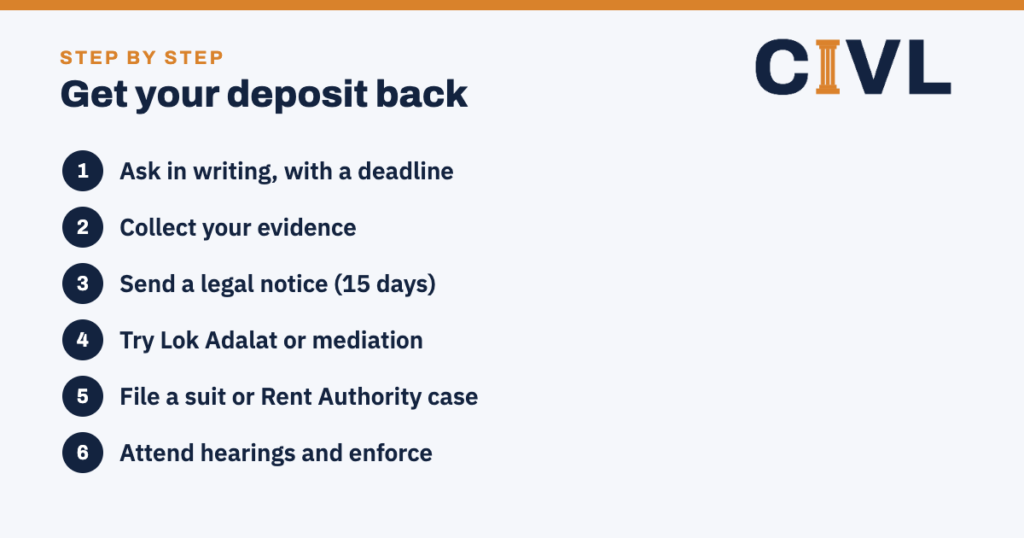
- Ask in writing, with a deadline. Email or message the landlord with the deposit amount, the date you handed back possession, your bank details and a request to pay within 7 days. Calls leave no record.
- Collect your evidence. Keep the rent agreement, the deposit receipt or bank transfer record, rent receipts, handover photos and all messages.
- Send a legal notice. With your security deposit not returned after the written request, send a legal notice by Speed Post with proof of delivery, and by email. State the amount, any interest you claim, and give 15 days to pay. You can send it yourself or through a lawyer.
- Try Lok Adalat or mediation. Your District Legal Services Authority can take up the dispute at a pre-litigation Lok Adalat for free. A settlement there is final and binding.
- File a civil suit or a Rent Authority case. File a suit for recovery of money in the civil court where the property is or where the landlord lives. On a written agreement, a summary suit under Order XXXVII of the Code of Civil Procedure is often available in the courts where it applies. In a Model Tenancy Act state, you can apply to the Rent Authority instead.
- Attend hearings and enforce the order. If the landlord still does not pay after the decree, apply to the court to execute it.
Security deposit not returned after the notice? Your options compared
| Option | Best for | What to expect |
|---|---|---|
| Pre-litigation Lok Adalat | Landlords willing to talk | Free and quick if both sides attend; settlement is final |
| Summary suit (Order XXXVII CPC) | Written agreement and clear proof of payment | Landlord must get court permission to defend, so it is usually faster than an ordinary suit |
| Ordinary civil suit | Disputed deductions or no written agreement | Full trial; can take longer |
| Rent Authority | States with a Model Tenancy Act-based law | Simpler, time-bound procedure |
| Consumer complaint | Co-living, hostel or managed rental businesses | Online filing on e-Jagriti; no fee up to ₹5 lakh |
For most people with a security deposit not returned, a strong legal notice followed by a Lok Adalat or a summary suit gives the best mix of speed and cost. Choose the forum before you file, because you cannot run the same claim in two places at once.
For landlords: how to return a security deposit without a dispute
Most cases of a security deposit not returned start with deductions the tenant never saw coming. Landlords can avoid that:
- Do a joint inspection on the day the tenant leaves, and note meter readings and any damage in writing, signed by both.
- Deduct only unpaid rent, unpaid bills and the cost of damage beyond normal wear and tear, as the agreement allows.
- Give an itemised list of deductions with bills or quotes.
- Refund the balance by bank transfer as soon as possible, ideally on the day you take back possession, so the transfer itself is a record.
Timelines and costs
| Step | Time limit | Cost |
|---|---|---|
| Written request | Give about 7 days | Free |
| Legal notice | Give 15 days to pay | Speed Post charges; lawyer’s fee if you use one |
| Pre-litigation Lok Adalat | Depends on the date given | Free |
| Civil suit for recovery | Generally within 3 years from when the refund was due (Limitation Act, 1963) | Court fee as per your state, based on the amount |
| Rent Authority (where available) | As per state law; the model law aims for 60 days | Small fee, as per state rules |
Can I go to consumer court?
Usually not, if your landlord is a private individual. Renting out your own home is generally not treated as a “service” under the Consumer Protection Act, 2019. The position may be different if you rented from a business that runs co-living, hostel or managed rental accommodation, or if a platform collected the deposit. In that case, see how to file a consumer complaint online, or ask CIVL about your case.
Can I adjust the deposit against the last month’s rent?
Many tenants do, but unless the landlord agrees in writing or the agreement allows it, not paying rent is itself a breach. The landlord may then claim the rent and deduct other costs. If you want to adjust, get the landlord’s consent by email or message first.
Common mistakes to avoid
- Paying the deposit in cash without a receipt. Always pay by bank transfer, and mention the amount in the agreement.
- Leaving without photos or a key handover note. Without them, damage claims are hard to challenge.
- Relying only on phone calls. Keep everything in writing.
- Stopping rent without written agreement. This gives the landlord a counter-claim.
- Waiting too long. A civil claim must generally be filed within three years.
- Making threats or going to the police over a pure money dispute. It rarely helps and can weaken your position.
Frequently asked questions
How long can a landlord keep the security deposit?
The agreement usually sets a time, often 15 to 30 days after you leave. If it is silent, the deposit should be refunded within a reasonable time after you hand back possession. Under the Model Tenancy Act, it is due when the landlord takes back vacant possession.
Can I claim interest on a security deposit not returned on time?
Yes. You can claim interest in your legal notice and in the suit. The court decides the rate and the period (Code of Civil Procedure, s.34).
Can the landlord deduct painting charges?
Only if the agreement says so, or if you caused damage beyond normal use. Routine repainting because of age is normally the landlord’s cost.
My rent agreement was not registered. Can I still recover the deposit?
Yes. An agreement of less than a year does not need registration. In any case, you can prove the payment with bank records, receipts and messages. See our guide to rent agreement registration for future tenancies.
The landlord lives in another city. Where do I file?
You can generally sue where the landlord lives or where the cause of action arose, which usually includes the place where the property is (Code of Civil Procedure, s.20).
Security deposit not returned by a PG or co-living operator: what can I do?
Send a written demand and then a legal notice, as above. Because these operators run a business, a consumer complaint may also be possible. Keep the booking terms, payment records and any app messages.
Can the landlord keep my security deposit for the notice period?
Only if the rent agreement says so. If you left without giving the agreed notice, the landlord can usually deduct rent for the unserved notice period. If you gave proper notice, they cannot keep the deposit for it.
Is a WhatsApp message enough to demand my deposit?
WhatsApp messages and emails are useful evidence and courts accept them. Still, if your security deposit is not returned after a friendly reminder, send a formal written notice by Speed Post with proof of delivery as well.
Where can I get a ready-to-use notice for a security deposit not returned?
Use CIVL’s security deposit refund notice. For other money disputes, see the legal notice format.
CIVL format
Send your deposit refund notice today
Use CIVL’s security deposit refund notice and read how to send a legal notice. Moving into a new place? See rent agreement registration and our rent agreement format. Still stuck? Ask CIVL.