
Sale deed registration is the step that actually makes you the owner of a flat, house or plot you buy. Until the sale deed is stamped and registered at the Sub-Registrar’s office, the property legally still belongs to the seller, however much you have paid.
Quick answer
In India a sale of immovable property worth ₹100 or more can be made only by a registered sale deed (Transfer of Property Act, 1882, s.54; Registration Act, 1908, s.17). An agreement to sell, a power of attorney, a will or an affidavit does not pass ownership.
For sale deed registration you pay stamp duty (set by your state, usually 4–7% of the higher of the price and the circle rate) and a registration fee (often 1%), then sign before the Sub-Registrar with two witnesses within four months of execution. After registration, apply separately for mutation.
What is a sale deed?
A sale deed (also called a conveyance deed) is the document by which the seller transfers ownership of property to the buyer for a price. It records the parties, a full description of the property, the price and how it was paid, the transfer of possession, and the seller’s promise that the title is clear.
Sale deed registration gives the deed legal effect. Under s.47 of the Registration Act, a registered deed operates from the date it was signed, and under s.49 an unregistered sale deed does not affect the property at all. It can at most be used as evidence of a contract.
Agreement to sell vs sale deed
| Point | Agreement to sell | Sale deed |
|---|---|---|
| What it does | A promise to sell in future on agreed terms | Actually transfers ownership |
| Creates ownership? | No (TPA s.54) | Yes, once registered |
| Registration | Not always compulsory today (rules vary by state) | Compulsory |
| Stamp duty | Lower duty in most states | Full conveyance duty |
| If the other side backs out | Sue for specific performance or refund | Ownership has already passed |
The Supreme Court has repeatedly said that “GPA sales” do not transfer title (Suraj Lamp & Industries v. State of Haryana, 2011). In September 2025 it again held that an agreement to sell, a GPA, an affidavit or a receipt does not make the buyer the owner, and that s.53A (part performance) only protects a buyer already in possession; it is a shield, not a basis to claim title (Ramesh Chand v. Suresh Chand, 2025 INSC 1059).
Before sale deed registration: checks to make
- Title chain: trace earlier sale deeds, gift deeds or inheritance for at least 13–30 years.
- Encumbrance certificate: shows registered mortgages and transfers. See our encumbrance certificate guide.
- Land records and mutation: the seller’s name should appear in the revenue or municipal records. Read how property mutation works.
- Dues: property tax, electricity, water and society dues should be cleared up to the date of sale.
- Approvals: building plan approval, completion or occupancy certificate and, for new projects, RERA registration (see our RERA complaint guide).
- Who signs: if the seller acts through an agent, check that the power of attorney is valid and registered where required. Our power of attorney registration guide explains this.
Documents needed for sale deed registration
- The draft sale deed on e-stamp paper (or with stamp duty paid online), signed by both parties
- Previous title deed of the seller and the chain documents
- Encumbrance certificate and latest property tax receipt
- Identity proof and PAN of the buyer and the seller (Aadhaar is commonly used for e-KYC)
- Passport-size photos of the parties and two witnesses, with the witnesses’ ID
- Proof of stamp duty and registration fee payment
- Power of attorney, if anyone signs on behalf of a party
- No-objection certificate from the society or development authority where required
- Form 60 if a party has no PAN (for high-value transactions)
Sale deed registration: step by step
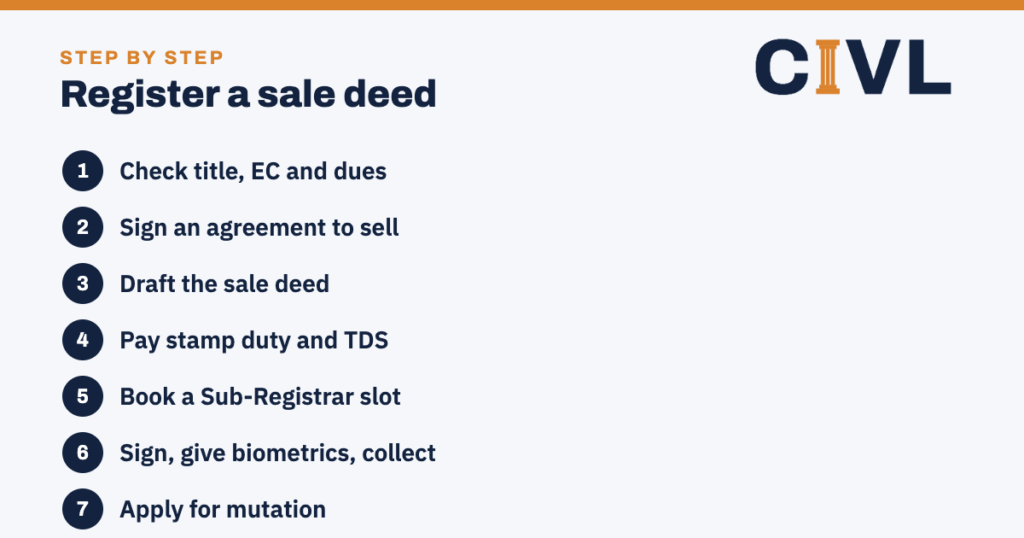
- Check the title. Complete the checks above, ideally with a property lawyer for high-value deals.
- Sign an agreement to sell (optional but common). It fixes the price, advance, timeline and who pays which costs.
- Draft the sale deed. Include full property details (survey or khasra number, boundaries, area), price, payment details, possession and indemnity clauses.
- Pay stamp duty and fees online. Most states use e-stamping or a state portal (GRAS in Maharashtra, NGDRS in many states). Deduct and deposit TDS if the price is ₹50 lakh or more.
- Book an appointment. Many states let you upload the draft and book a slot with the Sub-Registrar online.
- Appear before the Sub-Registrar. Buyer, seller and two witnesses attend with originals. Photos and fingerprints are taken (s.32A), the officer confirms execution and identity (s.34), and the deed is registered.
- Collect the registered deed and apply for mutation. Keep the original safe and apply to update the land or municipal records in your name.
Present the deed for sale deed registration within four months of signing (Registration Act s.23). The Registrar can accept it in the next four months on payment of a fine of up to ten times the fee (s.25).
Stamp duty and fees for sale deed registration
Stamp duty is a state subject, so the cost of sale deed registration varies across India. It is charged on the higher of the sale price and the government circle rate. The figures below are commonly published rates; always confirm on your state’s registration portal before paying.
| State | Stamp duty (typical) | Registration fee |
|---|---|---|
| Uttar Pradesh | 7% (men), 6% (women), 6.5% (joint man and woman) | 1% |
| Delhi | 6% (men), 4% (women), 5% (joint) | 1% plus a small pasting fee |
| Maharashtra (Mumbai) | About 6% including metro cess; women get a 1% concession | 1%, capped at ₹30,000 |
Several states give concessions to women buyers, and some charge extra cess or surcharge in cities. A deed that is under-stamped can be impounded and charged with a penalty, so do not under-declare the price.
TDS on property purchase
If you buy property (other than agricultural land) for ₹50 lakh or more, you must deduct TDS at 1% from the price and deposit it with the government. For payments from 1 April 2026, under the Income-tax Act, 2025, this is reported in Form 141, which replaced Form 26QB. The rate is higher if the seller has no valid PAN. The buyer, not the seller, is responsible for this, so keep the challan ready for sale deed registration and give the seller the TDS certificate.
What changes after sale deed registration?
- You become the owner from the date the deed was signed (s.47).
- Mutation is separate. Registration transfers title; mutation only updates revenue records for tax purposes. The Supreme Court said in 2025 that registration relates to the document, not the title, and that a Sub-Registrar cannot refuse registration because mutation is pending (Samiullah v. State of Bihar, 2025 INSC 1292).
- Transfer the utilities and society membership into your name.
- Keep the original deed safe. After sale deed registration, banks hold it if you take a home loan; get a certified copy for your records.
The draft Registration Bill, 2025
In May 2025 the Department of Land Resources released a draft Registration Bill, 2025 to replace the 1908 Act with online, paperless registration. Reports say it would also make agreements to sell and powers of attorney compulsorily registrable. As of November 2026 it is still a draft, so sale deed registration continues under the 1908 Act and your state’s rules.
Sale deed registration for special cases
Buying from a builder (new flat)
For an under-construction flat, you first sign a registered agreement for sale with the builder under RERA (s.13 caps the advance at 10% before this agreement). Sale deed registration (conveyance) happens on possession, after the occupancy or completion certificate. Check that the builder’s project is RERA-registered and that the land title and approvals are in order.
Resale flat in a housing society
Ask the society for a no-dues certificate and confirm the share certificate will be transferred. Check whether the society or development authority charges a transfer fee or needs permission. After sale deed registration, apply for membership and transfer of the share certificate.
Buying with a home loan
The bank does its own legal and technical check, pays the seller directly on the day of registration and keeps the original sale deed until the loan is repaid. Add the bank’s draft and loan details to the payment clause, and get the bank’s checklist early so registration is not delayed.
Seller lives abroad
An NRI seller can sign through a power of attorney executed abroad, attested at the Indian mission or apostilled, and stamped in India within three months of arrival. The buyer must deduct TDS at the higher rates that apply to NRI sellers.
Sale deed registration checklist on the day
- Original e-stamp or online duty receipt and registration fee receipt
- Two copies of the final sale deed, every page signed
- Original and photocopies of all IDs, PAN cards and photos
- Previous title deed in original, to be shown to the Sub-Registrar
- TDS challan (Form 141) where the price is ₹50 lakh or more
- Payment proof: demand drafts, bank transfer receipts
- Two witnesses with ID
Common mistakes to avoid
- Paying the full price on an agreement to sell or GPA and never registering a sale deed.
- Skipping the encumbrance certificate and missing an existing mortgage.
- Declaring a price below the circle rate to save stamp duty.
- Missing the four-month window for sale deed registration.
- Forgetting TDS on a property of ₹50 lakh or more.
- Assuming registration updates the land records; you must still apply for mutation.
- Wrong or incomplete property description, which causes trouble at resale and loan time.
Frequently asked questions
Is sale deed registration compulsory?
Yes. A sale of immovable property worth ₹100 or more must be made by a registered instrument (TPA s.54). An unregistered sale deed does not transfer ownership.
Can I become the owner through an agreement to sell?
No. An agreement to sell only gives a right to sue for specific performance. Ownership passes only on sale deed registration.
How long does sale deed registration take?
The visit to the Sub-Registrar usually takes a few hours once the slot is booked and duty is paid. Collecting the registered deed may take a few days, depending on the state.
Who pays stamp duty, the buyer or the seller?
By law and custom, the buyer usually pays stamp duty and the registration fee, unless the parties agree otherwise in writing.
Do both buyer and seller have to be present?
Yes, or their duly authorised attorneys. Two witnesses must also attend with ID.
What if the seller dies after signing but before registration?
The deed can still be presented within the time limit, but the legal heirs may need to be involved. Take legal advice quickly.
Can the stamp duty be refunded if the deal falls through?
Most states allow a refund of unused e-stamp duty within a fixed period, minus a deduction. Apply to the stamp office promptly.
Can sale deed registration be done online?
Many states let you pay duty, upload the draft and book a slot online, but the parties still appear before the Sub-Registrar for photos and fingerprints. The draft Registration Bill, 2025 proposes fully online registration but is not yet law.
What happens if the sale deed is not registered within four months?
It can still be presented within the next four months with a fine of up to ten times the registration fee (s.25). After that, the parties usually have to execute a fresh deed.
Does CIVL have a ready-to-use format for property transfers?
CIVL does not offer a sale deed format, because each sale needs property-specific drafting. For transfers within the family, see the gift deed format and relinquishment deed format.
CIVL format
Related property documents
Transferring within the family? Use the gift deed format or the relinquishment deed format. If someone will sign for you, see the power of attorney format. Read our gift deed registration guide, or Ask CIVL a question.