
Need a power of attorney format? This page explains when you need it, what it must contain and how to make it valid, step by step. You can also get CIVL’s ready-to-use power of attorney format as an editable Word file and PDF.

Quick answer
A power of attorney (POA) lets someone act on your behalf. A general POA covers many acts; a special POA covers one task, such as selling a flat or attending a registration. It is made on stamp paper as per your state, and must be registered where it deals with immovable property in many states. A POA does not transfer ownership.
Read the full guide: Power of attorney registration: when it is needed and how
What is a power of attorney?
A power of attorney is a document by which one person (the principal) authorises another (the agent or attorney) to act in their name. It is covered by the Powers-of-Attorney Act, 1882 and the law of agency in the Indian Contract Act, 1872.
The Supreme Court held in Suraj Lamp & Industries v. State of Haryana (2011) that a “GPA sale” does not transfer title to immovable property; only a registered sale deed does. A POA only lets the agent act for you, and it ends when you revoke it or on your death.
When you need it
- You live abroad or in another city and need someone to handle property, bank or court work.
- You are elderly or unwell and want a family member to manage paperwork.
- You need someone to sign and present a document for registration on your behalf.
- A company or firm authorises a person to represent it before an authority.
Stamp duty, notarisation and registration
| Requirement | What applies | Notes |
|---|---|---|
| Stamp paper / e-stamp | Required | Duty varies by state; it is usually higher where the POA is to sell property to someone other than family. |
| Notarisation | Usually | Notarised POAs are commonly accepted for non-property matters. |
| Registration | Often required for property | Many states require registration of POAs dealing with immovable property. |
| Witnesses | Two (recommended) | Required if you register it. |
POA rules differ by state, especially for property. A POA signed abroad is usually attested by the Indian embassy or apostilled, and must be stamped in India within three months of arrival.
What the power of attorney must contain
- Name, address and ID of the principal and the attorney.
- Whether it is general or special, and the exact powers given (for example “to sign and present the sale deed of flat no. __ for registration”).
- Property or account details, where relevant.
- Whether the attorney can appoint a substitute.
- Duration or event on which it ends, if limited.
- Signature of the principal, the attorney’s acceptance (optional), date, place and witnesses.
How to make it valid: step by step
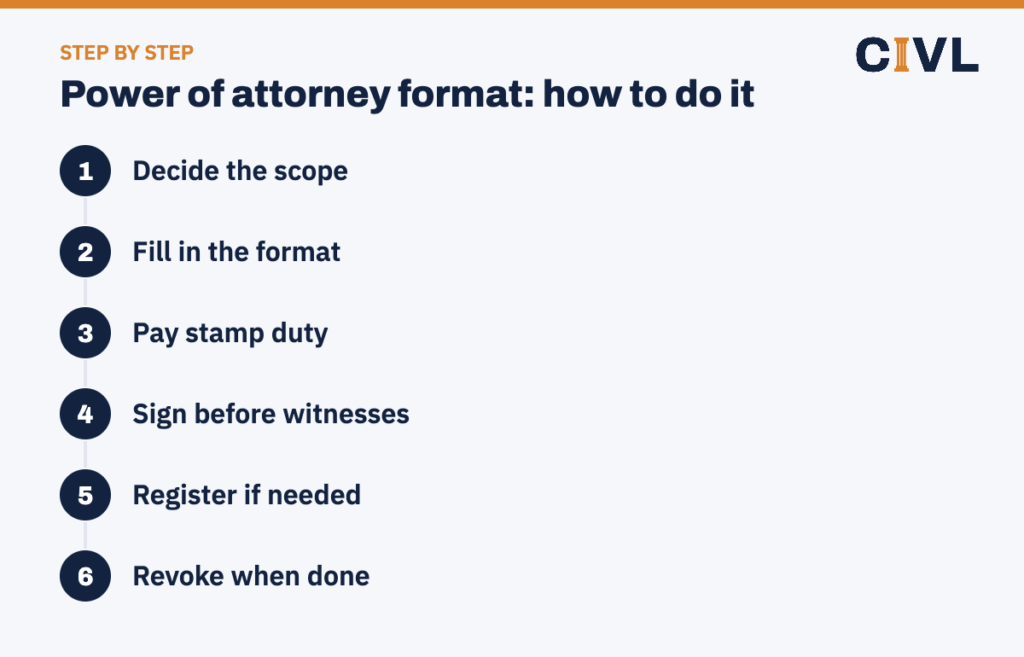
- Decide the scope. Prefer a special POA for a single task; give only the powers needed.
- Fill in the format. Describe the powers and property precisely.
- Pay stamp duty. Buy e-stamp or stamp paper as per your state’s rate.
- Sign before witnesses. Sign before two witnesses and a notary, or before the Sub-Registrar if registering.
- Register if needed. Register at the Sub-Registrar where the property is located if your state requires it.
- Revoke when done. When the task is over, revoke it by a written revocation deed and inform the people who relied on it.
Common mistakes to avoid
- Using a POA as a sale. A POA, agreement to sell and will together do not make the buyer the owner.
- Very wide general powers. A broad GPA can be misused. Give only what is needed.
- Not registering when required. An unregistered POA may be refused at the Sub-Registrar or bank.
- Forgetting to revoke. An old POA stays valid until revoked or until the principal dies.
CIVL format
Get the ready-to-use power of attorney format
- Editable Word file and a print-ready PDF
- Notes on how to fill every blank
- General and special POA versions
- Revocation of POA format
- Delivered to your email after payment
Price: ₹99 · Coming soon
Frequently asked questions
What is the difference between a general and a special power of attorney?
A general POA authorises a range of acts; a special POA authorises a specific act or transaction.
Can a property be sold through a power of attorney?
The attorney can sign a registered sale deed on behalf of the owner if the POA allows it. But a POA by itself does not transfer ownership to the attorney or a buyer.
Does a POA end on death?
Yes. Under the Indian Contract Act, an agency ends on the death of the principal.
How do NRIs give a POA?
Sign it before the Indian embassy or consulate, or before a local notary with an apostille, then pay stamp duty in India within three months of receiving it.
Where can I get a ready-to-use power of attorney format?
CIVL’s power of attorney format comes as an editable Word file and a print-ready PDF, with notes on filling every blank and checking your state’s rules. Use the button above to be told when it is available.