
Gift deed registration is how you legally transfer a house, flat or plot to someone without payment. If the gift is of immovable property, the deed must be signed before two witnesses, stamped and registered at the Sub-Registrar’s office, or the transfer simply does not happen.
Quick answer
A gift of immovable property is valid only if it is made by a registered deed, signed by the donor and attested by at least two witnesses (Transfer of Property Act, 1882, s.123). The person receiving the gift must accept it while the donor is alive (s.122).
Stamp duty is set by each state. Many states charge a much lower, fixed duty when the gift is to a close family member; Uttar Pradesh, for example, caps it at ₹5,000 for specified relatives. Present the deed for gift deed registration within four months of signing. After registration, apply for mutation so the land records show the new owner.
Related guides: sale deed registration and encumbrance certificate
What is a gift deed?
A gift deed is a written document by which one person (the donor) transfers property they own to another person (the donee) voluntarily and without any payment. Section 122 of the Transfer of Property Act defines a gift as a transfer of existing movable or immovable property made “voluntarily and without consideration” and accepted by the donee.
Because no money changes hands, a gift deed is commonly used within families: parents gifting a flat to a child, a husband gifting a share of a house to his wife, or grandparents gifting a plot to a grandchild. It takes effect during the donor’s lifetime, which is the key difference from a will. Once gift deed registration is complete and the gift is accepted, the donee becomes the owner.
Gift deed, will or relinquishment deed?
| Document | When it takes effect | Registration | Typical use |
|---|---|---|---|
| Gift deed | Immediately, once registered and accepted | Compulsory for immovable property | Transfer to anyone, family or not |
| Will | Only after the testator’s death | Optional | Plan who gets property later |
| Relinquishment deed | Immediately | Compulsory for immovable property | A co-owner or legal heir gives up their share to another co-owner |
If you inherited a property along with siblings and want to give your share to one of them, a relinquishment deed is often the better document. If you want the property to pass only after your death, use a will instead.
When is gift deed registration compulsory?
- Immovable property: a gift of land, a house, a flat or a share in any of them must be made by a registered deed, whatever its value (TPA s.123; Registration Act, 1908, s.17(1)(a)). An unregistered gift deed of immovable property does not transfer ownership and cannot be used as evidence of the transfer (Registration Act s.49).
- Movable property: jewellery, shares, a car or money can be gifted either by a registered deed or simply by delivery. Registration is optional, though a written deed is useful proof.
- Agricultural land: the same rule applies, but check your state’s land ceiling and tenancy laws, and whether the donee is allowed to hold agricultural land.
Who can make a gift and who can receive it?
- The donor must be an adult of sound mind and must actually own the property. You cannot gift property you expect to get in future.
- The gift must be free: no pressure, fraud or undue influence, and nothing in return. A deed that hides a payment is a sale, and stamp duty will be charged as a sale.
- The donee can be anyone, including a minor. A minor’s acceptance is given through a guardian, and the minor can accept or reject the gift on becoming an adult.
- The donee must accept the gift during the donor’s lifetime. If the donee dies before accepting, the gift fails (TPA s.122). Accepting is usually shown by signing the deed and taking possession.
Documents needed for gift deed registration
- The gift deed, printed on e-stamp paper or with stamp duty paid online, signed by the donor (and preferably the donee).
- Title documents of the property: the sale deed or previous gift deed, mutation entry, and the latest property tax receipt.
- Identity proof and PAN of the donor and donee (Aadhaar, passport, voter ID or driving licence), and their passport-size photographs.
- Identity proof of two witnesses, who must come to the Sub-Registrar’s office.
- Proof of relationship (for example a birth certificate or family register extract) if you are claiming a family stamp duty concession.
- An encumbrance certificate or society NOC, if your state or housing society requires it.
Gift deed registration: step by step
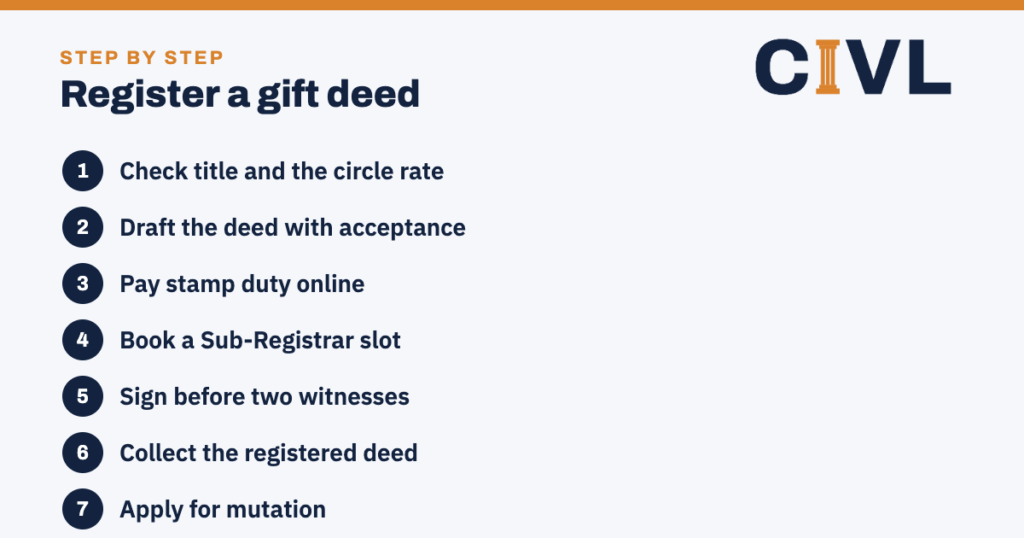
- Check title and value. Confirm that the donor is the recorded owner and that there is no loan or dispute on the property. Note the circle rate (guideline value), because stamp duty is calculated on it unless a family concession applies.
- Draft the deed. For a smooth gift deed registration, include the names, ages and addresses of both parties, their relationship, a full description of the property with boundaries, a statement that the gift is voluntary and without consideration, the donee’s acceptance, and the delivery of possession. A ready-to-use gift deed format saves time.
- Pay stamp duty. Before gift deed registration, pay online through your state’s registration portal (IGRS) or buy e-stamp paper from an authorised vendor. Keep the receipt.
- Book an appointment. For gift deed registration, most states let you upload the draft and book a slot at the Sub-Registrar’s office online.
- Sign before the Sub-Registrar. At the gift deed registration, the donor and donee (or the donee’s guardian) appear with two witnesses. Photographs and thumb impressions are taken, and the registration fee is paid.
- Collect the registered deed. The registered gift deed is usually returned the same day or within a few days. Check the names, the property details and the registration number.
- Apply for mutation. Ask the municipal body or the tehsil to update the property tax and land records in the donee’s name. See our property mutation guide.
Stamp duty and fees for gift deed registration
Stamp duty for gift deed registration is a state subject, so the rate depends on where the property is. In most states the donor pays it. As a rough picture:
| Item | What to expect |
|---|---|
| Gift to a non-relative | Usually the same rate as a sale, on the circle rate value (often 4% to 7%) |
| Gift to close family | Many states charge a fixed amount or a reduced rate. Uttar Pradesh: ₹5,000 for specified relatives, extended in 2026 to commercial and industrial property. Maharashtra: ₹200 for residential or agricultural property gifted to a spouse, child or grandchild |
| Registration fee | Usually about 1% of the property value, with caps in some states |
| Time limit | Present the deed within 4 months of signing (Registration Act s.23); a late fee applies for up to 4 more months (s.25) |
Which relatives count as “family” differs from state to state, so check your state’s stamp schedule or the registration department’s website before you buy the stamp. Rates also change through budget announcements, so check them again just before gift deed registration.
Income tax on a gifted property
- A gift of property from a relative (spouse, parents, children, siblings, the spouse’s siblings, lineal ascendants and descendants, and their spouses) is not taxed in the hands of the donee.
- A gift of property worth more than ₹50,000 (by stamp duty value) from a non-relative is taxed as the donee’s income, except on occasions such as marriage or by will or inheritance.
- If you gift property to your spouse, any rent from it is still added to your income (clubbing). When the donee later sells, the donor’s purchase cost and holding period are counted for capital gains.
The Income-tax Act, 2025 has carried these rules forward. Check the current position with a tax adviser before a high-value gift.
Can a gift deed be cancelled after registration?
After gift deed registration, an accepted gift is generally final. It can be revoked only in limited cases under TPA s.126:
- Both parties agreed in the deed that it can be revoked on a specified event that does not depend on the donor’s will alone.
- The gift was obtained by fraud, coercion or undue influence, in which case a civil suit is needed.
- Senior citizens: under s.23 of the Maintenance and Welfare of Parents and Senior Citizens Act, 2007, if a parent or senior citizen gifted property on the condition that the donee would look after them and the donee fails to do so, the Maintenance Tribunal can declare the transfer void. The Supreme Court confirmed this in Urmila Dixit v. Sunil Sharan Dixit (2025).
If you are gifting property to a child and expect to be cared for, write that condition clearly into the deed. Stamp duty already paid is generally not refunded if a gift is later cancelled.
What a gift deed must contain
- Full names, ages, addresses and PAN of the donor and the donee, and how they are related.
- A clear description of the property: address, survey or khasra number, flat number, area and boundaries.
- How the donor came to own it (purchase, inheritance, earlier gift), with document details.
- A statement that the gift is made out of love and affection, voluntarily and without any payment.
- The donee’s acceptance, and the date on which possession is handed over.
- Any condition, such as the donor’s right to live in the house or the donee’s duty to look after the donor.
- Signatures of the donor and donee, and of two witnesses with their addresses.
Common mistakes to avoid
- Using an unregistered or only notarised gift deed for a house or plot. It does not transfer ownership.
- Forgetting the donee’s acceptance clause, or leaving the donee out of the registration when they could sign.
- Claiming a family concession for a relative your state does not cover.
- Hiding a payment in a “gift” to save stamp duty. This can lead to a deficit duty demand and penalty.
- Not applying for mutation after gift deed registration, which leaves property tax and land records in the donor’s name.
- Gifting a property that is mortgaged or jointly owned without the consent of the bank or the co-owners.
Frequently asked questions
Is gift deed registration compulsory for a flat?
Yes. A flat is immovable property, so a gift of it must be made by a registered deed attested by two witnesses. A notarised deed is not enough.
Can a gift deed be registered without the donee being present?
The donor must appear. The donee’s acceptance can be shown in other ways, such as signing separately or taking possession, but it is safer for the donee to sign and attend the gift deed registration.
How long does gift deed registration take?
The Sub-Registrar visit usually takes a few hours once stamp duty is paid and the slot is booked. The registered deed is often returned the same day or within a week, depending on the state.
Who pays stamp duty on a gift deed?
Usually the donor, though the parties can agree otherwise. The amount depends on the state, the property’s value and the relationship between the parties.
Can I gift property to a friend?
Yes. Anyone can receive a gift, and gift deed registration works the same way. Stamp duty will usually be at the full rate, and the gift may be taxable in your friend’s hands if it is worth more than ₹50,000.
Does gift deed registration need a lawyer?
No law requires one. You can draft the deed yourself or use a format, pay the stamp duty and book the slot online. Take professional help with gift deed registration for valuable, disputed or agricultural property.
Can a gift deed be registered online?
Many states let you pay stamp duty, upload the draft and book a slot online, but the donor and witnesses still have to appear before the Sub-Registrar for gift deed registration. A few states are piloting fully online registration.
Is a gift of money or jewellery taxable?
Gifts from a relative are not taxed. Gifts from non-relatives worth more than ₹50,000 in total in a year are taxed as the receiver’s income, unless received on marriage or by inheritance.
Where can I get a ready-to-use gift deed format?
Use the CIVL gift deed format, which includes the acceptance and possession clauses and notes on stamp duty.
CIVL format
Documents for transferring family property
Use the gift deed format to gift a house or plot, the relinquishment deed format to give up an inherited share, or the will format if the property should pass only after your death. Read how to register a will, or ask CIVL a question.