
Filing a cheque bounce case in India follows strict deadlines under Section 138 of the Negotiable Instruments Act. This guide walks you through the complete process, from the bank’s return memo to notice, complaint, trial and settlement, and the 2025 Supreme Court changes that make early payment easier.
Quick answer
If a cheque given to pay a debt bounces, send a written demand notice within 30 days of receiving the bank’s return memo. The drawer gets 15 days to pay. If they do not, file a complaint before the Magistrate within one month after those 15 days end. The offence can lead to up to two years’ jail, a fine of up to twice the cheque amount, or both, and the case can be settled at any stage.
Free tool: work out the interest and total amount due with the interest calculator.
What is a cheque bounce case?
A cheque “bounces” (is dishonoured) when the bank returns it unpaid. Under Section 138, it is a criminal offence if the cheque was given to pay a legally enforceable debt or liability and was returned because the account did not have enough money, or the amount was more than the arrangement with the bank. Courts have held that other returns, such as “account closed” or “payment stopped by drawer”, can also lead to a cheque bounce case when the real reason is to avoid payment.
Once the cheque and signature are admitted, the law presumes it was given for a debt (Section 139). The drawer has to prove otherwise.
Before you start: check these conditions
- The cheque was for a debt or liability that the law can enforce, not a gift or a security for a future event that never arose.
- You presented it within its validity, which is three months from the date written on the cheque.
- You have the bank return memo showing the reason for dishonour.
- You are within the deadlines: 30 days for the notice, then 15 days for payment, then one month to file.
- For a company cheque, the company and the directors or officers in charge of its business at the time can be made accused (Section 141).
Cheque bounce case: the complete process step by step
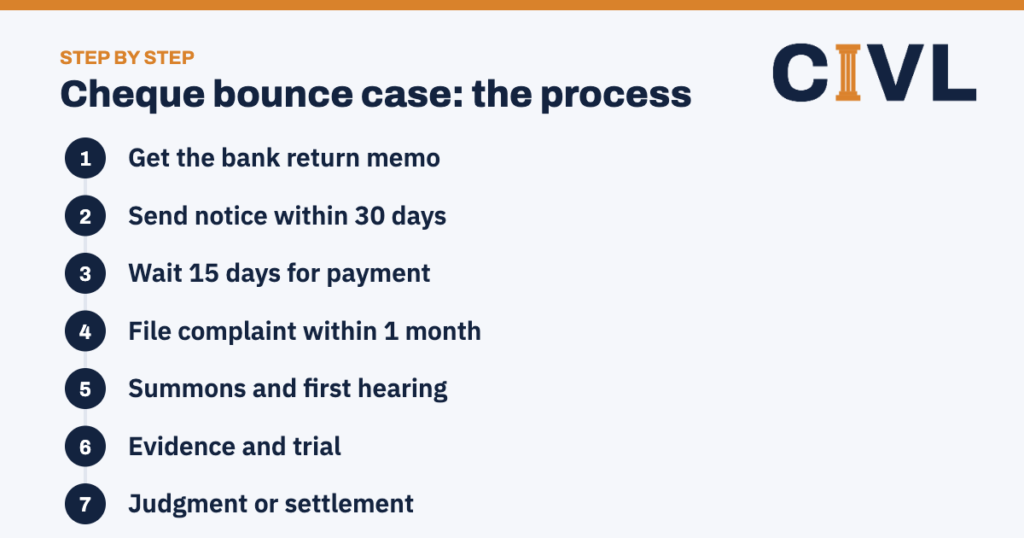
- Get the bank return memo. Collect the original cheque and the return memo from your bank. Note the date you received the memo; your 30 days start from then.
- Send a demand notice within 30 days. Demand payment of the cheque amount in writing, by Speed Post with proof of delivery (and email if possible). Our cheque bounce notice format has the wording, and how to send a legal notice explains proof of delivery.
- Wait 15 days from delivery. The drawer has 15 days from receiving the notice to pay. If they pay the cheque amount, no offence is made out.
- File the complaint within one month. If they do not pay, the cause of action arises on day 16. File a written complaint before the Judicial Magistrate First Class (or Metropolitan Magistrate) within one month. Attach the cheque, return memo, notice, postal receipt, tracking or delivery proof, and your affidavit. A late complaint can be accepted only if the court is satisfied there was sufficient cause for delay.
- Summons and first hearing. If the court takes the case, it summons the accused. Under the Supreme Court’s 2025 directions, the summons must tell the accused they can pay the cheque amount early through an online link, and complainants must file an affidavit of service.
- Evidence and trial. Your evidence is usually given by affidavit (Section 145). The case is meant to be tried summarily. The court can order the accused to pay interim compensation of up to 20% of the cheque amount (Section 143A).
- Judgment or settlement. The case can end in conviction, acquittal or a compromise. If the accused is convicted and appeals, the appeal court can require a deposit of at least 20% of the fine or compensation (Section 148).
Where to file a cheque bounce case
File it in the court that has jurisdiction over the branch of your bank where you deposited the cheque for collection (Section 142(2)). If the cheque was presented directly at the drawer’s branch, the court for that branch has jurisdiction. Once one case is filed in the right court, later cheque bounce cases between the same parties go to that same court.
Fees, costs and timelines
| Stage | Time limit | Cost |
|---|---|---|
| Present the cheque | Within 3 months of the cheque date | Bank charges, if any |
| Send demand notice | 30 days from receiving the return memo | Postage with proof of delivery |
| Drawer pays | 15 days from receiving the notice | — |
| File complaint | One month after the 15 days end | Court fee, which differs by state and cheque amount |
| Interim compensation | Ordered by the court during trial | Up to 20% of the cheque amount |
| Appeal after conviction | As per appeal rules | Deposit of at least 20% of the fine or compensation |
Settling a cheque bounce case: the 2025 cost rules
A cheque bounce case is compoundable (Section 147), so the parties can settle at any stage. In Sanjabij Tari v. Kishore S. Borcar (2025), the Supreme Court revised the old cost rules for settling late:
| When the accused pays and settles | Extra cost |
|---|---|
| Before the accused’s defence evidence is recorded | No extra cost |
| After defence evidence, before judgment | 5% of the cheque amount |
| Before the Sessions Court or High Court (appeal or revision) | 7.5% of the cheque amount |
| Before the Supreme Court | 10% of the cheque amount |
The Court also asked District Courts to set up online payment through QR codes or UPI links, and required every Section 138 complaint to carry a short synopsis right after the index. In short: paying early is cheapest for the accused, and the faster you file a clean complaint, the sooner that pressure starts.
Documents to file with a cheque bounce case
Courts check the paperwork closely at the first hearing. Keep this set ready, with two photocopies:
- The original dishonoured cheque.
- The bank’s return memo giving the reason for dishonour.
- A copy of your legal notice, the Speed Post receipt, the tracking printout and proof of delivery (or the returned envelope).
- Any reply from the drawer.
- Documents showing the debt, such as a loan agreement, invoices, bank transfers or messages.
- Your evidence affidavit under section 145 and an affidavit of service of the notice.
- A short synopsis of dates placed after the index, as the Supreme Court directed in 2025.
If you have received a cheque bounce notice or summons
If you are the drawer, act quickly. The cheque bounce case is cheapest to settle early:
- Pay within 15 days of receiving the notice and no case can be filed.
- If a case is already filed, paying before your defence evidence means no settlement cost under the Supreme Court’s 2025 guidelines; the cost rises at each later stage.
- Attend court on the date in the summons. The offence is bailable, and the court usually grants bail on a bond.
- Possible defences include that there was no legally enforceable debt (the presumption under section 139 can be rebutted), that the notice was not properly given, or that the complaint was filed late.
Civil recovery alongside the cheque bounce case
A cheque bounce case punishes the offence; it does not automatically give you a money decree. You can also file a civil suit to recover the money, often a summary suit under Order XXXVII of the Code of Civil Procedure, within three years. See our money recovery notice page for that route.
Common mistakes to avoid
- Counting from the wrong date. The 30 days for notice run from when you receive information of dishonour from the bank, not from the cheque date.
- Filing too early. A complaint filed before the 15 days for payment are over is premature.
- Demanding more than the cheque amount as the main demand. The notice must clearly demand the cheque amount. Claims for interest or costs should be shown separately.
- Weak proof of the notice. Keep the booking receipt, tracking printout and delivery proof.
- Leaving out responsible directors when the drawer is a company, or naming directors without stating their role in the business.
- Missing hearings. A complainant who keeps missing dates risks dismissal of the cheque bounce case.
Frequently asked questions
How long does a cheque bounce case take?
It varies a great deal by court. The law intends a quick summary trial, but many cases take one to three years. Early settlement and interim compensation can speed up recovery.
Can I file a cheque bounce case without a lawyer?
Yes, you can file and argue it yourself. Because the deadlines and paperwork are strict, many people use an advocate. Free legal aid is available to eligible people through Legal Services Authorities.
What if the notice comes back refused or unclaimed?
If it was sent to the correct address, it is generally treated as served, and the 15 days are counted from that point. Keep the returned envelope sealed.
Is a cheque given as security covered?
Often yes. If a debt existed when the cheque was presented, a cheque given as security can lead to a cheque bounce case. If no debt was due, it may not.
Can the accused go to jail in a cheque bounce case?
The law allows up to two years’ imprisonment, a fine up to twice the cheque amount, or both. In practice, courts often focus on payment, compensation and settlement.
Is a cheque bounce case bailable?
Yes. An offence under section 138 of the Negotiable Instruments Act is bailable, so the accused usually gets bail on appearing in court and furnishing a bond.
Can I file a cheque bounce case if the drawer stopped payment?
Yes. Courts have held that a cheque returned for “payment stopped by drawer” can still lead to a cheque bounce case, unless the drawer shows there was enough money and a valid reason to stop it.
Can I file a cheque bounce case for a post-dated cheque?
Yes. A post-dated cheque is valid for three months from the date written on it. Present it within that time and follow the same notice and complaint steps if it bounces.
Where can I get a ready-to-use cheque bounce notice?
CIVL’s cheque bounce notice format gives you the Section 138 notice ready to fill in, the first document in any cheque bounce case.
CIVL format
Start with the right notice
Use CIVL’s cheque bounce notice format. For other unpaid dues, see the legal notice format. Still stuck? Ask CIVL.