
Insurance claim rejected after you paid premiums for years? You have more options than most people realise. IRDAI rules set strict time limits for insurers, and the Insurance Ombudsman hears complaints up to ₹50 lakh free of cost, without a lawyer.
Quick answer
If your insurance claim is rejected, first ask for the reason in writing and complain to the insurer’s Grievance Redressal Officer, who must resolve it within 14 days. If you are not satisfied, escalate through IRDAI’s Bima Bharosa portal or call 155255.
You can then file a free complaint with the Insurance Ombudsman (cioins.co.in) within one year of the insurer’s final reply, for claims up to ₹50 lakh. Alternatively, file a consumer complaint on e-Jagriti. For health policies, after 60 months of continuous cover the insurer cannot reject for non-disclosure except in fraud.
Insurance claim rejected? Common reasons
- Non-disclosure of an existing illness or habit in the proposal form
- Waiting period not over (for pre-existing diseases or specific treatments)
- Treatment or event excluded under the policy wording
- Policy lapsed because a premium was not paid
- Late intimation of the claim or missing documents
- Hospitalisation said to be “not medically necessary” or for OPD-type treatment
- Alleged fraud or mismatch in documents
Not every insurance claim rejected for these reasons stays rejected. Courts and Ombudsmen often reject excuses such as minor delays in intimation, or “non-disclosure” of conditions unrelated to the claim.
Insurance claim rejected: rules that protect you
| Rule | What it says |
|---|---|
| Health moratorium (60 months) | After 60 continuous months of health cover, a claim cannot be contested for non-disclosure or misrepresentation, except for proven fraud |
| Life insurance (Insurance Act s.45) | After 3 years from the policy date or revival, a life policy cannot be called in question on any ground |
| Cashless health claims | Insurer must decide a cashless request within 1 hour and final discharge within 3 hours (IRDAI Master Circular, 2024) |
| Reasons in writing | A rejection must state the reasons and the policy clause relied on |
| Grievance timeline | Insurer must acknowledge immediately and resolve within 14 days |
| Ombudsman award | Insurer must comply within 30 days, or pay ₹5,000 a day of delay (health master circular) |
If your insurance claim is rejected: step by step
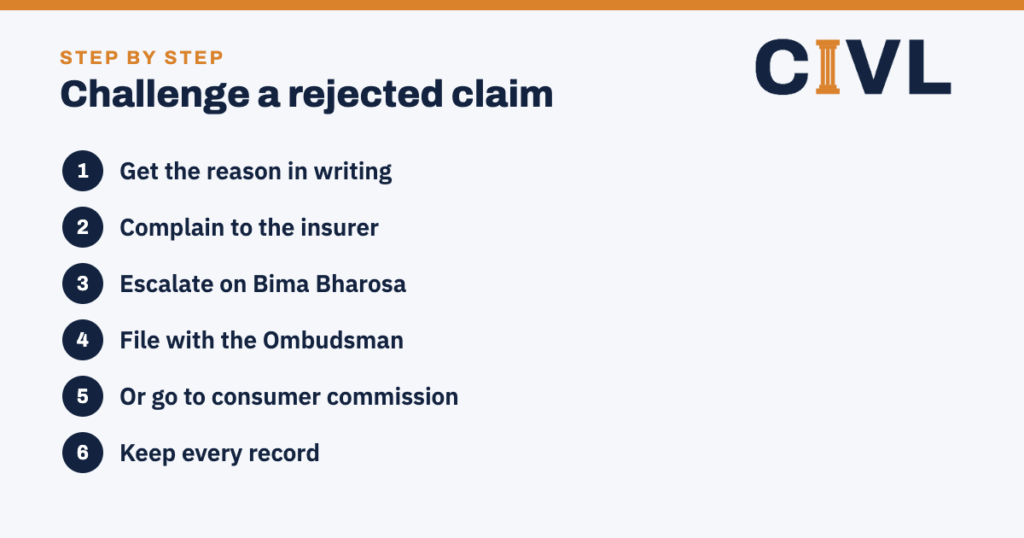
- Get the rejection reason in writing with the policy clause. Ask for the claim file, including any investigation report.
- Complain to the insurer’s Grievance Redressal Officer by email or on the insurer’s portal. Explain point by point why the reason is wrong and attach documents.
- Escalate to IRDAI on Bima Bharosa (bimabharosa.irdai.gov.in), by calling 155255 or 1800-4254-732, or by email to complaints@irdai.gov.in, if you get no reply in 14 days or the reply is unsatisfactory.
- File with the Insurance Ombudsman online at cioins.co.in, within one year of the insurer’s rejection of your grievance.
- Or file a consumer complaint on e-Jagriti if the claim is larger or you need wider relief.
- Keep every record: policy, proposal form, bills, emails and call references.
Insurance claim rejected? How the Insurance Ombudsman works
- Covers life, health and general insurance complaints from individuals, including claim rejection, partial settlement and delay.
- Claim limit: up to ₹50 lakh (raised from ₹30 lakh in 2023).
- First write to the insurer; you can go to the Ombudsman if the insurer rejects your grievance, does not reply in 30 days, or you are unhappy with its reply.
- File within one year of the insurer’s final reply.
- No fee and no lawyer needed. Hearings are often online.
- The Ombudsman should pass an award within three months of receiving the complete complaint. The award binds the insurer, not you.
- A draft amendment to the Ombudsman Rules was published in November 2025 (proposing an appeal mechanism and fully online filing). Check the current rules on cioins.co.in.
Insurance claim rejected: the consumer commission route
An insurance claim rejected without a valid reason is a “deficiency in service” under the Consumer Protection Act, 2019. You can file within two years on e-Jagriti, and claim the amount, interest, compensation for harassment and costs. No fee is payable for claims up to ₹5 lakh. Read our consumer complaint online guide for the process. You can choose either the Ombudsman or the consumer commission; do not pursue both on the same claim at the same time.
Insurance claim rejected: what to write in your complaint
- Policy number, claim number, dates of admission or loss
- The exact reason given for rejection and the clause quoted
- Why the reason does not apply (with medical papers, discharge summary, earlier policy records)
- What you want: full claim amount, interest and compensation
- Copies of all correspondence
Health insurance claim rejected
A health insurance claim rejected for “pre-existing disease” is the most common complaint. Check three things. First, was the condition really known or treated before the policy started? Second, has the waiting period for that condition already passed? Third, have you held continuous health cover for 60 months (including porting from another insurer)? If any of these favours you, say so in your complaint, with dates and policy copies.
If a cashless request is refused, you can still pay the hospital and file a reimbursement claim. A refusal of cashless is not the same as a final rejection of the claim.
Life insurance claim rejected
For a life insurance claim rejected on the ground of non-disclosure, check how long the policy has run. After three years from the date of issue or revival, s.45 of the Insurance Act bars the insurer from calling the policy in question on any ground, including fraud. Within three years, the insurer must prove that the fact hidden was material and that the policyholder knew it.
Motor insurance claim rejected
A motor insurance claim rejected because of a driving licence issue, a delay in informing the insurer, or a lapse in the registration certificate should be checked against the policy and court rulings. Courts have held that a short delay in intimation alone is not a valid reason to reject a genuine theft claim. Third-party claims for injury or death go to the Motor Accident Claims Tribunal.
Insurance claim rejected: documents to collect
- Policy schedule and full policy wording
- Proposal form (ask the insurer for a copy if you do not have it)
- Claim form, bills, discharge summary and test reports
- Rejection letter or email
- All emails, call reference numbers and the grievance acknowledgement
Insurance claim rejected in part: deductions you can challenge
Many people do not have their insurance claim rejected outright; instead they get only part of the bill. Read the settlement letter line by line. Common deductions are:
- Room rent limit: if you stayed in a room above the policy limit, some insurers cut not only the room charge but also doctor and procedure fees in proportion. Check what your policy wording says about “proportionate deduction”.
- Consumables and non-payable items: gloves, masks and similar items are often excluded unless you bought a consumables cover.
- Co-payment: a fixed percentage you agreed to pay, often in senior citizen policies.
- Sub-limits: caps on specific treatments such as cataract surgery.
- “Reasonable and customary” charges: the insurer may say the hospital charged more than usual for the area. Ask for the basis of this figure in writing.
A deduction that is not supported by your policy wording is treated like an insurance claim rejected in part. It can be challenged in the same way as a full rejection: first with the insurer’s grievance officer, then before the Insurance Ombudsman or the consumer commission.
Cashless denied vs insurance claim rejected
If the insurer refuses cashless treatment at the hospital, you can still pay the bill yourself and file a reimbursement claim within the time set in the policy. A cashless denial is often because of missing information at the time of admission, not a final decision on the claim. Under IRDAI’s 2024 master circular on health insurance, insurers must decide a cashless request within one hour and give final discharge approval within three hours of the hospital’s request; any extra hospital charges caused by a delay beyond that are to be borne by the insurer.
Insurance claim rejected or delayed: time limits
| Stage | What the rules say |
|---|---|
| Cashless request (health) | Decision within 1 hour of the hospital’s request |
| Final discharge approval (health) | Within 3 hours of the hospital’s request |
| Settlement or rejection after documents | Within the time set by IRDAI regulations, usually counted from the last document received; delay attracts interest |
| Grievance to the insurer | Reply expected within 14 days; if not, or if you are unhappy, go to the Ombudsman |
| Insurance Ombudsman | File within one year of the insurer’s final reply (or of the date it should have replied) |
| Consumer commission | Within two years of the cause of action, under the Consumer Protection Act, 2019 |
Keep a dated record of every document you submitted and every reply you received. These dates decide whether the insurer was late and whether your complaint is within time.
Motor accident claims against another driver
If you were injured, or a family member died, in an accident caused by another vehicle, the claim against that vehicle’s insurer is a third-party claim. It does not go to the Ombudsman, even when the other side’s insurer offers too little or you find your insurance claim rejected outright. It is filed before the Motor Accident Claims Tribunal (MACT) under the Motor Vehicles Act, 1988, usually where the accident happened or where you live. Police must also send an accident information report to the tribunal. An insurance claim rejected on your own vehicle (own damage) follows the normal insurer, Ombudsman and consumer route.
Worked example: health insurance claim rejected for “pre-existing disease”
Ravi bought a family health policy in 2021. In 2026 he was hospitalised for a heart procedure, and the insurer wrote that the insurance claim was rejected because he had high blood pressure before buying the policy, which he did not disclose.
- Ravi asks the insurer, in writing, for the documents relied on to reject the claim, and for a copy of his proposal form.
- He checks the dates: the policy has run for more than 60 months without a break. Under IRDAI’s rules, after 60 months of continuous coverage a health insurance claim cannot be contested on the ground of non-disclosure, except for proven fraud.
- He writes to the grievance officer, citing the moratorium rule and attaching the policy schedule and renewal receipts.
- When the insurer does not change its decision within 14 days, he files a complaint with the Insurance Ombudsman through the Bima Bharosa portal.
This kind of case is common. When an insurance claim is rejected on a ground the rules no longer allow, the rejection letter itself becomes strong evidence for the complaint.
Sample timeline after an insurance claim rejected letter
| When | What to do |
|---|---|
| Day 1–3 | Collect the rejection letter, policy wording, proposal form and all bills |
| Day 3–7 | Write to the insurer’s grievance officer with your reasons and documents |
| Day 21 or so | If no reply in 14 days, or the reply is unsatisfactory, prepare the Ombudsman complaint |
| Within 1 year | File before the Insurance Ombudsman (or, instead, the consumer commission within 2 years) |
| After the award | If the Ombudsman rules in your favour and you accept, the insurer must comply within the time set in the rules |
Acting early also keeps the evidence fresh: hospitals and garages are more helpful when the treatment or repair was recent.
Insurance claim rejected: how to avoid it next time
- Disclose every existing illness, habit and earlier claim in the proposal form, even if the agent says it is not needed.
- Read the exclusions, waiting periods, room rent limit and sub-limits before you buy, and again before a planned surgery.
- Inform the insurer or TPA within the time the policy sets: usually before a planned admission and within 24 to 48 hours of an emergency one.
- Keep original bills, discharge summaries, prescriptions and test reports together, and take photos of them.
- Renew the policy before the due date (or within the grace period) so that waiting periods and the 60-month moratorium keep running.
- Update the nominee and contact details on the policy whenever they change.
Most cases where an insurance claim is rejected come down to one of three things: non-disclosure, a policy exclusion, or missing documents. The first two are decided when you buy the policy, and the third when you file the claim. A little care at both stages prevents most disputes.
Common mistakes to avoid
- Accepting a “full and final” partial payment without protest.
- Going straight to court without first writing to the insurer.
- Missing the one-year Ombudsman deadline.
- Not reading the policy wording and the exclusions the insurer relies on.
- Hiding earlier treatment when buying a new policy; it is the biggest cause of rejection.
Frequently asked questions
What should I do first if my insurance claim is rejected?
Ask for the reason in writing and complain to the insurer’s Grievance Redressal Officer, who must resolve it within 14 days.
Is filing with the Insurance Ombudsman free?
Yes. There is no fee, and you do not need a lawyer.
What is the maximum amount the Ombudsman can award?
Up to ₹50 lakh, including expenses.
Can an insurer reject a health claim for an old illness after many years?
Not for non-disclosure after 60 months of continuous cover, unless it proves fraud.
How long does an Ombudsman complaint take?
The award is meant to come within three months of a complete complaint, though it can take longer in practice.
Can I go to the consumer commission instead?
Yes. A consumer complaint can be filed within two years of the cause of action.
Is a partial claim settlement the same as rejection?
You can challenge a partial settlement in the same way, if deductions are not justified by the policy.
Can I reapply after my insurance claim is rejected?
Yes. You can ask the insurer to review it with new documents, and then escalate to the Grievance Officer, IRDAI and the Ombudsman.
Does the Ombudsman handle group insurance?
Yes, complaints from individuals covered under group policies, such as employer health cover, can go to the Ombudsman.
Where can I get a ready-to-use complaint or notice format?
Use the CIVL consumer complaint format or the legal notice format to put your claim in writing.
Can I complain if my insurance claim is rejected after many years of premiums?
Yes. Long premium history does not give the insurer extra rights. For life policies, Section 45 of the Insurance Act, 1938 says a life policy cannot be called in question on any ground once three years have passed from the date of the policy (or of its revival).
Do I need a lawyer to fight an insurance claim rejected by my insurer?
No. The Ombudsman and the consumer commission are designed for people to file on their own. A lawyer can help in large or complex claims.
What if the hospital and insurer blame each other?
Ask the insurer for its reason in writing. If the hospital did not send papers on time, the insurer must still decide on documents you submit, and you can complain against the hospital separately.
What should I do first when my insurance claim is rejected?
Get the reason in writing, compare it with the policy wording, and send a written grievance to the insurer’s grievance officer with your documents.
Can an insurance claim rejected by the Ombudsman go to the consumer commission?
The Ombudsman’s award binds the insurer only if you accept it. If you are not satisfied, you can still go to the consumer commission or a civil court, within the time limit.
CIVL format
Put your claim in writing
Use the legal notice format for a firm demand to the insurer, and the consumer complaint format if you go to the commission. Read how to send a legal notice, or Ask CIVL.