
Need an RTI application format? This page explains when you need it, what it must contain and how to make it valid, step by step. You can also get CIVL’s ready-to-use RTI application format as an editable Word file and PDF.
Quick answer
An RTI application is a simple request for information from a government office under the Right to Information Act, 2005. For Central Government offices the fee is ₹10 (free for BPL card holders), you can apply online at rtionline.gov.in, and the office must reply within 30 days. No stamp paper, affidavit or reason is needed.
Read the full guide: How to file an RTI online
Free tool: fill in a few details and get a ready-to-print application from the free RTI application generator.
What is an RTI application?
Under Section 6 of the RTI Act, any Indian citizen can ask a “public authority” (government departments, municipal bodies, public sector banks and companies, government-funded bodies) for information it holds: files, records, copies of documents, the status of your application, reasons for a decision, and so on.
The application goes to the office’s Public Information Officer (PIO). You do not have to say why you want the information (Section 6(2)). Some information is exempt, such as matters affecting national security or another person’s personal information (Section 8).
When you need it
- Your passport, pension, refund, scholarship or certificate application is stuck and you want its status and file notings.
- You want copies of documents about your own property, such as mutation records or building approvals.
- You want to know how public money was spent on a road, drain or scheme in your area.
- A department rejected your claim and you want the reasons and the rule it relied on.
- You need certified copies of records for a court case or a complaint.
Stamp duty, notarisation and registration
| Requirement | What applies | Notes |
|---|---|---|
| Stamp paper / e-stamp | Not needed | Plain paper or the online form. |
| Notarisation | Not needed | No affidavit is required. |
| Registration | Not needed | Keep proof of filing (online registration number or postal receipt). |
| Fee | ₹10 for Central Government offices | Free for BPL card holders (attach a copy). Copies cost ₹2 per page. |
States make their own RTI fee rules. Most charge ₹10, but the fee, payment modes and word limits differ by state. Check the state RTI rules or the state RTI portal before you apply.
What the RTI application must contain
- Addressed to: “The Public Information Officer”, with the name of the department and its address.
- Your full name and postal address (email and phone are optional but useful).
- Clear, numbered questions or a list of documents you want, with the period they cover (for example, “certified copies of file notings on my application no. ___ dated ___”).
- Fee details: online payment reference, Indian Postal Order number, demand draft number, or a copy of your BPL card.
- The form in which you want the information (paper copies, inspection, CD or email).
- Date, place and your signature. For Central offices, keep it to about 500 words; a longer application cannot be rejected for that alone.
How to make it valid: step by step
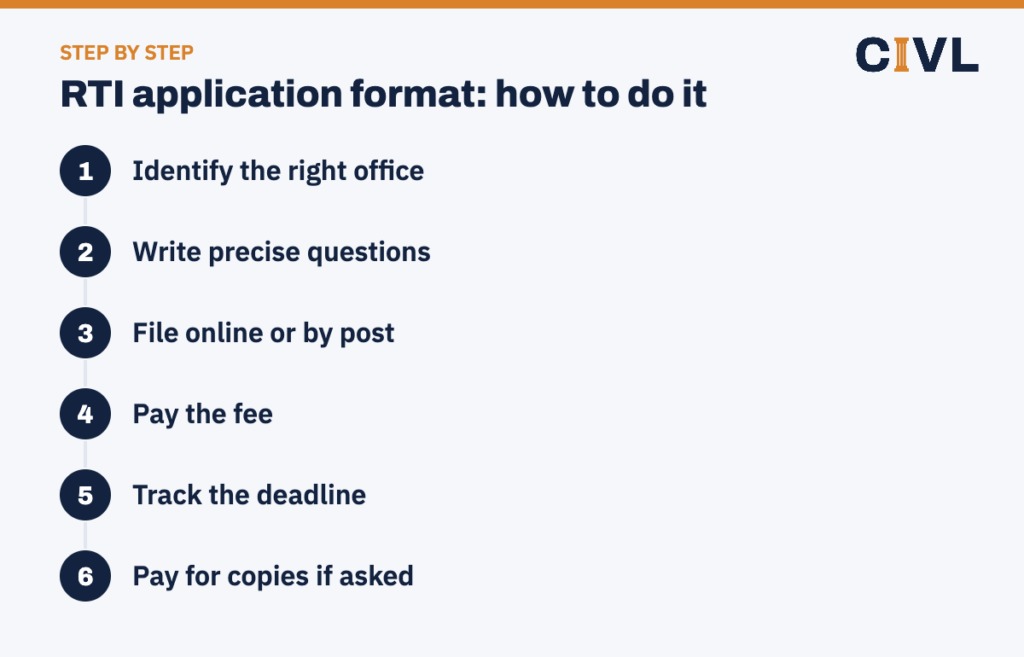
- Identify the right office. Ask the office that actually holds the records. If you send it to the wrong one, it must transfer the application within 5 days (Section 6(3)).
- Write precise questions. Ask for records, not opinions. “Provide a copy of…” works better than “Why did you…?”
- File online or by post. For Central ministries and departments, use rtionline.gov.in and pay ₹10 online. For state offices, use the state portal or send the application by Speed Post with an Indian Postal Order.
- Pay the fee. Online, by IPO, demand draft or cash at the office, payable to the Accounts Officer of the public authority. BPL applicants pay nothing.
- Track the deadline. The PIO must reply within 30 days (48 hours if it concerns someone’s life or liberty; 35 days if filed through an Assistant PIO).
- Pay for copies if asked. If the PIO asks for extra fees for copies, pay and keep the receipt. If you get no reply or a poor reply, file a first appeal within 30 days.
Common mistakes to avoid
- Asking “why” questions. The PIO only provides information that exists on record; it does not have to explain or give opinions.
- Bundling many subjects. Keep one application to one subject; file separate applications for unrelated matters.
- Wrong payee name on the IPO or draft. Make it payable to the Accounts Officer of that public authority.
- Asking a private company. Private companies are not covered. Ask the regulator that holds their records instead.
- Not keeping proof. Save the online registration number or the postal receipt; you need it for the appeal.
CIVL format
Get the ready-to-use RTI application format
- Editable Word file and a print-ready PDF
- Notes on how to fill every blank
- Sample questions for common situations (stuck applications, property records, public works)
- Postal and online filing checklist
- Delivered to your email after payment
Price: ₹49 · Coming soon
Frequently asked questions
What is the RTI fee?
₹10 for Central Government public authorities under the RTI Rules, 2012. BPL applicants pay no fee. States set their own fees, which are mostly ₹10.
How many days does the PIO have to reply?
30 days from receipt (Section 7(1)); 48 hours where life or liberty is involved. If the PIO misses the deadline, copies must be given free of charge (Section 7(6)).
Can I file an RTI online?
Yes. Central Government ministries, departments and many other central bodies accept applications at rtionline.gov.in. Many states have their own RTI portals.
Do I have to give a reason for asking?
No. Section 6(2) says you do not need to give any reason or personal details except those needed to contact you.
What if I get no reply?
File a first appeal with the First Appellate Authority of the same office within 30 days after the reply deadline ends.
Where can I get a ready-to-use RTI application format?
CIVL’s RTI application format comes as an editable Word file and a print-ready PDF, with notes on filling every blank and checking your state’s rules. Use the button above to be told when it is available.