
An encumbrance certificate (EC) is an extract from the Sub-Registrar’s records that lists every registered transaction on a property over a chosen period: sales, gifts, mortgages, leases and partitions. Buyers and banks rely on it to check that the property is free of registered charges.
Quick answer
An encumbrance certificate is issued by the Sub-Registrar’s office where the property is registered. If transactions are found, you get Form 15 listing them; if none are found, you get a nil EC (Form 16).
Most states now let you apply for an encumbrance certificate online, for a fee that depends on how many years you search. Banks usually ask for 13 to 30 years. An EC shows only registered documents, so combine it with a title search, a CERSAI search and a court case search.
What is an encumbrance certificate?
An “encumbrance” is any charge or liability on a property, such as a mortgage, a lease, a lien or a pending sale. The encumbrance certificate records the registered transactions affecting a particular property, in date order, with the document number, the parties and the nature of the deal.
Form 15 vs Form 16
| Form | When it is issued | What it means |
|---|---|---|
| Form 15 | Registered transactions were found in the period searched | Read each entry: an old mortgage may still be open, or the seller may already have sold part of the land |
| Form 16 (nil EC) | No registered transactions were found | No registered sale, mortgage or other charge in that period, at that office |
When you need an encumbrance certificate
- Buying a flat, house or plot (before signing the agreement to sell)
- Taking a home loan or loan against property; banks insist on an EC
- Applying for mutation or a patta transfer in some states
- Selling, so the buyer can check the title quickly
- Taking a loan against property or a top-up loan
- Partition, gift or settlement of family property
Documents and details you need
- Property details: survey or khasra number, plot or flat number, village or locality, and the Sub-Registrar office
- Document number and year of the last registered deed (sale deed, gift deed etc.)
- Names of the present and previous owners
- The period you want searched (start and end year)
- ID proof of the applicant, and a mobile number for OTP
How to get an encumbrance certificate: step by step
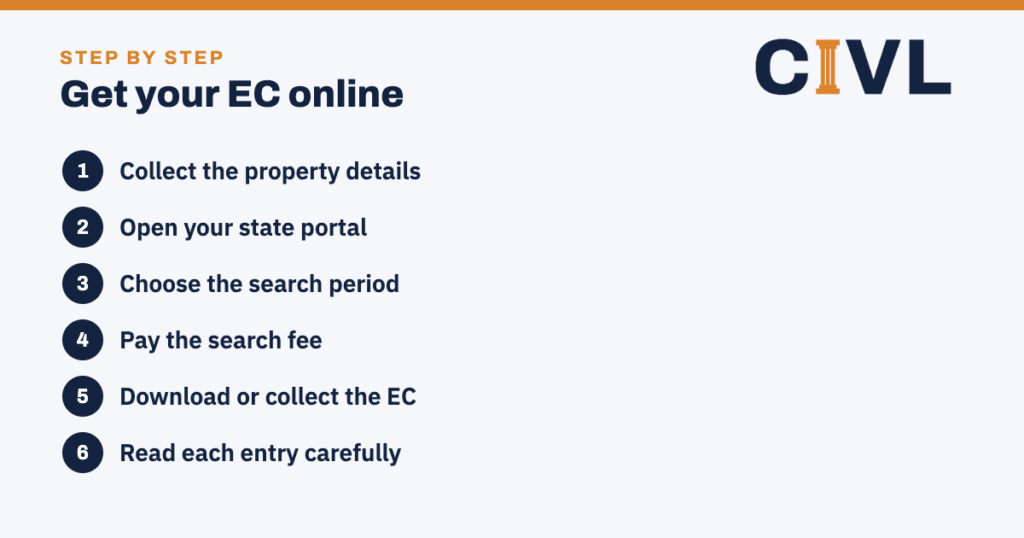
- Collect the property details from the last title deed.
- Open your state’s registration portal (list below) or visit the Sub-Registrar’s office.
- Choose the search period. Lenders often ask for 13 or 30 years.
- Pay the fee online. The fee usually depends on the number of years searched.
- Download or collect the encumbrance certificate. Many states issue a digitally signed EC.
- Read every entry and match document numbers, names and extents with the title deeds.
Encumbrance certificate online: state portals
| State | Where to apply | Notes |
|---|---|---|
| Tamil Nadu | tnreginet.gov.in | Free to view; certified EC for a small fee (about ₹15 for the first year and ₹5 for each further year, plus application charges) |
| Karnataka | Kaveri 2.0 (kaveri.karnataka.gov.in) | View by OTP; digitally signed EC for a fee; older records take longer |
| Telangana / Andhra Pradesh | State registration portals | EC search by document or survey number |
| Uttar Pradesh | e-District / IGRS UP (igrsup.gov.in) | Apply online and download; offline at the Sub-Registrar |
| Maharashtra | IGR Maharashtra (igrmaharashtra.gov.in) | Online property search of registered documents (Index II) for a fee |
Fees and timelines change, and some states still issue older-period ECs only at the office. If the portal shows no result, apply in person with the document numbers.
What an encumbrance certificate does not show
- Unregistered deals: an unregistered agreement to sell, a GPA sale or a family arrangement on plain paper.
- Mortgages by deposit of title deeds that were never registered. Check the CERSAI register, which records security interests created by banks (a public search costs about ₹10 plus GST).
- Court cases: search eCourts for pending suits involving the property or the seller.
- Tax and utility dues: ask for property tax, water and electricity receipts.
- Transactions at another office: if the jurisdiction of the Sub-Registrar changed, search the earlier office too.
How to read an encumbrance certificate
- Check that the survey number, extent and boundaries match the title deed.
- Follow the chain: each seller should be the buyer in an earlier entry.
- For every mortgage entry, look for a later release or reconveyance deed.
- Note leases, agreements and court attachments, and ask the seller to explain them.
- Make sure the search period ends close to today; ask for a fresh encumbrance certificate just before registration.
Encumbrance certificate for a home loan
Banks ask for an encumbrance certificate both before sanctioning a home loan and, in some cases, before the final disbursement. They usually want 13 to 30 years of history and an EC that is no more than a few weeks old. When you take a loan, the bank’s mortgage may itself appear in the EC (if registered) and will appear in CERSAI. When the loan is repaid, get the release or reconveyance deed registered so that a later encumbrance certificate shows the charge has been cleared.
Encumbrance certificate and other title checks together
| Check | What it covers | Where |
|---|---|---|
| Encumbrance certificate | Registered sales, gifts, mortgages, leases at the Sub-Registrar | State registration portal |
| CERSAI search | Security interests created by banks and lenders | cersai.org.in |
| Court case search | Pending suits and execution cases | eCourts services |
| Land records | Who is recorded as owner or occupant | State land records portal |
| RERA | Project registration, approvals and complaints | State RERA website |
No single document proves clean title. A careful buyer uses the encumbrance certificate as one piece of a title search, together with the chain of deeds, land records and these searches.
Encumbrance certificate entries explained
- Document number and year: lets you get a certified copy of that deed.
- Nature of document: sale, gift, mortgage, release, lease, partition, settlement.
- Executant and claimant: who gave and who received the right.
- Consideration or value: the price or loan amount stated.
- Schedule: survey number, extent and boundaries.
Encumbrance certificate for a flat or new apartment
A flat in a new project has two layers of history: the land on which the building stands and the flat itself. Before you book, ask for an encumbrance certificate for the project land covering at least 30 years. Look for the sale deeds by which the builder (or the landowner under a joint development agreement) got the land, and for any mortgage in favour of a bank that financed the project.
A project loan on the land is common and is not by itself a problem. What matters is that the lender has given a no-objection for the sale of your flat, so that your sale deed is not subject to the builder’s loan. Check the project’s page on the state RERA website as well: builders must disclose encumbrances and litigation there.
For a resale flat, ask for an encumbrance certificate on the flat itself, searched in the name of the current owner and earlier owners, along with the society’s share certificate or the apartment association’s no-dues letter.
Encumbrance certificate for agricultural land
For farmland, the encumbrance certificate from the Sub-Registrar shows registered deeds, but many rights in rural land are recorded only in revenue records. So pair the encumbrance certificate with the record of rights for the plot: the khatauni in Uttar Pradesh, the 7/12 extract in Maharashtra, the jamabandi in Punjab and Haryana, or the RTC (pahani) in Karnataka. These show the recorded owner, the type of land and, in many states, entries for crop loans and government charges.
Also check whether the land can legally be bought by you (some states restrict purchase of agricultural land by non-farmers) and whether it needs conversion before you build on it.
Checking court cases against a property
An encumbrance certificate will not show a civil suit about the property unless an order or decree has been registered. Under Section 52 of the Transfer of Property Act, 1882 (the rule of lis pendens), a buyer who buys during a pending case is bound by its result. So do a separate search:
- Search the eCourts services portal (district courts) by the seller’s name and by the names of earlier owners.
- Check the High Court’s case status page for writs or appeals involving the property.
- Ask the seller for a written declaration that there are no pending cases, notices or attachments.
- Publish a public notice in a local newspaper inviting objections before you register the sale.
Buyer’s checklist and timeline
- Before paying any token amount, get the title deed copies and an encumbrance certificate for 30 years.
- Match each owner in the chain of title with a registered deed in the encumbrance certificate.
- Check revenue records, property tax receipts and the CERSAI search for bank charges.
- Run the court-case search and issue the public notice.
- Just before registration, get a fresh encumbrance certificate up to the latest date, to catch any deed registered after your first search.
- After registration, get one more encumbrance certificate a few weeks later to confirm your sale deed appears in it.
Worked example: reading a mortgage and its release
Say the encumbrance certificate for a house shows three entries: a sale deed in 2012 by which the seller bought the house; a mortgage deed in 2013 in favour of a bank for ₹25 lakh; and a release deed in 2022 from the same bank. The release deed shows that the 2013 loan was repaid and the bank gave up its charge.
If the release deed were missing, the house would still be shown as mortgaged, and you should not buy until the seller produces the bank’s loan closure letter and registers a release, or arranges for the bank to be paid off from the sale price at the time of registration.
Encumbrance certificate vs title search report
| Point | Encumbrance certificate | Title search report |
|---|---|---|
| Prepared by | Sub-Registrar (registration department) | An advocate, after examining documents |
| What it covers | Registered deeds for the property in the period searched | Chain of ownership, revenue records, encumbrances, court cases and legal opinion |
| Gives an opinion? | No, it only lists entries | Yes, it says whether the title is clear and marketable |
| Needed for | Loans, sale, mutation, verification | Purchase decisions and most home loans (banks get their own) |
Think of the encumbrance certificate as raw data and the title search report as the analysis built on it. For any large purchase, it is worth having an independent advocate prepare a title report rather than relying only on the bank’s report, which is made for the bank’s protection.
Entries that need a second look
- Power of attorney sales: a sale by an attorney holder is valid only if the power of attorney was valid and the principal was alive on the date of sale.
- Sale agreements without a sale deed: an earlier registered agreement to sell may give another buyer a claim.
- Lease deeds: a long lease may mean a tenant has the right to stay on.
- Partition or settlement deeds: check that all co-owners joined in and that the seller’s share matches what is being sold.
- Court attachments: any attachment or sale certificate from a court or tax authority needs legal advice before you go ahead.
When an entry is unclear, get a certified copy of that deed from the same Sub-Registrar office and read it in full. The encumbrance certificate only gives a one-line summary.
Tips to get a correct encumbrance certificate
- Give the survey number, plot or flat number, village and the old and new property numbers if the numbering has changed.
- Mention the names of the present and earlier owners; some offices search by name as well as by property.
- Ask for the full period you need in one application rather than several short periods.
- If the area was earlier under another Sub-Registrar office, apply there too for the older years, since records may not have moved.
- Check the boundaries and extent shown against those in your sale deed; a mismatch can mean the search was done for a neighbouring plot.
An online encumbrance certificate is usually generated within minutes to a few days, depending on the state and whether older records are digitised. For years before computerisation, the office may need to search manual registers, which takes longer. If the online search shows “no transactions” for a period when you know a deed was registered, apply at the office for a manual search before relying on it.
Common mistakes to avoid
- Searching too short a period, such as 5 years, and missing an older mortgage.
- Relying on a nil EC alone and skipping CERSAI and court searches.
- Using an EC that is months old at the time of sale deed registration.
- Searching the wrong survey or sub-division number.
- Not asking for a release deed when the EC shows a mortgage.
Frequently asked questions
Who issues an encumbrance certificate?
The Sub-Registrar’s office where the property’s documents are registered, usually through the state registration portal.
What is a nil encumbrance certificate?
It is Form 16, issued when no registered transaction is found for the property in the period searched.
How many years should an encumbrance certificate cover?
Banks and lawyers commonly ask for 13 years, and often 30 years for land. Longer is safer for older properties.
How long does it take to get an encumbrance certificate?
Online, often the same day to a few working days. Older records or offline applications can take a week or more.
Is an encumbrance certificate proof of ownership?
No. It shows registered transactions, not title. Ownership is proved by the chain of registered deeds.
Can I get an EC for a flat in an apartment?
Yes. Search by the flat’s sale deed details; also check the EC for the land on which the building stands.
Does an EC show a home loan on the property?
Only if the mortgage was registered. Many bank mortgages are by deposit of title deeds, so check CERSAI as well.
Can I get an encumbrance certificate without the document number?
Usually yes, by searching with the survey number, village and period, but the document number makes the search faster and more accurate.
Is an encumbrance certificate needed for mutation?
Some states ask for it in mutation or patta transfer applications. Check your state’s revenue department requirements.
Where can I get a ready-to-use property document?
For transfers within the family, use the CIVL gift deed format or relinquishment deed format, each with notes on stamp duty and registration.
How many years should an encumbrance certificate cover?
For a purchase, ask for at least 30 years. Banks often ask for 13 to 30 years depending on their policy. A longer search gives more comfort about the chain of title.
Can I get an encumbrance certificate for property in another state?
Yes. Apply on that state’s registration portal or at the Sub-Registrar office where the property is located. The encumbrance certificate comes from the office where the deeds are registered, not from where you live.
Is an encumbrance certificate needed for a gift or will?
A gift deed is registered, so it will appear. A will need not be registered, so it may not appear; check probate or succession papers separately.
CIVL format
Property checks and transfers
Buying property? Read our sale deed registration guide and property mutation guide. For family transfers, use the gift deed format or relinquishment deed format. Questions? Ask CIVL.