

Need a money recovery notice format? This page explains when you need it, what it must contain and how to make it valid, step by step. You can also get CIVL’s ready-to-use money recovery notice format as an editable Word file and PDF.
Quick answer
A money recovery notice is a formal demand to someone who owes you money (a loan, unpaid invoice, salary or advance) to pay by a deadline before you sue. You can sign and send it yourself, with no stamp paper or notary. Remember the 3-year limitation period for most money claims.
Read the full guide: How to send a legal notice in India
Free tool: work out the interest and total amount due with the interest calculator.
What is a money recovery notice?
A money recovery notice is a type of legal notice focused on a debt. It records the amount due, how it became due, and the date by which it must be paid, with interest if agreed.
Most suits to recover money must be filed within three years under the Limitation Act, 1963 (for example, from the date a loan was given or an invoice fell due). A written acknowledgement of the debt signed by the debtor before the period ends gives you a fresh three years (Section 18). If the debt is based on a written contract or a bill, a quicker summary suit under Order XXXVII of the Code of Civil Procedure may be possible.
When you need it
- A friend, relative or business borrowed money and has stopped repaying.
- A client has not paid your invoices for goods or services.
- An employer has not paid salary, dues or reimbursements.
- A builder, seller or service provider has not refunded an advance.
Stamp duty, notarisation and registration
| Requirement | What applies | Notes |
|---|---|---|
| Stamp paper / e-stamp | Not needed | Plain paper or letterhead. |
| Notarisation | Not needed | Your signature is enough. |
| Registration | Not needed | Proof of sending and delivery matters instead. |
| Witnesses | Not needed | Keep a signed copy and postal receipts. |
These rules are the same across India. For commercial disputes above ₹3 lakh, pre-institution mediation is usually required before filing a suit in a Commercial Court.
What the money recovery notice must contain
- Your name and address, and the debtor’s correct name and address.
- How the money became due: loan date and mode, invoice numbers and dates, or agreement clause.
- Amount of principal, payments already received, and the balance.
- Interest claimed, if agreed in writing or reasonable, shown separately.
- A deadline to pay (usually 15 days) and bank or UPI details for payment.
- What you will do if unpaid: file a civil or summary suit, or start mediation, and claim costs.
- List of supporting documents, your signature and date.
How to make it valid: step by step
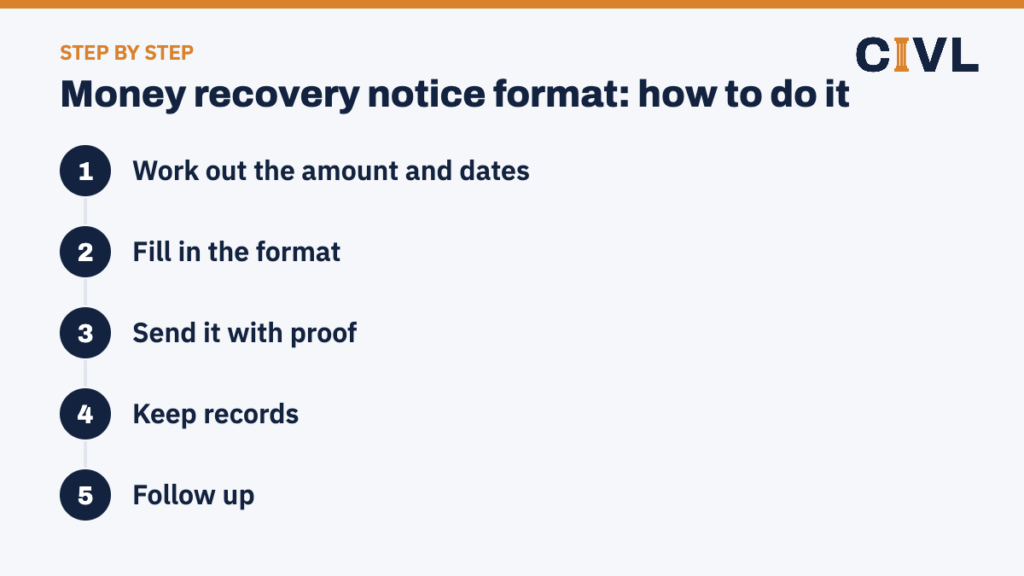
- Work out the amount and dates. List each payment, invoice and part-payment. Check the three-year limit.
- Fill in the format. Write facts in short numbered paragraphs.
- Send it with proof. Speed Post with tracking and proof of delivery, and email as an extra copy.
- Keep records. Save the receipt, tracking report and any reply.
- Follow up. If unpaid, start mediation (for commercial disputes) or file a suit before the limitation period ends.
Common mistakes to avoid
- Missing the limitation period. A notice does not extend the three years; only a written acknowledgement or part-payment by the debtor does.
- Threatening criminal action. Do not threaten police or criminal cases to pressure payment; it can be used against you.
- Inflated claims. Claim only what you can prove; show interest separately.
- Wrong party. For a company or firm, use its legal name and registered address.
CIVL format
Get the ready-to-use money recovery notice format
- Editable Word file and a print-ready PDF
- Notes on how to fill every blank
- Versions for personal loans, unpaid invoices and unpaid salary
- Interest calculation sheet
- Delivered to your email after payment
Price: ₹49 · Coming soon
Frequently asked questions
What is the time limit to recover money in India?
Generally three years under the Limitation Act, 1963, counted from when the money became payable. A signed acknowledgement or part-payment before expiry restarts the period.
Is a recovery notice compulsory before filing a suit?
No, except in some cases such as suits against the Government. But it often leads to payment and helps your case.
What is a summary suit?
A faster procedure under Order XXXVII CPC for claims on written contracts, bills of exchange or cheques, where the defendant must get permission to defend.
Can I claim interest?
Yes, if agreed in writing or shown in invoices. Otherwise the court may award reasonable interest.
Where can I get a ready-to-use money recovery notice format?
CIVL’s money recovery notice format comes as an editable Word file and a print-ready PDF, with notes on filling every blank and checking your state’s rules. Use the button above to be told when it is available.