

Need a legal notice format? This page explains when you need it, what it must contain and how to make it valid, step by step. You can also get CIVL’s ready-to-use legal notice format as an editable Word file and PDF.
Quick answer
A legal notice is a formal letter that tells the other side what they did wrong, what you want, and by when, before you go to court or a consumer commission. You can sign and send it yourself. It needs no stamp paper, no notary and no registration; your only cost is printing and Speed Post with proof of delivery (usually under ₹100).
Read the full guide: How to send a legal notice in India
What is a legal notice?
A legal notice is a written demand sent before starting a case. It sets out the facts, the right you are relying on, what you want the other person to do (pay money, return a deposit, fix a defect, stop doing something), and a deadline to do it. It also creates a dated record that you gave them a fair chance, which courts and commissions look at later.
For most private disputes no law makes a notice compulsory, but it is the normal first step and often settles the matter. In some cases it is compulsory: a suit against the Government or a public officer needs two months’ notice under Section 80 of the Code of Civil Procedure, 1908, and a cheque bounce case needs a demand notice under Section 138 of the Negotiable Instruments Act, 1881 (see our cheque bounce notice format).
When you need it
- Someone owes you money and has stopped responding (a loan, unpaid invoice or salary).
- Your landlord is not returning your security deposit, or a tenant is not paying rent or vacating.
- A seller, builder or service provider has given you a defective product or poor service.
- Someone is breaching an agreement, blocking your property or using it without permission.
- You plan to sue a government department or public officer (two months’ notice under Section 80 CPC).
- A cheque given to you has bounced (use the separate cheque bounce notice format, which has strict deadlines).
Stamp duty, notarisation and registration
| Requirement | What applies | Notes |
|---|---|---|
| Stamp paper / e-stamp | Not needed | Print on plain paper or your letterhead. |
| Notarisation | Not needed | Your signature is enough. |
| Registration | Not needed | Proof of sending and delivery matters instead. |
| Witnesses | Not needed | Keep a signed office copy for your records. |
These rules are the same across India. What matters is proof of delivery: keep the postal receipt and the delivery report.
What the legal notice must contain
- Date, and the mode of sending (for example “By Speed Post with tracking and by email”).
- Full name and address of the sender, and of each person or company the notice is addressed to.
- The facts in short numbered paragraphs, in date order, with amounts, invoice or agreement numbers.
- The right or law you rely on (the agreement clause, the Act or the section, if you know it).
- A clear demand: what exactly the other side must do, and the exact amount, if money is due.
- A deadline to comply, usually 15 or 30 days from receipt (for a suit against the Government, two months).
- What you will do if they do not comply (file a civil suit, consumer complaint or other case), and that you will claim costs.
- A list of documents you are relying on, and your signature.
How to make it valid: step by step
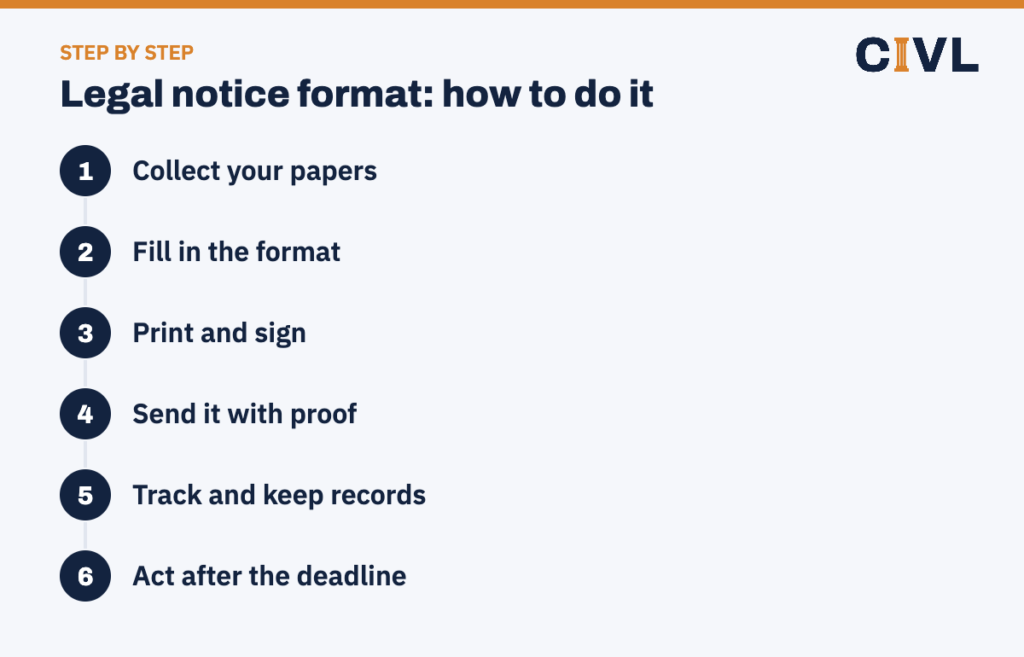
- Collect your papers. Agreement, bills, bank statements, messages and emails. Note every date and amount.
- Fill in the format. Use the other side’s correct legal name and current address. For a company, use its registered office address from the MCA website.
- Print and sign. Plain paper is fine. Sign every page and keep at least one signed copy.
- Send it with proof. Use India Post Speed Post with the proof of delivery add-on (Registered Post was merged into Speed Post in September 2025). You can also email or WhatsApp a copy, but always keep the postal proof.
- Track and keep records. Save the postal receipt, the tracking print-out and the acknowledgement card. Note the date the deadline ends.
- Act after the deadline. If they reply, read it carefully. If they do not comply, you can file your case. Use Ask CIVL if you are unsure which forum to approach.
Common mistakes to avoid
- Wrong name or address. A notice to the wrong entity or old address can be useless. Check company names on the MCA portal.
- Vague demand. “Settle my dues” is weak. State the exact amount or action and the deadline.
- Threats or abuse. Never threaten criminal action to pressure payment or use insulting language; it can be used against you.
- No proof of sending. A notice sent only by ordinary post or only on WhatsApp is hard to prove later.
- Waiting too long. Sending a notice does not stop the limitation period for your case. Keep track of the time limit.
- Admitting things you did not mean to. Stick to facts you can prove; your notice can be shown in court.
CIVL format
Get the ready-to-use legal notice format
- Editable Word file and a print-ready PDF
- Notes on how to fill every blank
- Versions for money due, breach of agreement and deficiency in service
- Covering letter and postal checklist
- Delivered to your email after payment
Price: ₹49 · Coming soon
Frequently asked questions
Can I send a legal notice myself without a lawyer?
Yes. Nothing in Indian law says a notice must come from an advocate. A clearly written notice signed by you and sent with proof of delivery is valid.
Is a legal notice sent on WhatsApp or email valid?
Courts have accepted notices served by email and WhatsApp in some cases, but the safest route is Speed Post with tracking and proof of delivery, with email or WhatsApp as an extra copy.
How many days should I give in a legal notice?
Usually 15 or 30 days from receipt. Some laws fix the period: two months for a suit against the Government under Section 80 CPC, and 15 days for payment in a cheque bounce notice.
What if the other side refuses to accept the notice?
If the postal record shows “refused” or “unclaimed” at the correct address, courts generally treat the notice as served. Keep the returned envelope unopened as proof.
What happens if they do not reply?
There is no penalty for not replying, but you can go ahead with your case once the deadline passes. Your notice and proof of delivery go into your case file.
Where can I get a ready-to-use legal notice format?
CIVL’s legal notice format comes as an editable Word file and a print-ready PDF, with notes on filling every blank and checking your state’s rules. Use the button above to be told when it is available.