
HRA exemption lets a salaried employee who lives in a rented home reduce tax on the house rent allowance paid by the employer. From 1 April 2026, the claim is made under the Income-tax Act, 2025, four more cities get the higher 50% limit and Form 124 replaces Form 12BB.
Quick answer
The exempt part of your HRA is the lowest of three amounts: the HRA you actually received; rent paid minus 10% of salary; and 50% of salary in Delhi, Mumbai, Kolkata, Chennai, Bengaluru, Hyderabad, Pune and Ahmedabad (40% elsewhere). “Salary” here means basic pay plus dearness allowance (and commission based on turnover).
HRA exemption is available only under the old tax regime. Give your employer Form 124 with rent receipts, and the landlord’s PAN if the yearly rent is more than ₹1 lakh. If your employer did not allow it, you can still claim it in your income tax return.
What is HRA exemption?
House rent allowance (HRA) is a part of salary that many employers pay to cover rent. It is taxable unless you qualify for the exemption. HRA exemption is the portion that the law treats as tax-free because you actually spend it on rent for the house you live in.
The rule was carried over from section 10(13A) of the old Income-tax Act, 1961 into the Income-tax Act, 2025 and the Income-tax Rules, 2026, which apply from 1 April 2026 (tax year 2026-27). The formula is the same; the main changes are the list of higher-limit cities and the new declaration form.
Who can claim HRA exemption?
- You are a salaried employee and your salary includes HRA.
- You live in rented accommodation and actually pay rent.
- You do not own the house you live in. Owning a house in another city does not stop the claim.
- You have opted for the old tax regime. Under the new regime, the full HRA is taxable.
If you are self-employed or your salary has no HRA, you cannot claim HRA exemption. Under the old regime you may instead get a separate rent deduction (the old section 80GG rule), capped at ₹5,000 a month (₹60,000 a year).
How HRA exemption is calculated
Work out three amounts for the year and take the lowest. The rest of your HRA is taxable.
| Limit | Formula |
|---|---|
| 1. Actual HRA received | The HRA shown in your salary slips |
| 2. Rent minus 10% of salary | Rent paid for the year minus 10% of (basic + DA) |
| 3. City limit | 50% of (basic + DA) in the 8 listed cities; 40% elsewhere |
Worked example
Priya works in Pune. Her basic pay plus DA is ₹50,000 a month (₹6,00,000 a year), her HRA is ₹20,000 a month (₹2,40,000) and she pays rent of ₹18,000 a month (₹2,16,000).
- Actual HRA: ₹2,40,000
- Rent minus 10% of salary: ₹2,16,000 − ₹60,000 = ₹1,56,000
- 50% of salary (Pune is now a 50% city): ₹3,00,000
Her HRA exemption is ₹1,56,000, the lowest of the three. The remaining ₹84,000 of HRA is taxed. Before April 2026, Pune was a 40% city, but in this example the third limit was not the lowest anyway. The change helps most when rent is high compared to salary.
Which cities get the 50% limit from 2026?
| 50% of salary | 40% of salary |
|---|---|
| Delhi, Mumbai, Kolkata, Chennai (as before) | All other cities and towns |
| Bengaluru, Hyderabad, Pune, Ahmedabad (new from 1 April 2026) |
Documents you need
- Rent receipts for each month (or quarter), signed by the landlord, showing the amount, period, address and the landlord’s name. Employers usually insist on them once rent crosses ₹3,000 a month. Our free rent receipt generator makes them in a minute.
- Rent agreement with the landlord. See our rent agreement format.
- Landlord’s PAN if rent is more than ₹1 lakh in the year. If the landlord has no PAN, a signed declaration from the landlord is usually asked for.
- Form 124, the new statement of claims to your employer, which replaced Form 12BB from 1 April 2026.
- Bank statements or UPI records showing the rent payments.
Claiming HRA exemption: step by step
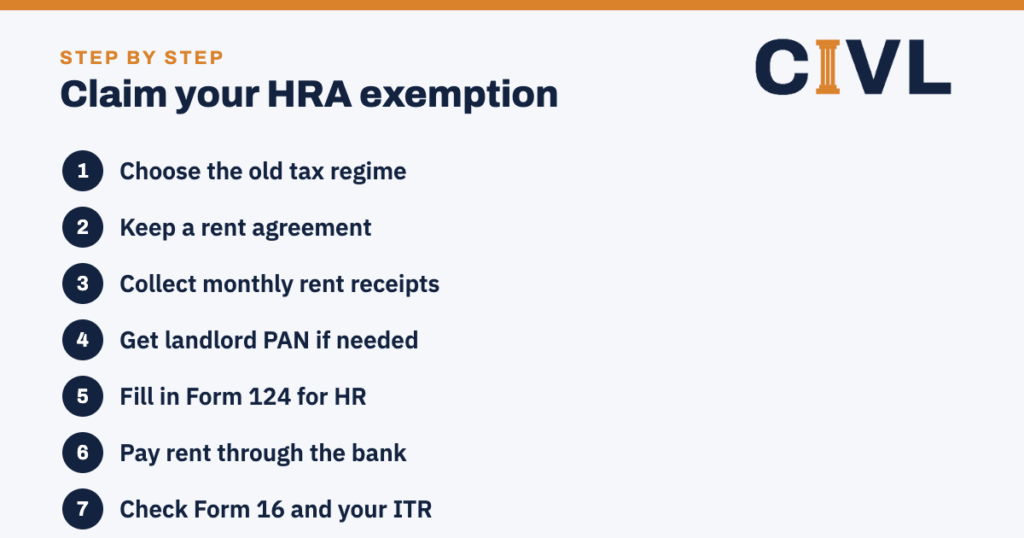
- Choose the old regime. Tell your employer at the start of the year. HRA exemption does not exist under the new regime.
- Keep a rent agreement. A written agreement proves the tenancy and the rent.
- Collect rent receipts. Get them signed every month or quarter. Cash receipts above ₹5,000 should carry a ₹1 revenue stamp.
- Get the landlord’s PAN. It is needed when yearly rent is above ₹1 lakh.
- Fill in Form 124. Give your employer the HRA claim, the landlord’s name, address and PAN, and your relationship with the landlord, if any.
- Pay rent through the bank. Bank transfer or UPI creates a record that matches your receipts.
- Check Form 16 and your return. Make sure the exemption shows in your salary certificate. If it is missing, claim it in your income tax return and keep the documents ready.
Rent paid to parents or a spouse
- Parents: you can pay rent to a parent who owns the house and claim HRA exemption, if the arrangement is genuine. Pay through the bank, sign a rent agreement, and your parent must show the rent as income in their own return. Form 124 now asks you to disclose the relationship.
- Spouse: rent paid to your husband or wife is usually challenged by the tax department as not genuine, because couples normally share a home. It is best avoided.
- Jointly owned house: if you co-own the house you live in, you cannot claim rent for your own share.
Special situations
Changing jobs or cities during the year
Work out HRA exemption separately for each period with the same salary, HRA, rent and city, and add the results. If you move from Lucknow to Pune in October, the 40% limit applies up to September and the 50% limit from October.
HRA and a home loan together
You can claim HRA exemption on a rented house and home loan benefits on a house you own, if you genuinely live in the rented house. This is common when your own house is in another city, is still under construction or is let out. Keep proof of why you do not live in your own house.
Paying rent in cash
Cash rent is allowed, but it is harder to prove. Get a receipt every month with a ₹1 revenue stamp on receipts above ₹5,000, and keep withdrawals that match. Bank transfer or UPI is always safer.
Living with parents in their house
If you live free in your parents’ house, there is no HRA exemption because you pay no rent. If you do pay them rent, follow the rules in the section above.
Is HRA exemption worth choosing the old regime for?
HRA exemption is the main reason many salaried people stay with the old tax regime. Whether it is worth it depends on how large your deductions are in total. The new regime is the default, has lower slab rates, a standard deduction of ₹75,000 for salaried people and, with the rebate, no tax on taxable income up to ₹12 lakh. The old regime has higher rates but allows HRA exemption, deductions for investments such as PPF and life insurance, home loan interest on a self-occupied house and health insurance premiums.
- If your HRA exemption is large (high rent in a 50% city) and you also use other deductions fully, the old regime often comes out ahead.
- If your rent is modest and you make few tax-saving investments, the new regime is usually better even after losing HRA exemption.
- Work out your tax both ways each year before telling your employer which regime you want; the income tax e-filing portal has a calculator for this.
- Salaried employees can switch between regimes each year when filing the return, but people with business income have limited chances to switch.
Second worked example: a high rent in Delhi
Amit works in Delhi. His basic pay plus DA is ₹80,000 a month (₹9,60,000 a year), his HRA is ₹40,000 a month (₹4,80,000) and his rent is ₹45,000 a month (₹5,40,000).
- Actual HRA received: ₹4,80,000
- Rent minus 10% of salary: ₹5,40,000 − ₹96,000 = ₹4,44,000
- 50% of salary (Delhi): ₹4,80,000
His HRA exemption is ₹4,44,000, and only ₹36,000 of HRA is taxed. Because his yearly rent is above ₹1 lakh, he must give his landlord’s PAN. His rent is below ₹50,000 a month, so he does not have to deduct TDS on rent (see below). If his rent were lower, say ₹20,000 a month, the second limit would fall to ₹1,44,000 and his HRA exemption would shrink by about two-thirds.
TDS on rent: when the tenant must deduct tax
If you pay rent of more than ₹50,000 a month to a resident landlord, you, as an individual tenant, must deduct TDS at 2% (the rate was cut from 5% from 1 October 2024) and deposit it using the challan-cum-statement on the income tax portal. You do not need a TAN for this. The deduction is usually made once a year or at the end of the tenancy.
If your landlord is a non-resident (NRI), the rules are stricter. TDS applies on the whole rent at the rate for non-residents (about 30% plus surcharge and cess), whatever the amount, and you need a TAN and must file TDS returns. Ask the landlord for a lower-deduction certificate from the tax department if the rate seems too high. Not deducting TDS can lead to interest and penalties on the tenant, and the HRA exemption itself may be questioned.
If you get a tax notice about HRA exemption
The tax department matches HRA claims with landlords’ PANs and returns, and sends notices where large claims look doubtful, such as rent paid to relatives or claims made only in the return. Do not panic; reply on the e-filing portal within the time given.
- Rent agreement, preferably registered or on stamp paper
- Monthly rent receipts signed by the landlord
- Bank or UPI statements showing each rent payment
- Landlord’s PAN and proof that the landlord declared the rent as income
- Electricity bills, gas bills or other proof that you actually lived at the rented address
- Form 124 given to your employer and Form 16 showing the exemption
Courts and tribunals have accepted HRA exemption on rent paid to parents where the payments were real and the parent declared the income, and rejected it where the evidence was only a few receipts with no money trail.
HRA exemption when you change jobs during the year
If you switch employers mid-year, each employer gives HRA exemption only for the months you worked there. Give each employer Form 124 with the rent receipts for its period. When you file your return, check that the two Form 16s together do not claim the exemption twice for the same months, and that the total matches what you can actually claim. If the new employer missed it, claim the balance in your return.
Tips to keep your HRA exemption safe
- Pay rent by bank transfer or UPI on a fixed date each month, with a note such as “rent for May”.
- Keep the rent agreement current; renew it when it expires, and keep the rent in it the same as what you pay.
- Ask your landlord to show the rent in their own tax return, especially if the landlord is a relative.
- Keep your address on Aadhaar, the bank and bills the same as the rented house, where possible.
- Store receipts and statements for at least six years, as notices can be sent for earlier years.
- Recheck the city list each year; the 50% city list changed from 1 April 2026.
Common mistakes to avoid
- Claiming HRA exemption under the new tax regime.
- Making up rent receipts without actually paying rent. The tax department matches landlord PANs with their returns.
- Leaving out the landlord’s PAN when yearly rent is above ₹1 lakh.
- Not disclosing that the landlord is a relative in Form 124.
- Using the 40% limit for Bengaluru, Hyderabad, Pune or Ahmedabad for tax year 2026-27, or the 50% limit for any other city.
- Counting allowances other than basic pay and DA as “salary” in the formula.
Frequently asked questions
Is HRA exemption available in the new tax regime?
No. HRA exemption can be claimed only under the old regime. Under the new regime the whole HRA is taxable.
Which cities get 50% HRA exemption from 2026?
Delhi, Mumbai, Kolkata, Chennai, Bengaluru, Hyderabad, Pune and Ahmedabad. All other places get 40% of salary.
What replaced Form 12BB?
Form 124 under the Income-tax Rules, 2026, from 1 April 2026. It also asks you to state your relationship with the landlord.
Is the landlord’s PAN compulsory?
Only if the rent you pay is more than ₹1 lakh in the year. Below that, rent receipts and the agreement are usually enough.
Can I claim HRA exemption if I own a house in another city?
Yes, if you live in a rented house where you work and do not own the house you live in.
Can I claim HRA exemption if my employer missed it?
Yes. You can claim it in your income tax return. Keep the rent receipts, agreement and payment proof in case the department asks.
How is HRA exemption calculated if I joined mid-year?
Calculate it only for the months you received HRA and paid rent. Take the lowest of the three limits for that period.
Do I need rent receipts if I pay rent by UPI?
Yes. Employers still usually ask for receipts and a rent agreement. UPI records support them but do not replace them.
Do I need to deduct TDS on rent for HRA exemption?
Only if your rent is more than ₹50,000 a month (2% TDS), or if the landlord is a non-resident (TDS on any amount). Otherwise no TDS is needed.
What if my landlord refuses to give PAN?
If yearly rent is above ₹1 lakh, the PAN is needed for HRA exemption. If the landlord has no PAN, get a signed declaration from the landlord stating so; the employer may still be cautious.
Should I choose the old regime only for HRA exemption?
Not necessarily. Compare your total tax under both regimes. The old regime helps when HRA exemption and other deductions together are large.
Can my HRA exemption be rejected after I file my return?
Yes, if the department finds the claim is not genuine. Keep the rent agreement, receipts, payment records and the landlord’s PAN for several years.
Where can I get rent receipts for my HRA exemption claim?
Use the free CIVL rent receipt generator, and the rent agreement format for the agreement itself.
CIVL format
Papers for your HRA claim
Make receipts with the free rent receipt generator and draw up the tenancy with the rent agreement format. Read about rent agreement registration and stamp duty, or ask CIVL a question.