
You do not have to register a will for it to be valid in India, but choosing to register a will makes it much harder to challenge and keeps a safe copy in government records. This guide explains when it makes sense to register a will, what it costs, the documents and witnesses you need, how to do it step by step, and the alternative of depositing a sealed will.

Quick answer
Registration of a will is optional (Registration Act, 1908, s.18). A will is valid if it is in writing, signed by the person making it and attested by two witnesses (Indian Succession Act, 1925, s.63). To register a will, the person making it appears in person before the Sub-Registrar with the original will, ID proof and two witnesses, and pays a small fee. No stamp duty is payable. There is no time limit, and a registered will can still be changed or cancelled by making a new will.
Why register a will?
- Harder to challenge: the Sub-Registrar records the identity, photo and thumb impression of the person making the will, which helps disprove claims of forgery or impersonation.
- Safe copy: the will is copied into the official register, so a certified copy is available even if the original is lost or destroyed.
- Evidence of the date: it fixes when the will was made, which matters if there are several wills.
- Peace of mind for heirs: banks and revenue offices often deal more smoothly with a registered will.
Registration does not make a will automatically valid. If the will is challenged, it must still be proved, usually by examining at least one attesting witness (section 68 of the old Evidence Act, now section 67 of the Bharatiya Sakshya Adhiniyam, 2023). But courts give weight to a registered will, and suspicious circumstances are harder to allege.
Before you register a will: make sure it is valid
- the person making the will must be an adult of sound mind, acting freely (Indian Succession Act, s.59)
- the will must be signed by that person, or by someone in their presence and by their direction (s.63)
- two witnesses must each see the signing and sign in the presence of the person making it
- avoid making a beneficiary or their spouse a witness: a gift to an attesting witness can be void (s.67)
- describe property clearly, name an executor, and add a clause revoking earlier wills
Use a tested format, such as CIVL’s will format, so that nothing important is missed.
What you need to register a will
- the original will, signed and witnessed
- identity proof and photographs of the person making the will
- two witnesses (often the attesting witnesses) with their identity proof
- a medical certificate of sound mind, especially if the person is elderly or unwell (not compulsory, but strongly advised)
- the registration fee, which is set by each state and is usually small
How to register a will: step by step
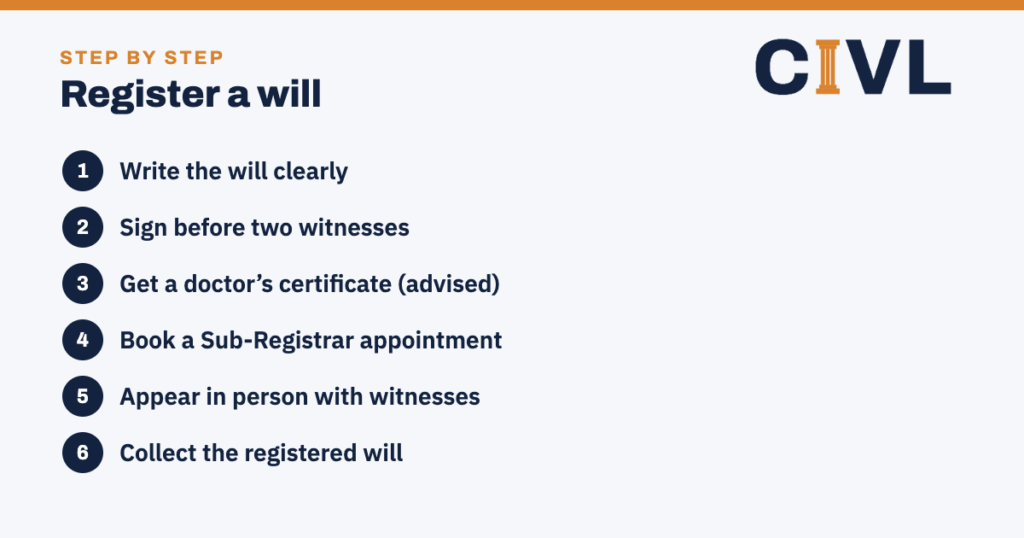
- Write the will clearly. List the property, the beneficiaries, the executor and any conditions. Plain paper is enough; no stamp paper is needed.
- Sign before two witnesses. Sign every page and the end, and have both witnesses sign in your presence.
- Get a doctor’s certificate (advised). A short certificate that you are of sound mind on the date of signing helps if the will is challenged.
- Book a Sub-Registrar appointment. You can go to any Sub-Registrar with jurisdiction where you live or where the property is; many states allow online booking.
- Appear in person with witnesses. The Sub-Registrar checks your identity, records your photo and thumb impression, confirms that you made the will, and registers it on payment of the fee.
- Collect the registered will. The original is returned with the registration endorsement. Keep it safe and tell your executor where it is.
Depositing a sealed will instead
If you want to keep the contents private, you can deposit your will in a sealed cover with the Registrar (Registration Act, ss.42 to 46). The cover is opened only after your death, on the application of a person entitled to it. You can withdraw it at any time.
Fees, time limits and probate
| Point | What to expect |
|---|---|
| Stamp duty | Not payable on a will |
| Registration fee | Small amount, set by each state |
| Time limit | None; a will can be registered at any time (Registration Act, s.27). After death, a person claiming under it can present it (s.40) |
| Changing the will | Make a new will at any time; it cancels the old one if it says so (Indian Succession Act, s.62 and s.70) |
| Probate | Needed for wills of Hindus, Sikhs, Jains and Buddhists made in, or about property in, the areas covered by section 57, such as Mumbai, Kolkata and Chennai; in most other places probate is optional |
Register a will from home: elderly or unwell testators
If the person making the will is old, ill or bedridden, they do not have to travel to the office to register a will. Under section 31 of the Registration Act, 1908, the Sub-Registrar can, on special cause and on payment of an extra fee, visit the person’s home or a hospital to register the document. Apply in writing to the Sub-Registrar with a doctor’s note explaining why the person cannot attend.
How to make your will harder to challenge
Most disputes are about whether the testator was of sound mind and acting freely. Simple steps make that easy to prove:
- Get a short certificate from a doctor, dated the same day, saying the testator is mentally fit to make a will.
- Choose two independent adult witnesses who are not beneficiaries or their spouses (section 67 of the Indian Succession Act).
- Record a short video of the testator reading or confirming the will and signing it in front of the witnesses.
- Register a will soon after signing it, so the Sub-Registrar’s record supports the date and identity.
- Explain in the will itself why any close family member is left out.
Registered will, probate and succession certificate
| Document | Who issues it | When it is needed |
|---|---|---|
| Registered will | Sub-Registrar | Optional; strong evidence that the will was signed by the testator |
| Probate | District Court or High Court | Compulsory for certain wills in Mumbai, Chennai and Kolkata areas (section 57); otherwise often asked for by banks or buyers |
| Succession certificate | Civil court | To collect debts or securities of a person who died without a will, or where no probate is obtained |
Wills under different personal laws
The basic rules on who can make a will and how it must be signed depend partly on the religion of the person making it. The steps to register a will at the Sub-Registrar’s office are the same for everyone, but what the will can do is not.
| Community | Law that applies | What to keep in mind |
|---|---|---|
| Hindus, Sikhs, Jains, Buddhists | Hindu Succession Act, 1956 (s.30) and the Indian Succession Act, 1925 (s.57 and Schedule III) | Can leave all self-acquired property and their share in joint family property by will. Writing, signature and two witnesses are required. |
| Christians and Parsis | Indian Succession Act, 1925, Part VI | Writing and two witnesses are required. Marriage after the will generally cancels it (s.69), so a new will is needed after marriage. |
| Muslims | Muslim personal law | A will (wasiyat) can be oral or written and needs no witnesses, but it generally cannot give away more than one-third of the estate, or give anything to an heir, unless the other heirs agree after the death. |
| Soldiers, airmen and sailors on active service | Indian Succession Act, ss.65 and 66 (privileged wills) | A privileged will can be made with fewer formalities, even orally in some cases. |
Muslims and others can still choose to register a will, and many do. Registration gives the same benefits of a fixed date, a recorded identity and a safe copy, even where the law does not require writing at all.
Registered will, unregistered will or sealed deposit: which to choose
There are three common ways to keep a will. Each is legally valid if the will itself is properly made.
| Point | Unregistered will | Registered will | Sealed will deposited with the Registrar |
|---|---|---|---|
| Validity | Valid if signed and attested | Valid if signed and attested | Valid if signed and attested |
| Privacy | Private | Copied into Book 3 of the Registrar’s records; copies are given only to the testator or their agent while they are alive | Fully private; the cover is opened only after death |
| Safe copy if the original is lost | No | Yes, a certified copy can be obtained | Yes, the Registrar keeps the sealed cover |
| Proof of identity and date | Must be proved by witnesses | Strong supporting evidence from the Sub-Registrar’s record | Recorded when the cover is deposited |
| Cost | Nothing | Small state fee | Small state fee |
For most families, the simplest choice is to register a will at the local Sub-Registrar. Choose the sealed deposit if keeping the contents secret from family members during your lifetime matters more to you.
Changing a will after you register a will
A will only takes effect on death, so you can change it as often as you like. Registration does not lock it in place.
- Make a new will. Write a fresh will that says it revokes all earlier wills and codicils (Indian Succession Act, s.70). This is the cleanest way to make major changes.
- Add a codicil. A codicil is a short document that changes or adds to an existing will. It must be signed and attested in the same way as a will, and it can also be registered.
- Destroy the will. Tearing or burning the will with the intention of revoking it also cancels it, but the copy in the Registrar’s records stays. A new will is a clearer way to show your intention.
- A later unregistered will still counts. A properly made later will cancels an earlier registered one even if the later will is not registered. Registration only makes the later will easier to prove, so it is wise to register the new will too.
If you deposited a sealed will and later change your mind, you can withdraw the sealed cover from the Registrar and deposit a new one.
Nominee or will: who gets the money?
Many people assume that the nominee on a bank account, demat account, mutual fund or flat will become its owner. In most cases that is not right. A nominee generally receives the asset only as a trustee for the people who inherit it under the will or under succession law.
- Shares and securities: in Shakti Yezdani v. Jayanand Jayant Salgaonkar (2023), the Supreme Court held that a nominee under company and depositories law does not become the absolute owner; the will or succession law decides who inherits.
- Bank accounts and flats in housing societies: the bank or society can safely pay or transfer to the nominee, but the nominee must hand over the asset to the legal heirs or beneficiaries.
- Life insurance: the main exception. Where the nominee is the spouse, parent or child of the policyholder, they are treated as a “beneficial nominee” and keep the money (Insurance Act, 1938, s.39(7)).
So keep nominations and the will consistent. If you register a will that leaves an account to one child but the nomination names another, the family may end up in a dispute even though the will should prevail.
After the testator’s death: how the family uses a registered will
- Find the will. The executor or family should locate the original. If it cannot be found, any person can apply for a certified copy of a registered will once the testator has died (Registration Act, s.57).
- Open a sealed will, if one was deposited. A person who produces the death certificate can apply to the Registrar to open the sealed cover. The Registrar opens it in their presence and copies the will into the register (ss.45 and 46).
- Get the death certificate. Several copies are needed for banks, the registry, insurers and the court.
- Apply for probate if needed. Probate is compulsory only for wills covered by section 57 (mainly property in or wills made in the old Presidency towns of Mumbai, Kolkata and Chennai). Elsewhere, banks or buyers may still ask for it for large assets.
- Transfer the assets. Use the will (and probate, if obtained) to claim bank balances, transfer shares and get property mutation done in the land or municipal records.
An executor named in the will is responsible for collecting the assets, paying any debts and handing the property to the beneficiaries. If no executor is named, a beneficiary can apply for letters of administration with the will annexed.
How NRIs can register a will, and wills made abroad
A non-resident Indian can register a will in India only by appearing in person before the Sub-Registrar, as for any other testator. Most NRIs register a will on a visit home. If that is not possible, the will can simply be signed and attested abroad: it is still valid in India without registration.
- Use two witnesses who are likely to be traceable later, since one may have to give evidence.
- Have the signatures notarised, or attested at the Indian embassy or consulate, so that the will is easier to prove in an Indian court.
- Describe Indian property with full addresses and survey or flat numbers, and say which law should govern any foreign assets.
- After death, a person claiming under the will can present it for registration in India (Registration Act, s.40).
Worked example: how to register a will in Lucknow
Ramesh, a 74-year-old retired teacher in Lucknow, owns a house, two fixed deposits and a demat account. He decides to register a will. He wants to leave the house to his wife for her lifetime and then to his two daughters equally, and the deposits and shares to his wife.
- He writes the will on plain paper, using a will format. It lists the house with its full address and khasra details, the bank and deposit numbers in part, and the demat account, and names his elder daughter as executor.
- He asks two neighbours, neither of them a beneficiary, to act as witnesses.
- On the morning of signing, his family doctor gives a one-paragraph certificate that he is of sound mind.
- He books an appointment with the Sub-Registrar on the state registration portal and goes with the original will, his Aadhaar and PAN, two photographs and both witnesses with their ID.
- The Sub-Registrar records his photo and thumb impression, confirms that he made the will of his own free will, and registers it on payment of the fee. The will is returned the same day with the registration endorsement.
- He updates the nominations on his deposits and demat account so that they match the will, and tells his daughter where the original is kept.
Total time to register a will: one visit of a few hours. No stamp duty was paid. If Ramesh later wants to change the will, he can make and register a new will that revokes this one.
Who can be a witness when you register a will?
- Any adult of sound mind who sees the testator sign (or acknowledge the signature) can be a witness.
- The witnesses do not need to know what the will says; they only confirm the signature.
- Both witnesses need not be present at the same time, but each must sign in the testator’s presence (Indian Succession Act, s.63).
- A doctor, neighbour, colleague or lawyer is a good choice. Avoid beneficiaries and their husbands or wives (s.67).
- Choose younger witnesses who will be easy to trace later, and note their full addresses on the will.
Practical tips before you register a will
- Number every page and sign at the foot of each one, so that pages cannot be swapped.
- Use the full legal names of beneficiaries as on their Aadhaar or PAN, and say how each is related to you.
- Include a residuary clause covering “all my remaining property”, so that assets you forgot or acquire later are not left without a will.
- Name a back-up executor in case the first one dies before you or does not want to act.
- Do not attach original title deeds to the will; describe them instead and keep them safely.
- Review the will every few years (and register a will again whenever you replace it), and after any marriage, divorce, birth, death or large sale or purchase.
Common mistakes to avoid
- Thinking an unregistered will is invalid. It is valid if properly signed and attested.
- Using a beneficiary as a witness. The gift to that witness can fail.
- Writing an unclear will. Vague property descriptions lead to disputes, registered or not.
- Forgetting to update it after a marriage, death or sale of property.
- Keeping it secret from everyone. Tell the executor where the registered will is kept.
- Giving away more than you can. You can only bequeath your own property, and under Muslim personal law a will is generally limited to one-third of the estate.
Frequently asked questions
Is it compulsory to register a will in India?
No. Registration is optional. A will is valid if it is in writing, signed and attested by two witnesses.
How much does it cost to register a will?
No stamp duty is payable. The registration fee is small and set by each state. Some people also pay a lawyer to draft the will.
Can I register a will online?
In some states you can book the appointment and pay the fee online, but you must appear in person before the Sub-Registrar.
Can I change a will after I register it?
Yes. You can make a new will at any time. A later will that revokes earlier ones replaces the registered will, even if the new one is not registered.
Can a will be registered after the person’s death?
Yes. A person claiming under the will can present it for registration after the death (Registration Act, s.40), but the Sub-Registrar will hold an enquiry and it is harder than registering during the person’s lifetime.
Can an NRI register a will in India?
Yes. An NRI can register a will by appearing before the Sub-Registrar while in India. A will signed abroad is also valid if it meets Indian rules on signatures and witnesses, and can be registered later.
Is stamp duty payable when you register a will?
No. A will does not need stamp paper and no stamp duty is payable. You pay only the registration fee and any copying or visit charges set by your state.
Can a registered will be challenged?
Yes. Registration is strong evidence that the will was signed, but it can still be challenged for lack of mental capacity, undue influence, fraud or suspicious circumstances. The person relying on the will must prove it under the Bharatiya Sakshya Adhiniyam.
Can a later unregistered will cancel a registered will?
Yes. The latest valid will is the one that counts, whether or not it is registered. A registered will gives no priority over a later will that is properly signed and attested. If you change your will, register the new one as well so that its date and authenticity are easy to prove.
Does a Muslim need to register a will?
No. Under Muslim personal law a will can be oral or written, and registration is not required. A Muslim can still choose to register a will to create a clear record, but the one-third limit and the rule on gifts to heirs still apply.
Is a nominee the owner of the money after death?
Usually not. For bank accounts, shares, mutual funds and society flats, the nominee receives the asset as a trustee for the legal heirs or the beneficiaries under the will. Life insurance is the main exception, where a spouse, parent or child named as nominee keeps the money.
Is a video recording of a will valid?
No. A video on its own is not a valid will for most people in India, because the Indian Succession Act requires a written will signed by the testator and attested by two witnesses. A video of the signing is still useful as extra evidence that the testator was of sound mind and acting freely.
Where can I get a ready-to-use format before I register a will?
Use CIVL’s will format, which includes the attestation clause and witness section needed to register a will.
CIVL format
Write your will before you register it
Start with CIVL’s will format. Planning gifts during your lifetime? See the gift deed format. For what heirs need later, read about the succession certificate and legal heir certificate. Still stuck? Ask CIVL.