
An RTI first appeal is your free, simple remedy when a Public Information Officer (PIO) ignores your RTI, refuses it or sends a vague reply. This guide explains when you can file an RTI first appeal, the 30-day deadline, what to write, how to file it online or by post, and what to do if the appeal also fails.
Quick answer
File an RTI first appeal within 30 days of the PIO’s reply, or within 30 days after the reply was due (usually 30 days from your application). Address it to the First Appellate Authority (FAA), an officer senior to the PIO in the same office. There is no fee for Central Government offices. The FAA should decide within 30 days (45 days at most, with written reasons). If you are still unhappy, file a second appeal with the Information Commission within 90 days.
Free tool: still need to file the original application? Use the free RTI application generator.
What is an RTI first appeal?
Under Section 19(1) of the Right to Information Act, 2005, any person who does not get a decision on their RTI in time, or who is unhappy with the PIO’s decision, can appeal to an officer senior in rank to the PIO. That officer is called the First Appellate Authority (FAA). The RTI first appeal is an internal review inside the same public authority, so it is quick, free in Central offices and needs no lawyer.
The law also puts the burden on the PIO: in any appeal, it is for the PIO to prove that denying the information was justified (Section 19(5)). You do not have to prove why you want the information.
When you can file an RTI first appeal
You can file an RTI first appeal on any of these grounds:
- No reply in time. If the PIO does not reply within 30 days (35 days if you sent the RTI through an Assistant PIO, 48 hours where life or liberty is involved), the law treats it as a refusal (Section 7(2)).
- Refusal. The PIO rejects your request, often citing an exemption under Section 8 or 9 without explaining why it applies.
- Incomplete or misleading reply. Some questions are skipped, or the answer is vague, wrong or not what you asked.
- Excessive fee. The PIO asks for an additional fee that seems unreasonable or is wrongly calculated.
- Wrong form of access. You asked for copies or an inspection, and the PIO refused without a valid reason (Section 7(9)).
- Third-party decision. A third party whose information is involved can also appeal against a decision to disclose it (Section 19(2)).
Tip: if the PIO did not reply in time, the information must later be given free of charge (Section 7(6)). Mention this in your RTI first appeal.
What you need before you start
- A copy of your RTI application, with the date and registration number or postal receipt
- The PIO’s reply, if any, and the date you received it
- Proof of the fee you paid (online receipt, postal order or BPL certificate)
- The name and address of the First Appellate Authority (see step 3 below)
- A short list of your grounds: which questions were not answered and why the reply is wrong
How to file an RTI first appeal: step by step
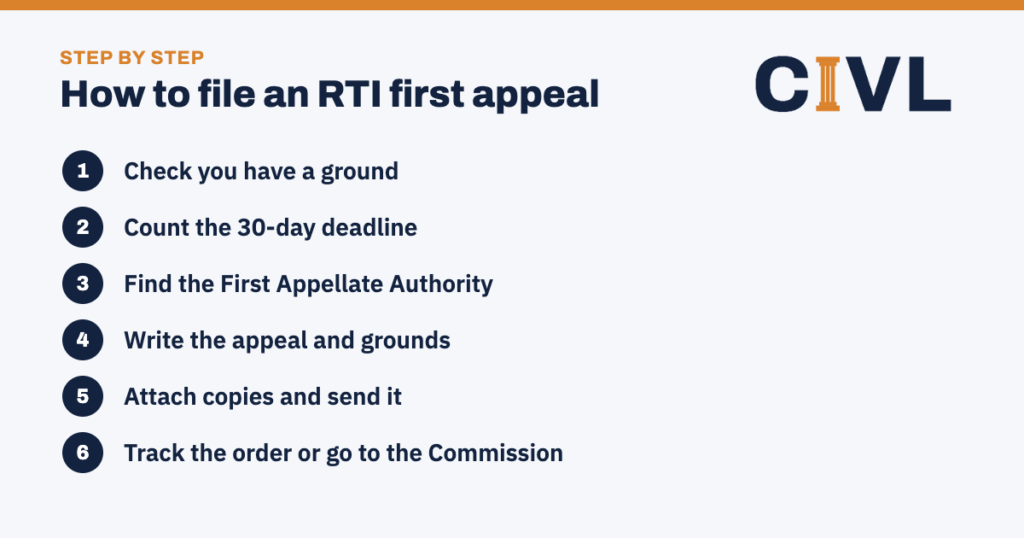
- Check you have a ground. Compare the reply with each question in your RTI. Note which ones were ignored, refused or answered wrongly.
- Count the 30-day deadline. The 30 days run from the date you received the reply or, if there was no reply, from the date the reply was due. Late appeals are allowed only if the FAA accepts your reason for the delay.
- Find the First Appellate Authority. The PIO must name the FAA when refusing a request (Section 7(8)). If not, check the “RTI” or “Proactive disclosure” page of the office’s website, or simply address it to “The First Appellate Authority” at the PIO’s office.
- Write the appeal and grounds. Give your details, the RTI details, the PIO’s reply, your grounds (one per point) and the relief you want, such as “direct the PIO to provide the information free of cost within 15 days”. Sign and date it.
- Attach copies and send it. Attach copies (never originals) of your RTI, the fee proof and the reply. For a Central public authority, file it online on rtionline.gov.in or send it by Speed Post with proof of delivery. For State offices, use the State portal, post or hand delivery.
- Track the order or go to the Commission. The FAA may call you for a hearing. Keep the appeal receipt. If there is no order in 45 days, or the order does not help, file a second appeal with the Information Commission.
Filing an RTI first appeal online
For RTIs filed with Central ministries and departments on the RTI Online portal, open rtionline.gov.in, choose “Submit First Appeal”, enter the registration number of your original RTI and your email ID, and type your grounds. You can attach a supporting PDF. There is no fee, and you get a new appeal registration number to track the status under “View Status”. See our guide on how to file RTI online for the portal basics.
The central portal does not handle State Government offices. Several States run their own RTI portals; elsewhere, send the RTI first appeal by Speed Post or hand it in and take a stamped acknowledgement.
Fees and timelines
| Stage | Time limit | Fee (Central offices) |
|---|---|---|
| PIO reply to your RTI | 30 days (48 hours for life or liberty; +5 days via an APIO) | ₹10 paid with the RTI |
| File the RTI first appeal | Within 30 days of the reply or of the missed deadline | Nil |
| FAA decides the appeal | 30 days, up to 45 days with written reasons | Nil |
| Second appeal to CIC or SIC | Within 90 days of the FAA decision or its due date | Nil |
| Information after a missed deadline | To be given free of charge (Section 7(6)) | Nil |
States follow their own RTI rules. Some charge a small fee for an RTI first appeal or ask for a court-fee stamp, so check the rules of your State before filing.
What to write in an RTI first appeal
There is no prescribed form for an RTI first appeal to a Central public authority; a clear letter is enough. Include:
- Heading: “Appeal under Section 19(1) of the RTI Act, 2005”
- Your name, address, phone and email
- Name and address of the PIO and of the First Appellate Authority
- RTI date and registration number, and the date and reference of the reply (or “no reply received”)
- Grounds of appeal, numbered, one per question
- Relief sought, e.g. full information free of cost, and a request for a hearing
- List of attachments, place, date and signature
What happens after you file
The FAA reads the RTI, the reply and your RTI first appeal. Many offices hold a short hearing, in person or by video, where the PIO also explains. The FAA can direct the PIO to give the information, partly accept the appeal, or reject it with reasons. The FAA cannot impose a penalty; only the Central or State Information Commission can penalise a PIO (up to ₹250 a day, maximum ₹25,000, under Section 20).
If the FAA does not decide within 45 days, or you disagree with the order, file a second appeal with the Central Information Commission (for Central offices) or your State Information Commission within 90 days (Section 19(3)). For a Central office, this can be filed online through the CIC portal linked from RTI Online.
Appeal or complaint?
Section 18 lets you complain directly to the Information Commission, for example if no PIO has been appointed. But the Supreme Court held in Chief Information Commissioner v. State of Manipur (2011) that the Commission cannot order disclosure in a complaint. If you want the information itself, the RTI first appeal followed by a second appeal is the right route.
Personal information after the DPDP Act
From 13 November 2025, the Digital Personal Data Protection Act amended Section 8(1)(j) of the RTI Act, so a PIO can refuse personal information about another person without weighing the wider public interest. The Supreme Court refused to stay the change in February 2026 and has referred the challenges to a larger bench, so the amended section applies for now. If your RTI was refused under Section 8(1)(j), argue in your RTI first appeal that the information is about public duties or public money, not private life.
Common mistakes to avoid
- Missing the 30-day deadline, then giving no reason for the delay
- Sending the appeal to the same PIO instead of the First Appellate Authority
- Adding new questions in the appeal; an appeal can only cover what you asked in the RTI
- Writing a long complaint instead of clear, numbered grounds
- Not keeping proof of delivery, which you will need for the second appeal
- Going straight to the Commission without first filing the RTI first appeal
Frequently asked questions
Is there a fee for an RTI first appeal?
No fee is charged for an RTI first appeal to a Central Government public authority. Some States charge a small fee under their own rules.
Can I file an RTI first appeal after 30 days?
Yes, but only if the First Appellate Authority accepts that you had sufficient cause for the delay. Explain the reason (illness, travel, late receipt of the reply) in the first paragraph.
What if the First Appellate Authority does not decide?
If there is no decision within 45 days of filing, you can file a second appeal with the Information Commission within 90 days of the date the decision was due.
Can I file an RTI first appeal online?
Yes, for Central public authorities on rtionline.gov.in using the registration number of your RTI. For State offices, use the State’s RTI portal where one exists, or post.
Do I need a lawyer for an RTI first appeal?
No. The process is meant for ordinary citizens. A clear letter with numbered grounds is enough.
Where can I get a ready-to-use RTI first appeal format?
Use CIVL’s RTI first appeal format. It has the heading, grounds and relief paragraphs ready, so you only fill in your RTI details.
CIVL format
Write your RTI first appeal in minutes
Use CIVL’s RTI first appeal format and, for a fresh request, the RTI application format. New to RTI? Read how to file RTI online. Still stuck? Ask CIVL.