
Mutual consent divorce is the quickest and least painful way to end a marriage in India. Both spouses file a joint petition, settle money, property and children’s issues between themselves, and the family court grants the divorce, often within six months and sometimes sooner.
Quick answer
For Hindus (including Sikhs, Jains and Buddhists), mutual consent divorce is under s.13B of the Hindu Marriage Act, 1955. Spouses must have lived separately for at least one year and agree that they cannot live together. After the first motion, the law gives a six-month cooling-off period before the second motion, which the court can waive.
Similar provisions exist in the Special Marriage Act (s.28), the Divorce Act for Christians (s.10A, two years’ separation) and the Parsi Marriage and Divorce Act (s.32B). Either spouse can withdraw consent at any time before the decree.
Conditions for mutual consent divorce
- Separation: living separately for at least one year (two years for Christians under s.10A). “Separately” means not living as husband and wife, even if under the same roof.
- Inability to live together, stated by both.
- Free consent of both, with no force, fraud or undue influence.
- Agreement on all terms: alimony, stridhan and gifts, custody and visitation, and withdrawal of pending cases.
- Marriage at least one year old before the petition, unless the court allows earlier filing for exceptional hardship.
Which law applies
| Community / marriage | Law | Separation needed |
|---|---|---|
| Hindu, Sikh, Jain, Buddhist | Hindu Marriage Act, s.13B | 1 year |
| Marriage under the Special Marriage Act (any religion) | Special Marriage Act, s.28 | 1 year |
| Christian | Divorce Act, 1869, s.10A | 2 years |
| Parsi | Parsi Marriage and Divorce Act, s.32B | 1 year |
| Muslim | Personal law (mubarat, by mutual agreement) | No fixed period |
Documents needed
- Marriage certificate, or wedding photos and invitation (see our marriage registration guide)
- Address and ID proof of both spouses
- Proof of separate residence for the past year, where available
- Settlement agreement or memorandum of understanding signed by both
- Details of income, assets and liabilities (many family courts require an affidavit of assets)
- Details of children, and the custody arrangement
- Passport-size photos
Mutual consent divorce: step by step
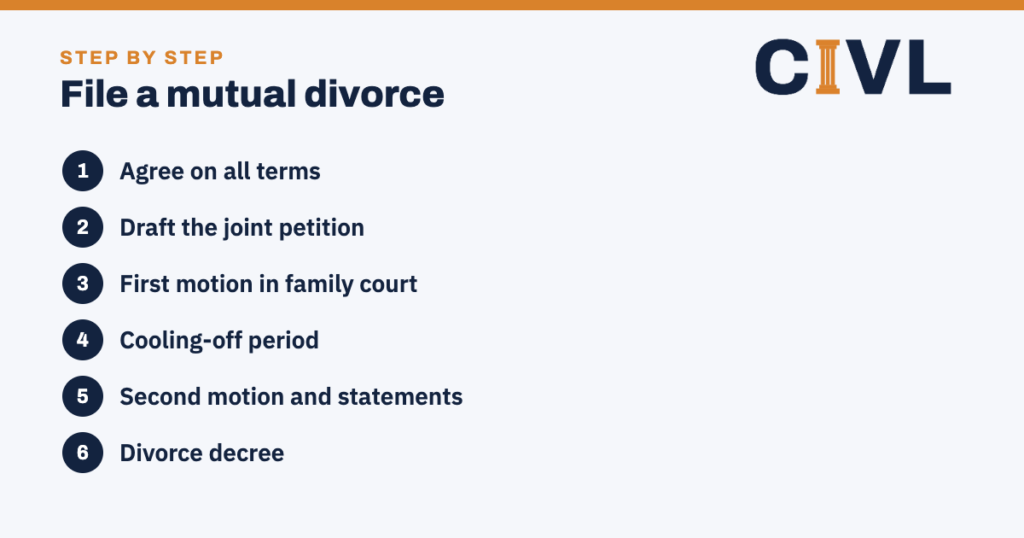
- Agree on all terms, ideally in writing: alimony (lump sum or instalments), stridhan, joint property, children, and withdrawal of other cases.
- Draft the joint petition with supporting affidavits, signed by both spouses.
- First motion: file in the family court where you married, last lived together, or where the wife lives. Both appear, the court records statements and may refer you to mediation.
- Cooling-off period: six months from the first motion, which can be waived by the court.
- Second motion: filed after six months and within 18 months of the petition. Both spouses confirm consent and the court checks the settlement.
- Divorce decree: the court grants the divorce. Get a certified copy and update your records.
Waiving the waiting periods
- Six-month cooling-off period: it is directory, not mandatory. The family court can waive it where separation has already lasted 18 months or more, mediation has failed, and the parties have settled all issues (Amardeep Singh v. Harveen Kaur, 2017). These conditions are illustrative (Amit Kumar v. Suman Beniwal, 2021).
- Supreme Court’s special power: under Article 142, the Supreme Court can dispense with the period and grant divorce where the marriage has irretrievably broken down (Shilpa Sailesh v. Varun Sreenivasan, Constitution Bench, 2023). Only the Supreme Court has this power.
- One-year separation: in December 2025 a Full Bench of the Delhi High Court held that this can also be waived in cases of exceptional hardship, using the proviso to s.14 (Shiksha Kumari v. Santosh Kumar). This binds courts in Delhi; other High Courts may take a different view.
Withdrawing consent
Consent must continue until the decree. Either spouse can withdraw before the second motion is decided, and the court cannot then grant a mutual consent divorce (Sureshta Devi v. Om Prakash, 1991). A spouse who backs out after receiving money under a settlement may face consequences, so draft the settlement carefully, with payment linked to the decree.
Cost and time
Court fees are usually nominal and set by each state. Most mutual consent divorce cases finish in six to eighteen months; where the cooling-off period is waived, a few weeks. Many family courts allow video appearance for a spouse living abroad.
After the decree
- Remarriage is allowed once the decree is final; a consent decree is generally not appealed.
- Update your name, if changed, and records such as passport, bank nominations, insurance and tax returns.
- In Uttarakhand, divorce decrees passed after 27 January 2025 must be registered under the Uniform Civil Code (online, fee ₹250).
Settlement terms in a mutual consent divorce
- Permanent alimony: a one-time amount or instalments; state that it is full and final.
- Stridhan and gifts: list what will be returned and when.
- Joint property and loans: who keeps the house, who pays the EMIs, and how joint accounts are closed.
- Children: custody, visitation, school and medical expenses, and travel abroad.
- Pending cases: both agree to withdraw criminal complaints, maintenance and other cases; courts often allow quashing of related cases after settlement.
- Timing: link payments to the first and second motions, often half at each stage.
Mediation in a mutual consent divorce
Family courts often send couples to mediation or counselling before recording the first motion. Even where the spouses have already agreed, mediation helps put the terms in a settlement agreement that the court can accept. Free mediation is available at court-annexed mediation centres, and free legal aid is available to eligible people through Legal Services Authorities.
Children in a mutual consent divorce
The court checks that arrangements for the children are in their best interests. Parents can agree on joint or sole custody and visitation. The child’s welfare comes first, so the court can change custody terms later if circumstances change. Child maintenance is the child’s right, and a settlement cannot bargain it away.
Mutual consent divorce vs contested divorce
| Point | Mutual consent divorce | Contested divorce |
|---|---|---|
| Who files | Both spouses jointly | One spouse |
| Grounds | Separation and agreement | Cruelty, desertion, adultery etc. must be proved |
| Time | Often 6–18 months, sometimes weeks | Often several years |
| Cost and stress | Lower | Higher |
Worked example: a mutual consent divorce timeline
Anita and Rahul married in Lucknow in 2019 and have lived apart since March 2025. They agree on a lump-sum alimony of ₹12 lakh, the return of Anita’s jewellery, joint custody of their son with weekday residence with Anita, and the withdrawal of a pending maintenance case.
| Date | Step |
|---|---|
| April 2026 | Sign the settlement agreement and the joint petition under s.13B |
| May 2026 | First motion: both appear, statements recorded; first half of the alimony paid by demand draft |
| June 2026 | They apply to waive the cooling-off period, as they have been apart for over a year, mediation has failed and all issues are settled |
| July 2026 | The court allows the waiver; second motion heard |
| July 2026 | Decree of mutual consent divorce passed; balance alimony paid and the maintenance case withdrawn |
Had the waiver been refused, the second motion would have been filed after November 2026 (six months after the first motion) and before the 18-month limit. The example is only a guide; each family court has its own listing practice.
Mutual consent divorce for Muslim couples
Muslim personal law recognises divorce by mutual agreement, called mubarat, and divorce at the wife’s request with her giving up some rights, called khula. These do not need a court petition, although many couples record the terms in a written deed signed before witnesses. A couple whose marriage was registered under the Special Marriage Act must use s.28 of that Act and go to the family court, whatever their religion.
If one spouse lives abroad
Many mutual consent divorce cases involve a spouse working overseas. Courts have allowed such spouses to take part by video conference, especially where mediation has already taken place. A spouse abroad can sign the petition and affidavits before an Indian embassy or a notary (with apostille), and a relative holding a power of attorney can handle filing and paperwork. Statements of consent, though, must come from the spouse personally. In Amardeep Singh v. Harveen Kaur (2017), the Supreme Court held that the six-month cooling-off period is not mandatory, which helps couples who cannot travel twice.
Tax on alimony and settlement payments
- Lump-sum alimony paid once as a full and final settlement is generally treated as a capital receipt and not taxed in the hands of the spouse who receives it.
- Monthly or periodic alimony is generally treated as income of the receiving spouse and taxed at their slab rate.
- Transfer of property between spouses as part of the settlement may need a registered document and stamp duty; check with the sub-registrar before signing.
- The paying spouse usually cannot deduct alimony from their own taxable income.
Because the tax result depends on how the payment is described, the settlement agreement should state clearly whether the amount is a one-time, full and final payment.
Maintenance for children after a mutual consent divorce
Spouses can settle their own claims against each other, but a child’s right to maintenance belongs to the child. Courts can revisit child support later if circumstances change, even after a settled mutual consent divorce. Write down who pays school fees, medical costs and higher education, and how the amount will rise over time. If one parent plans to move abroad with the child, put the consent and conditions for travel in the settlement.
What the judge checks at the hearings
- That both spouses are present and are the persons named in the petition
- That the consent is free and has not been obtained by force, fraud or pressure
- That the period of separation is genuine
- That the settlement terms are fair, especially for children
- That both still consent at the second motion
Pending criminal cases and a mutual consent divorce
Many couples reach a mutual consent divorce after cases have already been filed: a complaint of cruelty, a domestic violence case, or a maintenance petition. The settlement should list each case by number and court, and say who will withdraw it and by when. Maintenance and domestic violence cases can usually be withdrawn in the court where they are pending. A criminal case that cannot simply be withdrawn can be quashed by the High Court under its inherent powers (s.528 of the Bharatiya Nagarik Suraksha Sanhita, 2023, earlier s.482 CrPC), and courts regularly do this after a genuine matrimonial settlement.
Link the payments to these steps. A common pattern is: part of the alimony at the first motion, the rest at the second motion, and the withdrawal or quashing applications filed in between.
Checklist before you sign the settlement
- Is every amount written in figures and words, with the mode and date of payment?
- Does it list each item of stridhan and jewellery, and where and when it will be handed over?
- Are joint bank accounts, lockers, loans and insurance policies dealt with?
- Are custody, visitation, holidays and schooling for the children spelt out?
- Does it list every pending case, with who will withdraw it?
- Does it say both spouses give up further claims against each other, apart from child maintenance?
- Have both spouses read it in a language they understand, and signed each page?
A careful settlement is the main reason a mutual consent divorce goes through quickly. Disputes at the second motion almost always arise from terms that were left vague at the start.
Mediation centres and free legal aid
Every district has a court-annexed mediation centre, and mediation there is free. Women, children and persons with low income are entitled to free legal aid from the District Legal Services Authority, which can help draft the petition and settlement. You can also reach the National Legal Services Authority through its helpline 15100.
Common mistakes to avoid
- Filing before one year of separation without a waiver application.
- A vague settlement that does not cover stridhan, custody or pending cases.
- Paying the full alimony before the second motion.
- Missing the 18-month window for the second motion.
- Not getting a certified copy of the decree.
Frequently asked questions
How long does a mutual consent divorce take in India?
Usually six to eighteen months. If the court waives the six-month period, it can be granted in a few weeks.
Do both spouses have to appear in court?
Yes, at the first and second motions, although many courts allow video appearance in suitable cases.
Can we file for mutual consent divorce if we live in the same house?
Yes, if you have not lived as husband and wife for a year. Courts look at the substance of the relationship, not just the address.
Can one spouse withdraw consent?
Yes, at any time before the decree.
Is alimony compulsory in a mutual consent divorce?
No. The spouses agree on alimony, which may be nil, a lump sum or instalments, and the court checks it is fair and voluntary.
Where do we file the petition?
In the family court where the marriage took place, where you last lived together, or where the wife currently lives.
Can NRIs get a mutual consent divorce in India?
Yes. A spouse abroad can often join by video conference, and a power of attorney holder can handle some steps.
Can a mutual consent divorce be filed online?
Some family courts accept e-filing, but both spouses still have to appear (in person or by video) to record their statements.
Is a mutual consent divorce valid abroad?
An Indian decree is generally recognised abroad, but some countries need it apostilled. Check with the country’s embassy.
Is lump-sum alimony taxable in a mutual consent divorce?
A one-time, full and final alimony payment is generally treated as a capital receipt and is not taxed. Periodic monthly alimony is generally taxable as income of the person receiving it.
Can Muslims get a mutual consent divorce?
Yes. Muslim personal law allows divorce by mutual agreement (mubarat) and khula. A Muslim couple married under the Special Marriage Act must use s.28 of that Act.
Can child maintenance be waived in a mutual consent divorce?
No. Parents can agree on the amount, but the child’s right to maintenance cannot be given up, and the court can revise it later.
Does a spouse living abroad have to come to India for the divorce?
Not always. Courts often allow appearance by video conference, and documents can be signed before an Indian embassy or a notary with apostille.
Where can I get a ready-to-use affidavit after divorce?
If you want to change back your name, use the CIVL name change affidavit format, and read our gazette name change guide.
CIVL format
Paperwork after a divorce
Changing your name back? Use the name change affidavit format and our gazette name change guide. Updating your address? Try the address proof affidavit format. Updating your will? See the will format. Or Ask CIVL.