
Need an NDA format? This page explains when you need it, what it must contain and how to make it valid, step by step. You can also get CIVL’s ready-to-use NDA format as an editable Word file and PDF.
Quick answer
A non-disclosure agreement (NDA) is a contract that keeps business information confidential. It is valid under the Indian Contract Act, 1872, is usually printed on stamp paper of the value your state charges for agreements, and needs no registration. It can be signed electronically.
What is a non-disclosure agreement (NDA)?
An NDA (or confidentiality agreement) sets out what information is confidential, who can see it, how it must be protected, and for how long. It can be one-way (only one side shares) or mutual (both sides share).
Courts enforce confidentiality obligations, including by injunction. But clauses that stop someone from working in a trade after the relationship ends are generally void under Section 27 of the Contract Act, so keep the NDA focused on confidentiality.
When you need it
- Discussing a business idea, investment or partnership with someone.
- Sharing product designs, code, client lists or pricing with a vendor or freelancer.
- Hiring employees or consultants with access to sensitive information.
- Before due diligence in a sale or investment.
Stamp duty, notarisation and registration
| Requirement | What applies | Notes |
|---|---|---|
| Stamp paper / e-stamp | Required | At your state’s rate for agreements; an unstamped NDA must be stamped (with penalty) before it can be used as evidence. |
| Notarisation | Not needed | Optional. |
| Registration | Not needed | It is a private contract. |
| Witnesses | Optional | Two witnesses are good practice. |
Stamp duty on agreements is set by each state. E-stamping is available in most states.
What the non-disclosure agreement (NDA) must contain
- Names and details of the parties; one-way or mutual.
- Purpose for which information is shared.
- Definition of confidential information and exclusions (public, already known, independently developed).
- Obligations: use only for the purpose, limited access, security measures.
- Term of the agreement and how long confidentiality lasts after it ends.
- Return or destruction of information on request.
- Remedies (injunction, damages), governing law and jurisdiction, and signatures.
How to make it valid: step by step
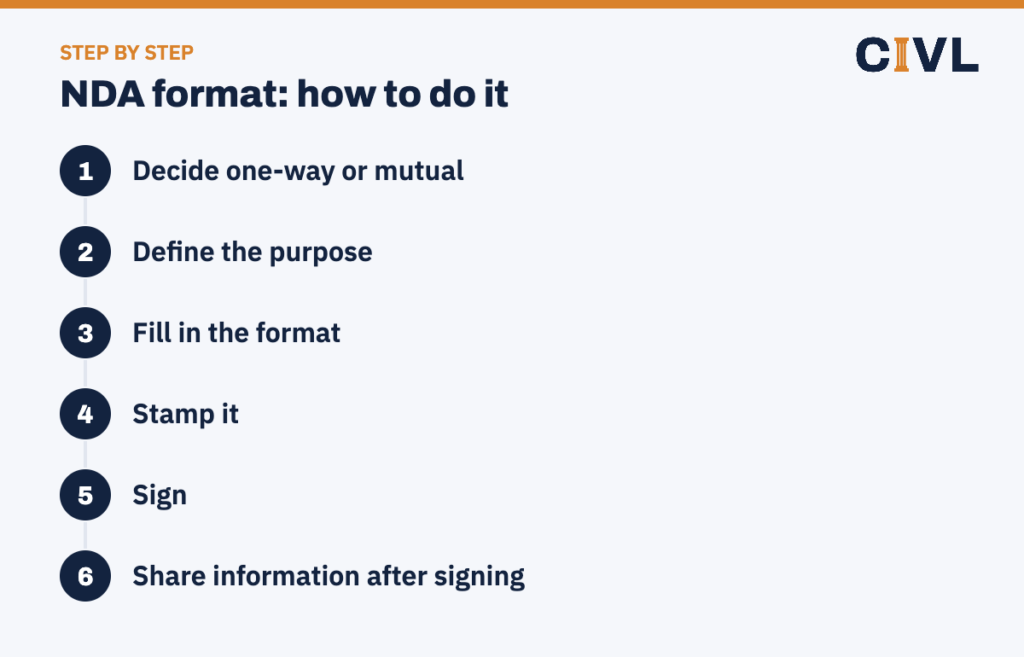
- Decide one-way or mutual. Mutual if both sides will share sensitive information.
- Define the purpose. Narrow purposes are easier to enforce.
- Fill in the format. Use correct legal names and authorised signatories.
- Stamp it. Buy e-stamp at your state’s rate.
- Sign. Sign physically or with a valid electronic signature.
- Share information after signing. Mark documents “Confidential”.
Common mistakes to avoid
- Overbroad non-compete. Post-relationship restraints on trade are generally unenforceable.
- No exclusions. Without standard exclusions, the NDA may be unreasonable.
- Leaving it unstamped. Courts can impound unstamped agreements until duty and penalty are paid.
- Sharing before signing. Get the NDA signed first.
CIVL format
Get the ready-to-use NDA format
- Editable Word file and a print-ready PDF
- Notes on how to fill every blank
- One-way and mutual versions
- Employee confidentiality clause
- Delivered to your email after payment
Price: ₹199 · Coming soon
Frequently asked questions
Is an NDA legally enforceable in India?
Yes, as a contract under the Indian Contract Act, 1872, if it is reasonable and properly executed.
Does an NDA need stamp paper?
It should be stamped as per your state’s rate for agreements. An unstamped agreement can be impounded until duty and penalty are paid.
Can an NDA be signed online?
Yes. Electronic signatures are recognised under the Information Technology Act, 2000; many states offer e-stamping.
How long should confidentiality last?
Commonly two to five years after the agreement ends; trade secrets may be protected for as long as they remain secret.
Where can I get a ready-to-use NDA format?
CIVL’s NDA format comes as an editable Word file and a print-ready PDF, with notes on filling every blank and checking your state’s rules. Use the button above to be told when it is available.