
An income certificate is an official document from your state government that states the annual income of you or your family. You need it for scholarships, fee concessions, reserved seats, pensions and many welfare schemes, and in most states you can apply for it online.
Quick answer
An income certificate is issued by the state Revenue Department, usually by the Tahsildar, SDM or a designated revenue officer, after a local verification. Apply on your state’s e-District or service portal (for example e-District UP, Aaple Sarkar in Maharashtra, e-District Delhi or TN e-Sevai).
The fee is small, and the certificate usually comes in about one to four weeks. Validity is set by the state or by the scheme you are applying for; many treat it as valid for the current financial year. The EWS certificate is a different document with its own rules.
What is an income certificate?
It is a certificate, based on your declaration and a field check, of the yearly income of an individual or a family from all sources: salary, business, agriculture, pension and other income. Because it is a state document, the name of the form, the officer and the fee differ from state to state.
Income certificate vs ITR vs EWS certificate
| Document | Issued by | Used for |
|---|---|---|
| Income certificate | State Revenue Department (Tahsildar / SDM) | State scholarships, schemes, fee waivers, pensions |
| Income tax return (ITR) | Filed by you with the Income Tax Department | Tax, loans, visas; proof of your own taxable income |
| EWS income and asset certificate | Tahsildar or other notified officer | 10% EWS reservation in central and state jobs and admissions; family income below ₹8 lakh and asset limits |
Who can apply
- Any resident of the state, for themselves or on behalf of the family
- Students applying for scholarships (usually through a parent’s income)
- Applicants for pensions, subsidised housing or welfare schemes
- Parents applying for fee concessions or RTE admission (where income-linked)
Documents needed for an income certificate
- Application form or online form with a self-declaration of family income
- ID proof (Aadhaar, voter ID)
- Address proof or ration card
- Proof of income: salary slips or Form 16, pension slip, ITR, land records for agricultural income, or an affidavit for informal work
- Passport-size photo
- Some states ask for a notarised affidavit; see the affidavit format for a model
How to apply for an income certificate: step by step
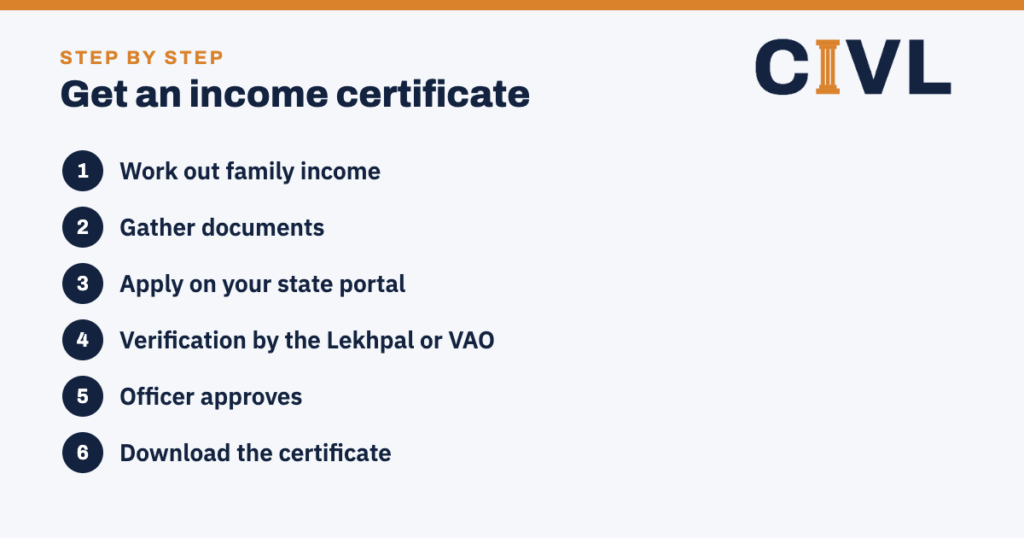
- Work out total family income from all sources for the last financial year.
- Gather the documents listed above and scan them.
- Apply on your state portal or at a Common Service Centre (CSC), Jan Seva Kendra or e-Sevai centre, and pay the fee.
- Verification: a field officer (Lekhpal in UP, Talathi in Maharashtra, VAO in Tamil Nadu) checks your details.
- Approval: the Tahsildar, Nayab Tahsildar or SDM approves the application.
- Download the income certificate with its digital signature and verification number.
Income certificate online: state portals
| State | Portal | Issued by / time |
|---|---|---|
| Uttar Pradesh | edistrict.up.gov.in / e-Sathi | Tahsildar, after Lekhpal verification; fee about ₹20 at centres; often 10–30 days |
| Maharashtra | Aaple Sarkar (aaplesarkar.mahaonline.gov.in) | Nayab Tahsildar; 15 days under the Right to Services Act, with appeals if late |
| Delhi | e-District Delhi | SDM after local inquiry; normally within 21 days |
| Tamil Nadu | TN e-Sevai | Tahsildar, after VAO and RI enquiry |
Other states have similar e-District services. If your state has a right-to-services law, a delayed or rejected application can be appealed to a higher officer.
Validity of an income certificate
There is no single national rule. Many states and scholarship schemes accept an income certificate issued for the current financial year; some accept certificates up to six months or a year old. Always check the scheme’s notification, and apply for a fresh certificate when your income changes.
EWS certificate in brief
- Family gross income from all sources must be below ₹8 lakh in the previous financial year.
- A family is excluded if it owns 5 acres or more of agricultural land, a flat of 1,000 sq ft or more, or a residential plot above set sizes.
- It is valid for one financial year and is issued in a prescribed format.
- It is a separate application from an ordinary income certificate.
Income certificate for scholarships
Most state and central scholarships set an annual family income limit, and the income certificate is the proof. Apply well before the scholarship deadline, because verification takes time. Make sure the name of the student and the parent on the income certificate match the school records, Aadhaar and bank account. Some national scholarships accept a self-declaration for lower amounts, but state schemes usually insist on a certificate from the Tahsildar.
What counts as family income
- Salary, wages and pension of the family members covered by the scheme (usually parents and the applicant)
- Income from business, profession or shop
- Agricultural income from land owned or cultivated
- Rent and interest income
- Not usually counted: one-time gifts or loans (rules vary by scheme)
Each scheme defines “family” slightly differently, so read the definition in the scheme notification before applying for the income certificate.
Verifying an income certificate
Certificates issued online carry a certificate number and often a QR code. Institutions can verify them on the state portal. Keep the digitally signed PDF; a scanned copy of a printout may not verify properly.
Income certificate portals in more states
Every state issues its own income certificate, so the portal depends on where you live. The table below lists the usual online route in other large states. The service name may differ slightly (for example “income certificate”, “aay praman patra” or “income and asset certificate”), but the documents and the Revenue Department verification are broadly the same.
| State | Where to apply |
|---|---|
| Bihar | RTPS / ServicePlus portal (serviceonline.bihar.gov.in) or the RTPS counter at the block |
| Rajasthan | e-Mitra kiosk or the Rajasthan SSO portal |
| Madhya Pradesh | MP e-District / Lok Seva Kendra |
| Gujarat | Digital Gujarat portal or the taluka Jan Seva Kendra |
| Karnataka | Nadakacheri (Atalji Janasnehi Kendra) or Seva Sindhu |
| Telangana and Andhra Pradesh | MeeSeva centres; in Andhra Pradesh also village and ward secretariats |
| Kerala | e-District Kerala or an Akshaya centre; the Village Officer usually verifies |
| Haryana and Punjab | Saral (Haryana) and Sewa Kendras (Punjab) |
| Jharkhand | JharSewa portal or a Pragya Kendra |
| West Bengal | The state e-District / service portal or the BDO/SDO office |
If you cannot find the service online, ask at the nearest Common Service Centre (CSC). CSC operators can file the income certificate application for you for a small service charge.
How to check status and download your income certificate
- Keep the application or reference number shown on the receipt after you apply.
- Open the same portal and choose “Track application” or “Application status”.
- Enter the reference number (and, on some portals, your mobile number or OTP).
- Once the status shows approved, download the digitally signed income certificate as a PDF, or collect it from the centre where you applied.
- Check the name, father’s or husband’s name, address and the annual income figure before you use it anywhere.
Most states now issue a digitally signed income certificate with a QR code or certificate number. An office or college can verify it online, so you usually do not need a physically signed copy.
If your income certificate is rejected or delayed
Common reasons for rejection are a mismatch between the income you declared and what the Lekhpal or Patwari found, missing proof of residence, an unclear photograph or document scan, and applying to the wrong district. The rejection note on the portal normally states the reason.
- Fix and reapply: correct the problem (for example, add salary slips or a pension statement) and file a fresh application.
- Appeal for delay: many states have right-to-services laws that fix a time limit for each service. Examples include the Uttar Pradesh Janhit Guarantee Adhiniyam, 2011, the Bihar Lok Sewaon Ka Adhikar Adhiniyam, 2011, the Madhya Pradesh Lok Sewaon Ke Pradan Ki Guarantee Adhiniyam, 2010 and the Maharashtra Right to Public Services Act, 2015. If the time limit passes, you can appeal to the appellate officer named on the portal.
- Ask for reasons: if the reason is unclear, you can also file an RTI application asking for the inspection report on your application.
Income certificate for students living away from home
An income certificate is issued by the tehsil or district where your family normally lives, not where you study. A student in a hostel in another city should apply in the home district, using the parent’s income details and the family’s address proof. If your parents have moved, apply where they now live and attach current address proof.
For central scholarships on the National Scholarship Portal, the income certificate usually has to be in the scholarship’s prescribed format or issued by a competent authority of the state, so read the scheme guidelines before you apply.
Self-declaration and correction
Many states ask for a self-declaration (swaghoshna patra) of family income along with the application, and some accept it in place of an affidavit. Fill it carefully: a false declaration can lead to cancellation of the certificate and of any benefit you received with it.
If the issued certificate has a spelling mistake or wrong income figure, apply again on the same portal with the correct details and proof, or ask the issuing office whether it allows a correction request. Do not use a certificate with a wrong name, because it may fail verification.
Where an income certificate is commonly used
- Scholarships and fee concessions: state post-matric and pre-matric scholarships, fee reimbursement and hostel allotments usually set an annual family income limit.
- Social security pensions: old age, widow and disability pension schemes run by states often check family income.
- Housing and welfare schemes: some housing, ration and subsidy schemes ask for an income certificate along with other proof.
- Free legal aid: under the Legal Services Authorities Act, 1987, people below the income limit set by each state can get free legal aid, and an income certificate or affidavit is used as proof.
- Court and tribunal matters: an income certificate can support a claim for maintenance or a request for exemption from fees, though courts also look at other evidence.
Worked example: calculating family income
Suppose a student lives with her parents. Her father earns ₹1,80,000 a year from a private job, her mother earns ₹40,000 a year from tailoring, and the family gets ₹30,000 a year from a small piece of farmland. For most income certificate applications, the family income is the total of all three: ₹2,50,000 a year.
If the scholarship limit is ₹2,50,000, she just qualifies. If she had left out the farm income, the Lekhpal or Patwari would likely find it during verification, the certificate would show a different figure, and the application could be rejected for a wrong declaration. Declaring every source up front avoids that problem.
Note that the meaning of “family” and the treatment of some income (for example, a married brother’s salary) can differ between schemes. When a scheme defines family income, follow the scheme’s definition over the general rule.
Tips for a quick income certificate
- Apply well before the scholarship or admission deadline; verification can take weeks in peak season.
- Use the same spelling of names as on Aadhaar and school records.
- Upload clear, readable scans and a recent passport-size photograph.
- Keep your mobile number active; status updates and OTPs come by SMS.
- Save the PDF of your certificate and keep a few printed copies.
In short, an income certificate is a simple document, but small errors cause most delays. Apply in the right district, declare all family income, attach clear proof and keep your reference number. If your state sets a time limit for the service, use the appeal route when the deadline passes.
Common mistakes to avoid
- Showing only your own income when the scheme asks for family income.
- Leaving out agricultural or pension income and facing rejection at verification.
- Using an old income certificate from a previous financial year.
- Applying for an income certificate when the job or admission asks for an EWS certificate.
- Giving a false declaration; it can lead to cancellation of benefits and prosecution.
Frequently asked questions
Who issues an income certificate?
The state Revenue Department, usually the Tahsildar, Nayab Tahsildar or SDM, after a field verification.
How long does an income certificate take?
Usually one to four weeks, depending on the state and on verification. Right-to-services laws set time limits in some states.
Can I apply for an income certificate online?
Yes, in most states, through e-District or the state service portal, or at a CSC or Jan Seva Kendra.
Is an income certificate the same as an EWS certificate?
No. The EWS certificate has its own income and asset limits and format and is used for EWS reservation.
Can a salaried person get an income certificate?
Yes. Attach salary slips or Form 16 as proof of income.
What if my application is rejected?
Read the reason, correct the documents and reapply, or appeal to the higher officer under your state’s right-to-services law.
Do I need an affidavit?
Some states ask for a self-declaration or a notarised affidavit of family income.
Can I correct a mistake in my income certificate?
Yes. Apply to the issuing office with proof, or reapply online with the corrected details.
Is an income certificate needed for a ration card?
Some states ask for it when deciding eligibility for priority or Antyodaya cards; others rely on a self-declaration.
Where can I get a ready-to-use affidavit format?
Use the CIVL address proof affidavit format as a model for a self-declaration, or the name change affidavit format if names differ across documents.
Can I get an income certificate if my family has very little income?
Yes. The income certificate records your actual family income, whatever it is. Low-income families often need it most, for scholarships, pensions and welfare schemes.
Is an income certificate needed for the OBC non-creamy layer certificate?
The non-creamy layer certificate has its own income test and format. Some states ask for an income certificate as supporting proof; check your state’s caste certificate service.
How do I verify an income certificate online?
Use the verification option on the issuing state’s portal and enter the certificate number, or scan the QR code on the certificate.
Do I need a new income certificate every year?
Usually yes, if the scheme or admission asks for the current financial year. Many families apply for a fresh income certificate each year before scholarship season.
Can someone else apply for my income certificate?
Yes. A parent can apply for a student, and a CSC operator can file the online form for you. The certificate is still issued in the applicant’s name after verification.
Is an income certificate valid in another state?
An income certificate is issued for use within the issuing state’s schemes. For a scheme in another state or a central scheme, check whether it accepts a certificate from your home state or needs its own format.
What if my income changes after I get the certificate?
Apply for a fresh income certificate. Using an old certificate after your income has risen above a scheme’s limit can lead to recovery of the benefit.
Is there a fee for an income certificate?
Fees are small and vary by state, usually a nominal government fee plus a service charge if you apply through a CSC or e-Mitra style centre.
CIVL format
Affidavits for certificates
Need a self-declaration? Start from the address proof affidavit format. If your name differs across documents, use the name change affidavit format. See also our birth certificate correction guide, or Ask CIVL.