
FSSAI registration is the basic food safety registration every small food business in India needs before it starts, from home bakers and cloud kitchens to tea stalls and small grocers. From 1 April 2026 it covers businesses with turnover up to ₹1.5 crore a year, costs ₹100 a year and is applied for online on FoSCoS. Larger businesses need a State or Central licence. This guide explains which one you need, the documents, each step and the rules after you get it.
Quick answer
Basic FSSAI registration: turnover up to ₹1.5 crore a year; Form A on foscos.fssai.gov.in; fee ₹100 a year.
State licence: above ₹1.5 crore up to ₹50 crore. Central licence: above ₹50 crore, and always for importers, e-commerce food businesses and some other categories.
No renewals: under the March 2026 reforms, registrations and licences no longer need periodic renewal, but annual fees and other duties continue.
What is FSSAI registration?
The Food Safety and Standards Act, 2006 says no one may run a food business without a licence or registration from the Food Safety and Standards Authority of India (FSSAI). Small businesses get a basic registration; bigger ones get a licence. Both give you a 14-digit number that must appear on food packaging, menus, bills and your premises.
FSSAI raised the turnover limits from 1 April 2026 (FSSAI order of 13 March 2026, following the Licensing and Registration Amendment Regulations, 2026). Many businesses that needed a State licence earlier now need only a basic FSSAI registration.
Which do you need: FSSAI registration or a licence?
| Type | Annual turnover (from 1 April 2026) | Form and annual fee |
|---|---|---|
| Basic FSSAI registration | Up to ₹1.5 crore (earlier ₹12 lakh) | Form A; ₹100 |
| State licence | Above ₹1.5 crore up to ₹50 crore (earlier ₹12 lakh to ₹20 crore) | Form B; usually ₹2,000–₹5,000 |
| Central licence | Above ₹50 crore (earlier ₹20 crore); importers, e-commerce operators and some others regardless of turnover | Form B; usually ₹7,500 |
Turnover is not the only test: the kind of business and production capacity also matter. The FoSCoS portal asks a few questions and tells you the right category. Street vendors registered with their municipal body or town vending committee under the Street Vendors Act, 2014 are now treated as FSSAI-registered.
Documents for FSSAI registration
- Recent passport-size photo of the applicant.
- Photo identity proof (Aadhaar, voter ID, passport or PAN).
- Proof of possession of the premises: ownership papers, a rent agreement or an NOC from the property owner.
- List of food products you make or sell.
- For firms and companies: partnership deed or certificate of incorporation and authority letter.
- For a licence, more documents apply, such as a layout plan, water test report, list of equipment and a food safety management plan.
FSSAI registration step by step
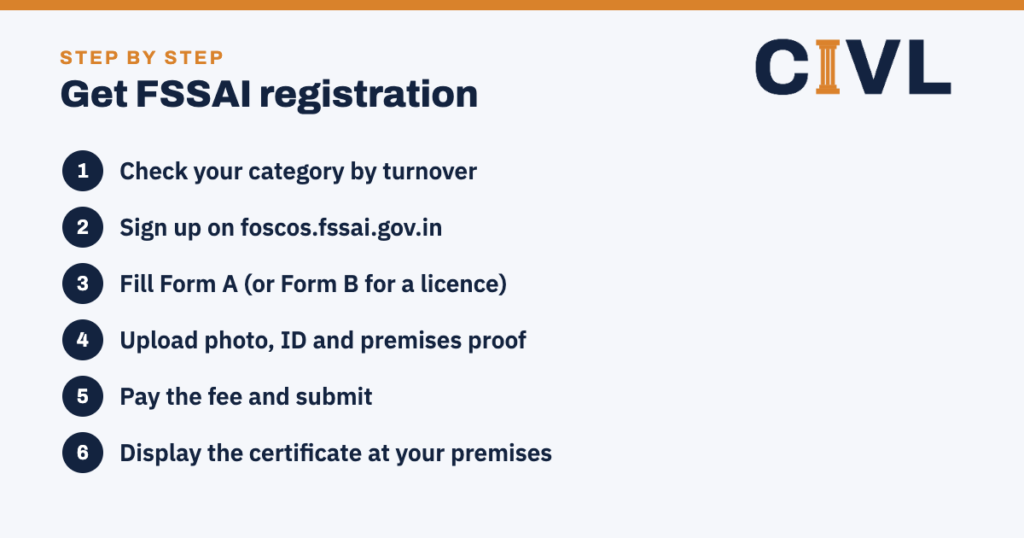
- Check your category. On foscos.fssai.gov.in, choose your state and kind of business and enter your expected turnover. The portal shows whether you need registration or a licence.
- Sign up. Create a login with your mobile number and email.
- Fill Form A. Enter applicant and business details, premises address, food categories and the period you want to pay for.
- Upload documents. Photo, identity proof and premises proof, in the size and format shown.
- Pay and submit. Pay the fee online and note the application reference number. Under the 2026 reforms there is no pre-inspection for basic registration, and eligible applicants can get it almost instantly.
- Download and display. Download the certificate from FoSCoS and display it prominently at your premises. Print the 14-digit number on labels, bills and menus.
FSSAI registration fees and timelines
| Item | Position |
|---|---|
| Basic registration fee | ₹100 a year |
| State licence fee | Usually ₹2,000–₹5,000 a year, by category |
| Central licence fee | Usually ₹7,500 a year |
| Time for registration | Often instant or a few working days |
| Validity | No periodic renewal for new approvals under the 2026 reforms; keep paying the annual fee |
Your duties after FSSAI registration
- Follow the basic hygiene and sanitation requirements in Schedule 4 of the licensing regulations.
- Display the certificate and use the 14-digit number on packaging, menus and bills.
- Modify the registration on FoSCoS when your address, products or ownership change, and upgrade to a licence if turnover crosses ₹1.5 crore.
- File annual returns where they apply (mainly manufacturers and importers).
- Food safety checks are now risk-based: businesses with a good record face fewer repeat inspections.
Penalty for running a food business without FSSAI registration
Under section 63 of the Food Safety and Standards Act, running a food business that needs a licence without one can lead to imprisonment of up to six months and a fine of up to ₹5 lakh. Food safety officers can also issue improvement notices and stop sales.
What the 2026 reforms mean if you already have FSSAI registration
The FSSAI reforms that took effect on 1 April 2026 also apply to businesses that already held a registration or licence. According to FSSAI’s published FAQs and reports on them:
- Existing registrations and licences get perpetual validity, so you no longer need to renew them.
- Businesses are moved to the right category on FoSCoS based on the turnover they declare. Your FSSAI number stays the same.
- If the new limits put you in a lower category (for example, a State licence holder with turnover under ₹1.5 crore), the change is made without a modification fee.
- Applications pending on 1 April 2026 and granted later also get perpetual validity.
- You still have to pay the annual fee and file annual returns where they apply.
Log in to FoSCoS and check that your category and turnover are shown correctly. If not, file a modification request.
FSSAI registration for online food sellers
Food delivery apps and e-commerce sites such as Swiggy, Zomato and Amazon ask for a valid FSSAI registration or licence number before listing a food seller. Home bakers, cloud kitchens and small packaged-food brands therefore need FSSAI registration before going online. Show your 14-digit FSSAI number on menus, product listings, labels and invoices, and keep the certificate displayed at your kitchen or shop.
When to move from FSSAI registration to a licence
If your annual turnover goes above ₹1.5 crore, or you start an activity that always needs a licence (such as some manufacturing or import), apply for a State or Central licence on FoSCoS. Do this before you cross the limit, because running a food business with the wrong category can attract a penalty.
Which category fits your food business?
The table below shows where common small businesses usually fall. The FoSCoS eligibility check has the final word, because some activities need a licence whatever the turnover.
| Business | Usually needs | Points to watch |
|---|---|---|
| Home baker or home chef | Basic registration | Register the home kitchen address; show the number on Instagram, WhatsApp catalogues and labels |
| Tiffin or dabba service | Basic registration | Registration covers cooking and delivery from the registered kitchen |
| Tea stall, chaat or snack counter | Basic registration (or the street vendor route) | Vendors registered under the Street Vendors Act are treated as registered |
| Small grocery or kirana shop | Basic registration | Packaged food you resell must carry the maker’s licence number |
| Cloud kitchen | Basic registration up to ₹1.5 crore turnover | Each kitchen location needs its own number |
| Caterer for events | Registration or State licence, by turnover | Keep a fixed kitchen address; temporary event stalls may need separate permission |
| Small packaged-food brand | Registration or State licence, by turnover and activity | Labelling rules apply in full; some manufacturing needs a licence regardless of turnover |
| Importer or e-commerce food platform | Central licence | Always a Central licence, whatever the turnover |
One FSSAI registration for each premises
FSSAI registration is tied to a place, not just to a person or a brand. If you cook in one kitchen and sell from two shops, each location that handles food generally needs its own registration or licence.
- A cloud kitchen brand running three kitchens needs three numbers.
- Moving your kitchen means modifying the registration with the new address, or applying afresh if you move to another state.
- Food transported in your own vehicles is covered by your registration; a separate transporter needs its own.
- When you sell through a marketplace, the listing must show the number for the premises that actually makes or stores the food.
Labelling rules for packaged food
Anyone selling packaged food, even a home baker selling jars of cookies, must follow the Food Safety and Standards (Labelling and Display) Regulations, 2020. The label should show:
- the name of the food and a list of ingredients, in descending order of weight
- nutritional information (some small and fresh foods are exempt)
- the green vegetarian or brown non-vegetarian symbol
- allergen declarations, such as nuts, milk, gluten or soy
- the FSSAI logo and your 14-digit registration or licence number
- the name and address of the maker or packer
- net quantity, batch or lot number, and date of manufacture with a “use by” or “best before” date
Net quantity and the maximum retail price also fall under the Legal Metrology (Packaged Commodities) Rules, 2011. Loose food served fresh at a counter does not need a printed label, but the FSSAI number must still be displayed at the premises.
Hygiene checklist for small food businesses
Schedule 4 of the licensing regulations sets basic hygiene rules for every food business. For a registered small business, food safety officers usually look for the following:
- clean, potable water for cooking and washing, with a water test where required
- a kitchen kept clean, free of pests, with covered bins and proper drainage
- raw and cooked food stored separately, and perishable food kept chilled
- clean utensils and surfaces, with food-grade containers
- staff who are healthy, wear clean clothes and head covers, and wash hands before handling food
- no smoking, chewing or spitting in the food area
- food bought only from registered or licensed suppliers, with bills kept
FSSAI’s Food Safety Training and Certification (FoSTaC) programme offers short courses. A trained food safety supervisor is required for licensed businesses, and the basic course is a good idea for anyone holding FSSAI registration.
Worked example: a home baker in Lucknow
Neha bakes cakes and cookies at home in Lucknow and sells them through Instagram and a food delivery app. Her expected turnover is about ₹6 lakh a year.
- On FoSCoS she enters Uttar Pradesh, “petty food business / home-based” and her turnover. The portal shows basic registration in Form A.
- She uploads her photo, Aadhaar and, since the flat is rented, a short NOC from the owner.
- She pays ₹100 for one year and receives her certificate and 14-digit number.
- She updates her cookie jar labels with the FSSAI logo, number, ingredients, allergens (wheat, milk, nuts), net weight and a best-before date, and adds the number to her Instagram bio and the delivery app.
- She keeps supplier bills, follows the hygiene checklist and renews nothing, but pays the annual fee each year.
If her turnover grows past ₹1.5 crore, or she opens a separate production unit, she will move from FSSAI registration to a State licence.
Inspections, notices and penalties
A food safety officer can inspect any registered premises. If the officer finds a breach, the usual first step is an improvement notice (s.32) telling you what to fix and by when. If you do not comply, the registration can be suspended or cancelled. You can appeal against the notice or a cancellation to the state Commissioner of Food Safety within 15 days.
| Offence (Food Safety and Standards Act, 2006) | Maximum penalty as the Act stood |
|---|---|
| Selling food not of the nature, substance or quality demanded (s.50) | ₹5 lakh; ₹25,000 for petty businesses |
| Sub-standard food (s.51) | ₹5 lakh |
| Misbranded food, including wrong labels (s.52) | ₹3 lakh |
| Misleading advertisement (s.53) | ₹10 lakh |
| Unhygienic or unsanitary processing (s.56) | ₹1 lakh |
| Other breaches with no specific penalty (s.58) | ₹2 lakh |
Unsafe food that causes injury or death carries imprisonment under s.59. Penalties are set by an adjudicating officer, who must consider the size of the business and whether the breach was repeated. Check FSSAI’s website for any later amendment to these amounts.
Common mistakes to avoid
- Using a registration number from a different premises or an old certificate.
- Applying for a licence when a basic FSSAI registration is enough, or the other way round.
- Paying agents who charge large “government fees”; the registration fee is only ₹100 a year.
- Forgetting that online sellers on marketplaces must show their FSSAI number on product listings.
- Not updating the registration after shifting your kitchen or shop.
Want it done for you?
Want your FSSAI registration or licence, GST and Udyam handled together? AdvisoNet, CIVL’s sister service run by Company Secretaries and Chartered Accountants, can do it for a fixed fee.
Frequently asked questions
Do home bakers need FSSAI registration?
Yes. Anyone selling food, including from home, needs at least a basic FSSAI registration.
What is the turnover limit for FSSAI registration in 2026?
From 1 April 2026, basic registration covers annual turnover up to ₹1.5 crore. Above that you need a State licence, and above ₹50 crore a Central licence.
Does FSSAI registration need renewal?
Under the March 2026 reforms, registrations and licences no longer need periodic renewal. You still pay the annual fee and keep details updated. Check FoSCoS for how this applies to approvals granted earlier.
Can I get FSSAI registration for a rented shop?
Yes. Upload the rent agreement or an NOC from the owner as proof of possession.
Is FSSAI registration needed for a cloud kitchen on food delivery apps?
Yes. Delivery platforms list only kitchens with a valid FSSAI registration or licence.
Do I need FSSAI registration to sell on Swiggy or Zomato?
Yes. Food delivery platforms list only sellers with a valid FSSAI registration or licence number, and you must display that number on your menu.
Do temporary food stalls need FSSAI registration?
Generally yes. Temporary stalls and stalls at fairs or events count as petty food businesses and need FSSAI registration. From April 2026, street vendors registered under the Street Vendors Act, 2014 are deemed registered.
How do I upgrade FSSAI registration to a licence?
Apply for a State or Central licence on FoSCoS, depending on your turnover and activity. Once the licence is granted, surrender the old registration so you hold only one.
Is FSSAI registration the same as an FSSAI licence?
No. FSSAI registration is the basic, simpler form for small food businesses with turnover up to ₹1.5 crore. A State or Central licence is needed above that or for certain activities.
Can I apply for FSSAI registration without a shop?
Yes. Home-based businesses can register using their home address. You may need the owner’s NOC if the house is rented.
Do I need a separate FSSAI registration for each outlet?
Generally yes. FSSAI registration is for a particular premises, so each kitchen, shop or warehouse that handles food needs its own registration or licence. A brand with three cloud kitchens needs three numbers.
What must a home baker print on the label?
The product name, ingredients, veg or non-veg symbol, allergens, the FSSAI logo with your 14-digit number, your name and address, net quantity, and the date of manufacture with a use-by or best-before date. Nutritional information is also needed unless an exemption applies.
Is FoSTaC training compulsory with FSSAI registration?
A trained food safety supervisor under FSSAI’s FoSTaC programme is required for licensed businesses. For a small business with basic registration it is generally not compulsory, but the short basic course is useful and inexpensive.
Where can I get a ready-to-use NOC for FSSAI registration?
Use CIVL’s NOC from property owner format or the commercial lease agreement format as proof of your premises.
CIVL format
Premises proof for FSSAI registration
Use CIVL’s NOC from property owner or commercial lease agreement formats, or Ask CIVL. Also read our Udyam registration guide.